
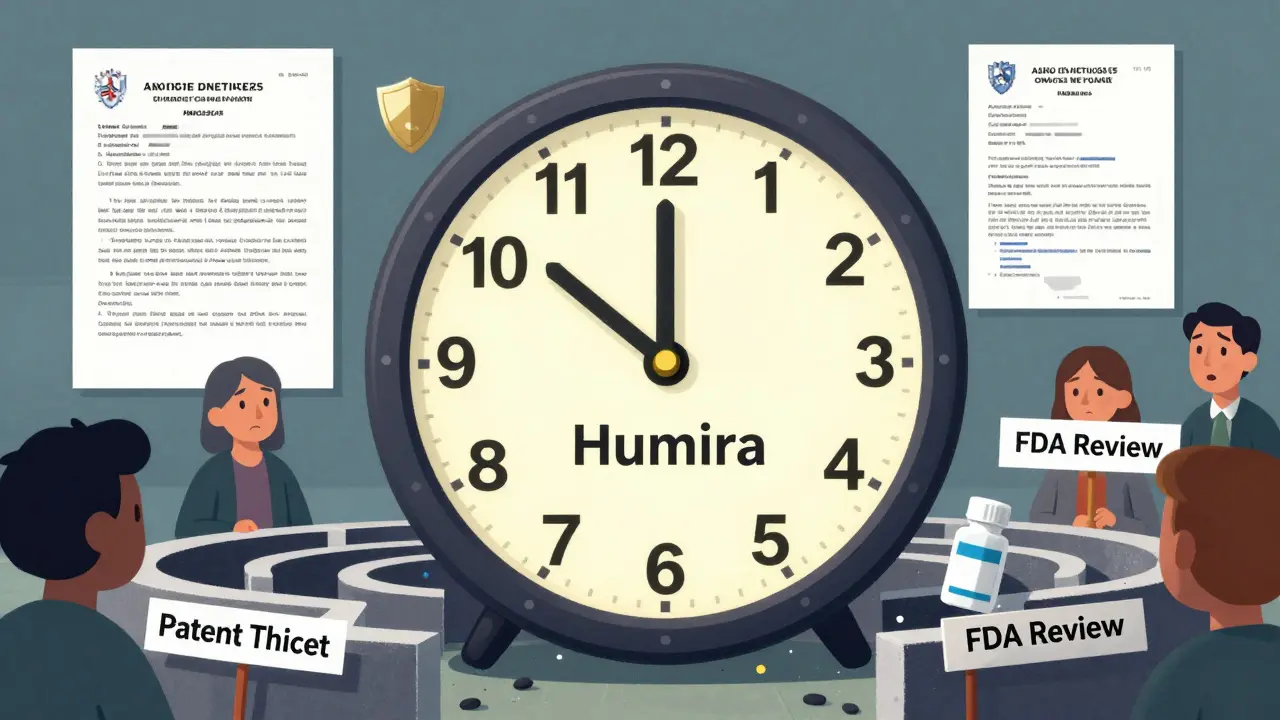
When you hear that a drug like Humira is about to lose its patent protection, you might assume biosimilars will flood the market right away. But in the U.S., that’s not how it works. Even after the original patent expires, biosimilars can’t just show up and start selling. There’s a legal and regulatory maze that delays competition for years - sometimes more than a decade. And this isn’t just a technicality. It directly affects how much patients pay for life-changing treatments.
How Long Must You Wait for a Biosimilar?
The U.S. doesn’t treat biologics like regular pills. A biologic - think Humira, Enbrel, or Keytruda - is made from living cells, not chemicals. That makes copying it far harder than making a generic version of, say, ibuprofen. To balance innovation and access, Congress passed the Biologics Price Competition and Innovation Act (BPCIA) in 2010. It created a special path for biosimilars, but with strict rules.
Here’s the timeline in plain terms:
- Year 0: The brand-name biologic gets FDA approval.
- Year 4: Biosimilar companies can finally submit their application to the FDA.
- Year 12: The FDA can approve the first biosimilar.
That’s 12 years of market exclusivity - no competition allowed. Even if the original patent expires at year 8, biosimilars still can’t be sold until year 12. This isn’t a patent extension. It’s a separate, congressionally mandated exclusivity period. And it’s longer than most other countries. The EU gives 10 years of data protection plus 1 year of market exclusivity - 11 total. The U.S. gives 12. Japan also gives 12. But the difference in timing has real consequences.
Why the U.S. Lags Behind Europe
Humira was approved in the U.S. in 2002. In Europe, biosimilars started arriving in 2018 - six years later. But in the U.S., the first biosimilar didn’t hit the market until 2023. That’s a 21-year gap between the drug’s launch and biosimilar entry. During that time, the price of Humira in the U.S. rose 470%. In Europe, where biosimilars entered earlier, prices dropped by 60% or more.
Why the delay? It’s not just the 12-year clock. It’s also the legal battles. Companies like AbbVie, which makes Humira, piled on hundreds of patents - over 160, according to research from I-MAK. These weren’t all about the core molecule. Many covered delivery devices, dosing schedules, or manufacturing tweaks. Each one became a potential lawsuit.
This tactic, called a “patent thicket,” is designed to scare off competitors. Even if a biosimilar company clears the FDA’s scientific hurdles, they still have to fight through years of litigation. The “patent dance” - a formal, court-mandated exchange of information between the brand and biosimilar maker - often drags on for 2 to 5 years before a single product can even be approved.
The Cost of Delay
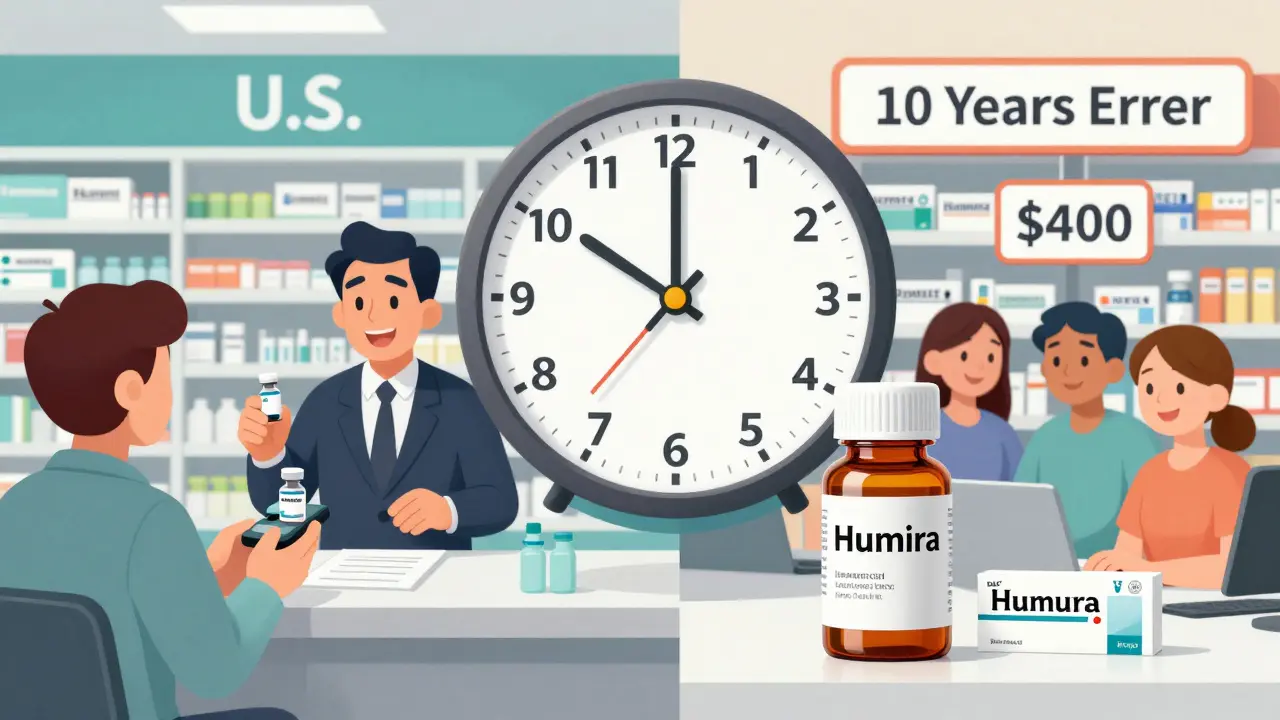
The impact isn’t theoretical. In 2022, the Arthritis Foundation reported that U.S. patients paid an average of $3,000 per month for Humira. In Germany, the same drug cost $400. That’s not because German healthcare is better. It’s because biosimilars entered sooner.
Patients with rheumatoid arthritis, Crohn’s disease, or psoriasis often can’t switch treatments easily. If a biosimilar isn’t available, they’re stuck paying the brand price - even if they’re on Medicaid or Medicare. Pharmacists surveyed by the National Community Pharmacists Association found that 63% of their patients had skipped doses or stopped treatment entirely because they couldn’t afford the drug.
And it’s not just Humira. Between 2025 and 2034, 118 biologics will lose exclusivity in the U.S. - a $234 billion market. But only 12 of them currently have biosimilars in development. Why? Because the cost to develop one is staggering.
Biosimilar Development: It’s Not Just Science
Making a generic pill costs $1-2 million and takes about two years. Making a biosimilar? It takes $100 million to $250 million and 5 to 10 years. Why? Because biologics are made from living cells. Even tiny changes in how they’re grown, stored, or shipped can affect how they work in the body.
The FDA requires proof that a biosimilar is “highly similar” with “no clinically meaningful differences” in safety, purity, or potency. That means:
- Thousands of lab tests comparing the biosimilar to the original
- Pharmacokinetic studies showing how the body absorbs and processes the drug
- Potentially, clinical trials with hundreds of patients
And that’s just to get approval. Then comes the hard part: getting doctors and insurers to switch. Many still think biosimilars are “inferior.” Some states have laws that require doctors to get special permission before substituting a biosimilar. Others don’t allow substitution at all.
The Biosimilar Void
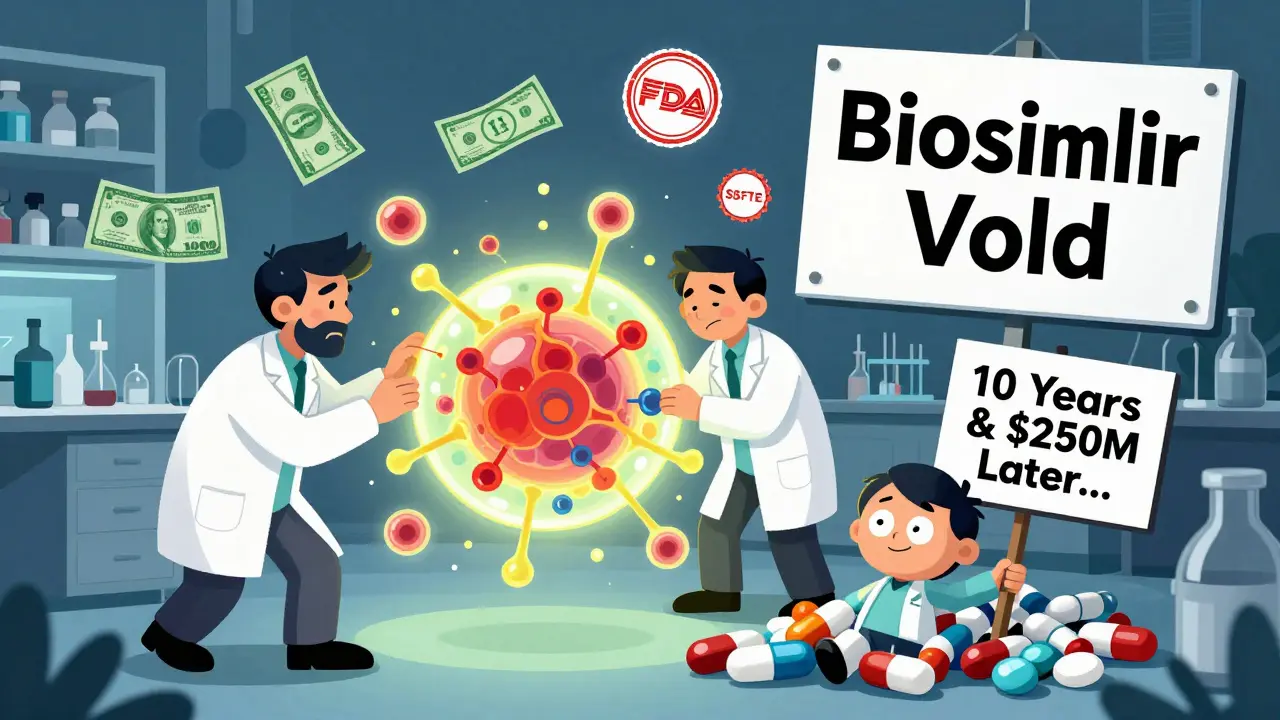
There’s a growing crisis called the “biosimilar void.” It’s when a biologic is about to lose exclusivity - but no one is ready to make a biosimilar. The Biosimilars Council found that 88% of expiring biologics with orphan drug status (for rare diseases) have no biosimilar in development. That includes treatments for cancers, autoimmune disorders, and genetic conditions.
Why? Because these drugs are complex. They’re made from antibodies, gene therapies, or cell-based products. The manufacturing is so intricate, and the patient population so small, that companies don’t see a financial return. Pfizer’s data shows that developing a biosimilar for an antibody-drug conjugate can cost over $250 million. If only 5,000 patients in the U.S. need it, the math doesn’t add up.
Meanwhile, the FDA has tried to help. Their 2022 Biosimilars Action Plan promised to improve communication, speed up reviews, and support competition. But progress has been slow. Since 2015, the U.S. has approved only 38 biosimilars. Europe has approved 88.
What’s Next?
There’s no easy fix. The 12-year exclusivity period is written into law. The patent dance is a legal requirement. And developing biosimilars for complex drugs remains expensive and risky.
But change is coming. More companies are entering the space. The first biosimilar for a gene therapy is expected by 2027. Some states are changing laws to allow automatic substitution. And Congress is starting to listen. The Congressional Budget Office estimated that if barriers are lowered, biosimilars could save the U.S. healthcare system $158 billion over the next decade.
The question isn’t whether biosimilars will enter the market. They will. The question is: how long will patients have to wait? And how much will they pay in the meantime?
Can a biosimilar be approved before the 12-year exclusivity period ends?
No. Under the BPCIA, the FDA cannot approve any biosimilar application until 12 years after the reference biologic was first approved. Even if all patents have expired and the scientific data is complete, the agency is legally barred from approving the product before that 12-year mark. The only exception is if the reference product’s exclusivity is shortened by a court ruling - which has never happened.
Why don’t biosimilars just copy the original drug?
Biologics are too complex to copy exactly. Unlike small-molecule drugs, which have a fixed chemical structure, biologics are made from living cells. Their structure can vary slightly depending on how they’re grown, purified, or stored. That’s why biosimilars must prove they’re “highly similar” with no clinically meaningful differences - not identical. This requires extensive testing, not just chemical analysis.
Do biosimilars work as well as the original biologic?
Yes. The FDA requires that biosimilars demonstrate no clinically meaningful differences in safety, purity, or potency. Thousands of patients have been treated with biosimilars in the U.S. and Europe, and outcomes are consistently equivalent to the original. In fact, the European Medicines Agency reports that biosimilars now make up 72% of the market for their reference products in Europe.
Why are biosimilars cheaper if they’re so hard to make?
They’re cheaper because they don’t need to repeat the original clinical trials. The brand-name company spent billions proving the drug is safe and effective. The biosimilar maker only needs to prove similarity. That cuts development costs by 70-80%. Even with a $100 million price tag, it’s still far less than the $2-5 billion it cost the original company. Savings are passed on to patients and insurers.
Will biosimilars be available for cancer drugs soon?
Yes, but slowly. The first biosimilars for major cancer drugs like Herceptin and Avastin arrived in 2019 and 2020. More are coming, especially for drugs like Keytruda and Rituxan. But complex biologics - like antibody-drug conjugates and CAR-T therapies - still face major hurdles. None have biosimilars in development yet, and experts expect the first to enter around 2027-2029.
So basically, the system is rigged. 12 years of monopoly just because it's a biologic? That's not innovation, that's exploitation. Patients are getting screwed while CEOs cash in. Simple as that.
Let me get this straight... you're telling me we spent over $200 billion on drugs that could've been half the price if we just... didn't invent 160 patents on a syringe??
Like. Bro. We're not in a sci-fi novel. This is healthcare. And we're acting like the patent office is a WWE ring.
And don't even get me started on the 'patent dance'... it's not a dance, it's a slow-motion car crash with lawyers holding the steering wheel.
Meanwhile, some kid with Crohn's is choosing between rent and their next injection. And we're debating whether a biosimilar's glycosylation profile is 'clinically meaningful.'
Can we just... stop?
OMG I just read this and I’m crying 😭
Like… I have RA and I’ve been on Humira since 2018. I remember when it was $5k/month. Now it’s $6k. And I’m lucky-I have good insurance.
But my friend in Texas? She had to stop because her deductible was $10k. She’s on disability. She can’t work. And now she’s in pain again.
And we’re talking about patent thickets like it’s a board game? 😑
It’s not a business model issue. It’s a moral one. People are suffering. And we’re arguing over whether a biosimilar’s Fc region is ‘identical enough.’
Can we PLEASE just make this easier??
I love science. I love innovation. But not at this cost.
Wait so you're saying the government made a rule to keep drug prices high? Shocking. Never saw that coming.
Every great system begins with a vision. The BPCIA was meant to balance innovation with access. But today, it's become a shield for monopolies.
We must remember: science serves humanity-not the other way around.
If we can land on Mars, we can make a biosimilar affordable. The question is: do we have the will?
Let us not confuse complexity with necessity. Let us not mistake profit for progress.
The path forward is not more patents. It is more courage.
So the FDA can approve a biosimilar at year 12… but the brand company spends 10 years filing patents on the color of the vial?
And we call this innovation?
Let’s be real: this isn’t about science. It’s about rent-seeking dressed up in lab coats.
Meanwhile, the real innovators? The ones trying to build biosimilars for orphan drugs? They’re broke. And the FDA’s ‘action plan’? A PowerPoint slide with a progress bar stuck at 12%.
It’s not broken. It’s designed this way.
From a biopharma R&D perspective, the 12-year exclusivity window is actually a rational equilibrium. The marginal cost of biosimilar development is still massive-$150M avg, 7 years, 90% failure rate in Phase III due to immunogenicity cliffs.
And don't get me started on CMC complexity: glycan profiles, aggregate formation, forced degradation kinetics-these aren’t just buzzwords, they’re clinical risk vectors.
Yes, the U.S. lags behind the EU. But that’s because the EMA has a harmonized regulatory framework and centralized pricing negotiations. We have 50 state formularies and 300+ PBMs playing whack-a-mole with reimbursement.
Fix the reimbursement incentives first. The biosimilars will follow.
Thank you for this comprehensive and meticulously sourced analysis. It is both intellectually rigorous and deeply human in its implications.
One must consider not only the legal architecture of the BPCIA, but also the sociopolitical context in which pharmaceutical innovation is incentivized-particularly in a system where healthcare is treated as a commodity rather than a right.
The disparity in pricing between the United States and the European Union is not merely a function of regulatory timelines; it is a reflection of divergent value systems.
While the FDA has made commendable strides in streamlining review pathways, the absence of mandatory substitution laws, coupled with entrenched physician bias and payer resistance, continues to impede equitable access.
It is my sincere hope that future policy reforms will prioritize patient outcomes over shareholder returns.
With profound respect for the complexity of this issue, I remain optimistic that systemic change is not only possible-it is inevitable.