
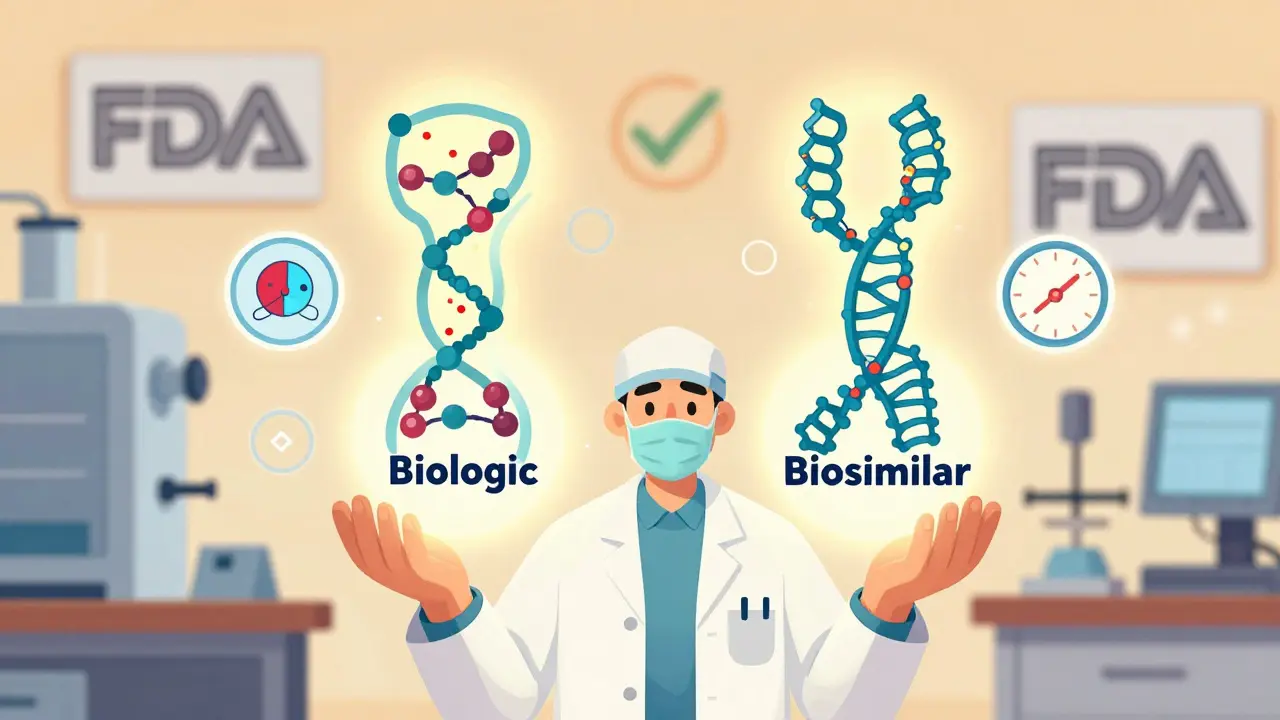
When you hear the word generic, you probably think of a cheap, identical version of a brand-name pill. But when it comes to biologic drugs-those complex treatments for cancer, rheumatoid arthritis, or diabetes-nothing is that simple. These aren’t chemicals you can copy like aspirin. They’re made from living cells. That’s why a biosimilar isn’t a generic. It’s something else entirely: a highly similar, scientifically proven alternative that can save patients tens of thousands of dollars a year. And starting in late 2025, the FDA changed how it reviews them-big time.
Why Biosimilars Aren’t Generics
Generic drugs are exact copies of small-molecule medicines. If you take a generic ibuprofen, you’re getting the same molecule, in the same form, with the same effects as Advil. Biosimilars? Not even close. They’re made from proteins produced by living cells-like antibodies or hormones. Even tiny changes in how those cells are grown, stored, or processed can alter the final product. That’s why the FDA doesn’t require a biosimilar to be identical. It just has to be highly similar in structure, function, safety, and effectiveness. The goal isn’t perfection. It’s predictability.Before October 2025, proving that similarity meant running full-scale clinical trials comparing the biosimilar directly to the original biologic. These studies took years. They cost $100 million to $300 million. And they often didn’t add much new information. The FDA realized: if you can prove with advanced lab tests that two proteins behave the same way-down to the shape of their molecules, their charge, their folding patterns-do you really need to give 500 patients both drugs just to see if one works as well?
The 2025 FDA Guidance: A Game Changer
On October 29, 2025, the FDA dropped a draft guidance that rewrote the rules. The new approach says: if a biosimilar meets three clear conditions, you don’t need a comparative efficacy study at all. Those conditions are:- The reference product and biosimilar come from well-characterized cell lines and are highly purified.
- The link between the drug’s molecular features and how it works in the body is well understood.
- A pharmacokinetic (PK) study in humans can show the drug moves through the body the same way.
This is huge. For companies that make biosimilars, it means cutting years off development and slashing costs from $200 million to around $75 million on average. It also means more biosimilars will hit the market faster. Right now, only 76 biosimilars are approved in the U.S., compared to over 100 in Europe. The new guidance is meant to close that gap.
The FDA’s reasoning? Modern tools like mass spectrometry and high-performance chromatography can now detect differences smaller than a single amino acid. If those tools show two proteins are virtually identical across 200+ quality attributes, the chance they’ll behave differently in patients is extremely low. That’s not speculation-it’s data. And the FDA is betting on it.
Interchangeability: What It Really Means
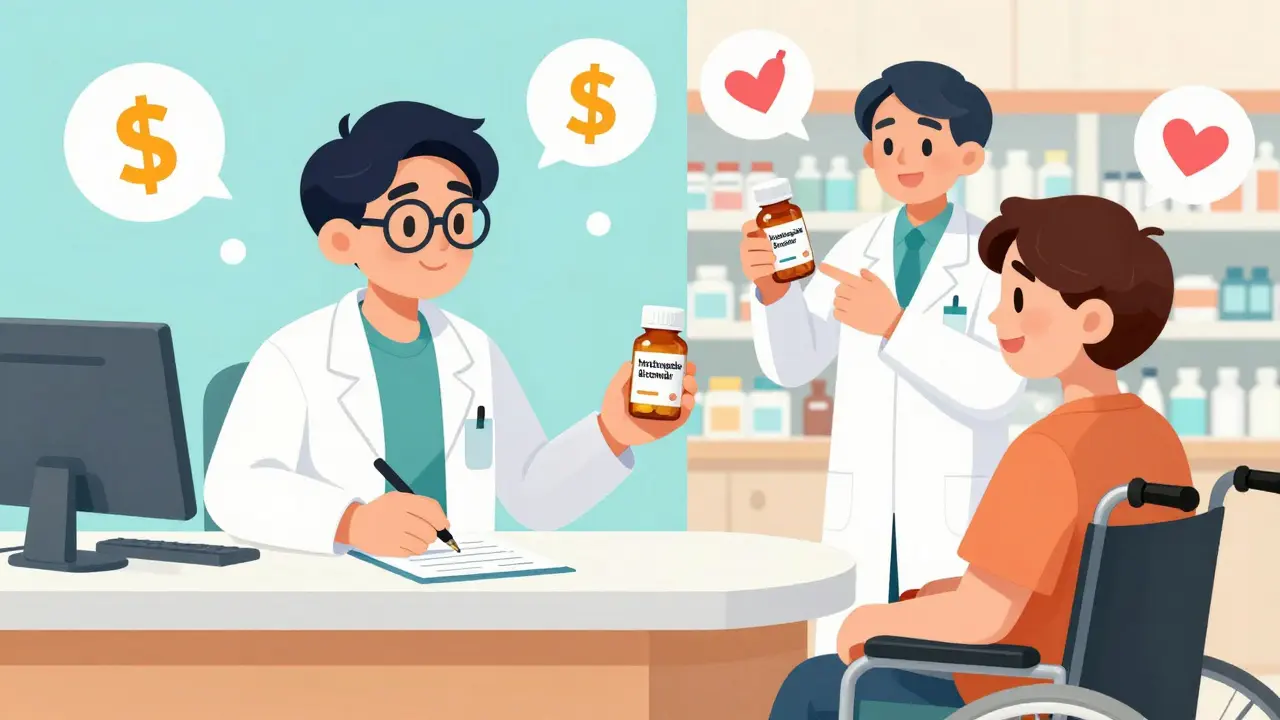
Here’s where things get messy. There’s a second tier: interchangeable biosimilars. These are the ones pharmacists can swap in without asking a doctor. In theory, this should make biosimilars easier to use. In practice? It’s been a roadblock.Before 2025, proving interchangeability meant running “switching studies”-giving patients the original drug, then switching them to the biosimilar, then back again-to show no safety issues arose from the change. The FDA now says that’s unnecessary. At the GRx+Biosims conference in October 2025, Commissioner Marty Makary bluntly said: “Every biosimilar should have the designation of interchangeable.”
That sparked debate. Critics argue that interchangeability isn’t just a scientific term-it’s a legal one. The law says you need separate approval for it. The FDA’s stance may be scientifically sound, but it could create confusion for pharmacists, insurers, and state laws. Right now, 34 states still require prescriber consent before substituting a biosimilar, even if the FDA says it’s interchangeable. That mismatch slows adoption.
Still, progress is happening. In October 2025, two denosumab biosimilars-Enoby and Xtrenbo-received interchangeability status simultaneously. That’s the first time the FDA approved multiple interchangeable versions of the same drug. It’s a signal: the system is shifting.
Who’s Making Biosimilars-and Who’s Not
The big players are still Sandoz, Pfizer, and Amgen. Together, they’ve got 39 of the 76 approved biosimilars. But smaller companies are trying to break in. The problem? The analytical tools needed to prove biosimilarity are expensive. Labs need $5 million just to set up the right equipment. Only 12 of the 76 approved biosimilars came from companies with fewer than 100 employees. That’s not because they lack ideas-it’s because the barrier to entry is still high.For example, a biosimilar for adalimumab (Humira) requires testing dozens of structural features that affect how the drug binds to its target. If one of those features is off by 1%, the entire batch might be rejected. That’s why 42% of biosimilar applications get a “complete response letter” from the FDA asking for more data. The new guidance aims to cut that number, but it won’t eliminate it. The science is just that demanding.
Real-World Impact: Cost Savings and Patient Experience
The math is simple: biologics like Humira or Enbrel cost $50,000 to $100,000 per patient per year. Biosimilars? They’re priced 15% to 35% lower. In some cases, discounts hit 50%. Mayo Clinic reported a 37% drop in biologic spending after switching oncology patients to biosimilars-saving $18 million in one year. That’s not theoretical. That’s real money for hospitals, insurers, and patients.Patients? Most are fine with them. A September 2025 survey by the Arthritis Foundation found 78% of users were satisfied with their biosimilar. But 41% were nervous at first. Common fears: “Will it work as well?” “Will I have side effects?” After talking to their doctors, 68% of those concerns disappeared. On Reddit, one patient wrote: “Switched from Humira to a biosimilar. Same results. Half the cost. No more panic attacks about my co-pay.”
But it’s not perfect. About 22% of users in online forums reported minor differences-more injection-site redness, occasional fatigue. These aren’t dangerous, but they’re real. That’s why the FDA still requires safety monitoring. Even with the best science, biology is biology.
Where the U.S. Stands vs. Europe
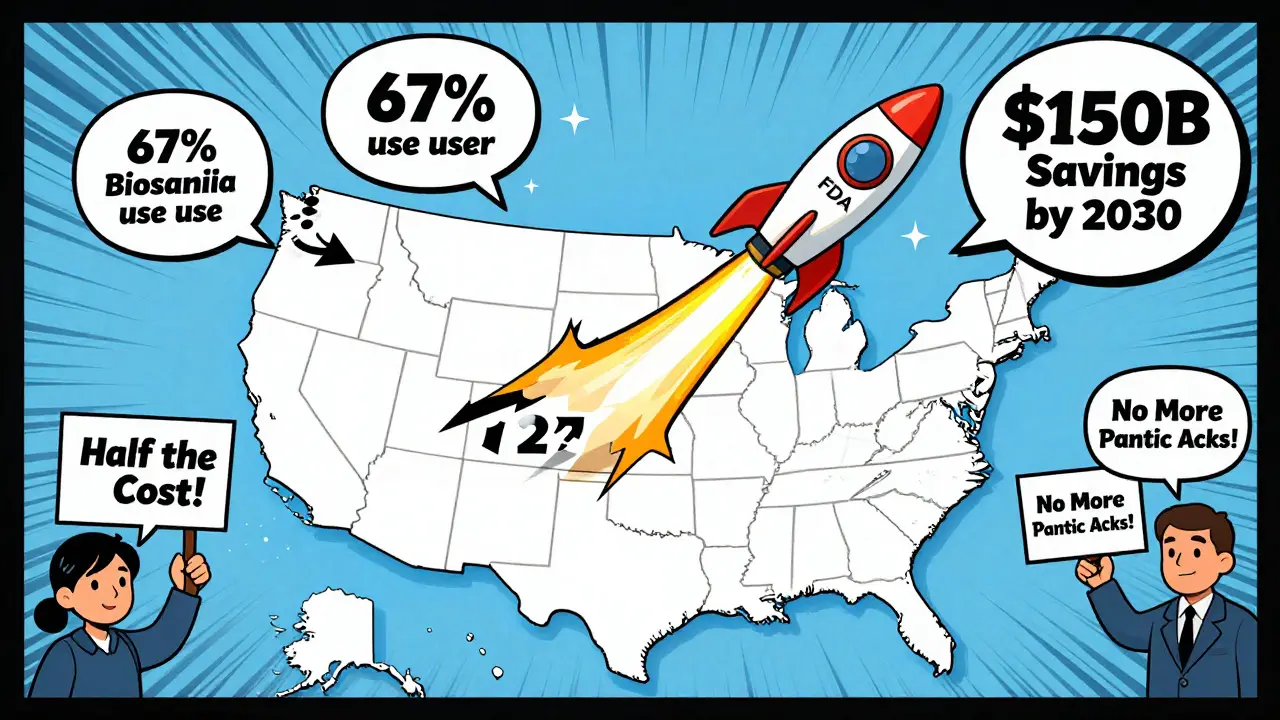
Europe has been using biosimilars since 2006. Today, 67% of patients on biologics in the EU get a biosimilar. In the U.S.? Only 23%. Why the gap? Europe’s regulator, the EMA, has always accepted fewer clinical studies. The U.S. used to demand more. Now, with the 2025 changes, we’re finally catching up. The FDA’s new path aligns closely with the EMA’s: focus on analytical data, PK studies, and immunogenicity. No need for long, expensive efficacy trials.The result? The U.S. biosimilar market, worth $18.7 billion in 2024, is projected to hit $62.3 billion by 2029. That’s a 27% annual growth rate. And if the FDA’s guidance holds, approvals could jump from 8-10 per year to 15-20. That’s hundreds of thousands of patients gaining access to affordable care.
What’s Still Holding Things Back
The science is moving fast. But the system isn’t. Three big hurdles remain:- Patent litigation: 68% of approved biosimilars face legal delays. Big pharma uses patents to block entry-even when the patents are weak. The FTC says this is a major problem.
- State substitution laws: 34 states still require doctor approval to switch. That’s outdated. Pharmacists are trained. The science supports substitution. But legal rules lag.
- Patient awareness: Only 32% of Americans even know what a biosimilar is. Education is missing.
The FDA can streamline approval. But it can’t fix state laws, end lawsuits, or teach patients. That needs lawmakers, insurers, and providers to step up.
What Comes Next
The draft guidance is open for public comment until January 27, 2026. Final rules are expected by June 2026. Industry experts expect 15-20 new biosimilars approved each year after that. By 2030, the market could be worth over $150 billion in savings annually.For patients with chronic diseases, this isn’t just about cost. It’s about access. A biosimilar might be the difference between starting treatment-or delaying it for months because you can’t afford it. The science is ready. The system just needs to catch up.
Are biosimilars as safe as biologics?
Yes. The FDA requires extensive analytical, pharmacokinetic, and immunogenicity data to prove biosimilars are as safe and effective as the original biologic. Post-market monitoring is mandatory, and over 76 biosimilars have been approved since 2015 with no pattern of increased safety risks. Real-world data from hospitals and patient surveys confirm comparable outcomes.
Why are biosimilars cheaper than biologics?
Biosimilars cost less because they don’t need to repeat expensive clinical trials proving safety and effectiveness from scratch. They rely on data from the original biologic, plus targeted studies to show similarity. Development costs have dropped from $200 million to $75 million on average thanks to the FDA’s 2025 guidance. This allows manufacturers to offer lower prices without sacrificing quality.
Can pharmacists substitute biosimilars without a doctor’s permission?
Only if the biosimilar has an official FDA interchangeability designation AND your state allows pharmacist substitution. While the FDA now considers all biosimilars interchangeable from a scientific standpoint, federal law still requires a separate designation. And 34 states still require prescriber approval for substitution. So even if a biosimilar is interchangeable, you may still need a doctor to sign off-depending on where you live.
Do biosimilars work for all biologic drugs?
Not yet. The FDA’s streamlined pathway works best for well-understood biologics like monoclonal antibodies (e.g., adalimumab, trastuzumab). Complex molecules like antibody-drug conjugates or fusion proteins are harder to characterize, so they still require more clinical data. But the FDA is expanding the science every year, and more categories are becoming eligible.
How many biosimilars has the FDA approved so far?
As of late 2025, the FDA has approved 76 biosimilars for 29 different reference products. These treat conditions including cancer, rheumatoid arthritis, Crohn’s disease, diabetes, and osteoporosis. The pace of approvals is accelerating, with 12 new biosimilars approved in 2025 alone.
Biosimilars are a win for patients. Half the cost, same results. No more choosing between rent and medication.
So the FDA finally got it? 🤯 I mean, we’ve had this tech for years. Why did it take so long to stop making companies burn $200M just to prove a protein folds right? Also, side note: I switched to a biosimilar for my RA last year. No drama. Same life. Less debt. 🙌
I’ve been thinking about this a lot. It’s not just about cost-it’s about dignity. People shouldn’t have to beg for access to medicine that could save their life. The science is here. The ethics are clear. What’s holding us back isn’t the data. It’s the system. And systems can change. They just need people to keep pushing.
OMG I JUST REALIZED-this is the biggest healthcare win since insulin went generic! Like, we’re talking about people who can’t afford Humira for 10 years? Now they can? And the FDA just said ‘you don’t need 500 patients to test this’? I’m crying. Not because it’s emotional, but because it’s so obvious. Why did no one do this sooner??
While I acknowledge the scientific rationale underpinning the FDA’s revised guidance, I must emphasize the necessity of maintaining rigorous regulatory standards. The potential for unforeseen immunogenic consequences remains nontrivial, particularly in vulnerable populations. To prematurely relax evidentiary thresholds risks undermining public trust in pharmacovigilance infrastructure. One must not confuse efficiency with safety.
LMAO US is finally catching up? Europe’s been doing this since 2006. We’re still stuck in 2010 while the rest of the world moves on. And don’t even get me started on patent trolling. Big Pharma is just playing chess while patients lose pawns. #StopTheLobbying
Let’s cut the fluff. Biosimilars work. They’re cheaper. Stop making it complicated. Just approve them and let pharmacies switch them. Done.
I’ve worked in biotech for 15 years. This guidance? It’s brilliant. The old way was a waste of time and money. We had the tech to prove similarity. We just didn’t have the courage to use it. Now we do. The real challenge? Getting insurers to stop fighting it. They’d rather keep paying $90K for a brand than $60K for a biosimilar. It’s not about science. It’s about profit.
okay but like… what if the biosimilar has a different glycosylation pattern? i mean, we know that affects half-life and immunogenicity right? and the FDA says ‘oh just do a pk study’-but pk studies don’t capture long-term immune responses. what about patients on chronic therapy? 5 years in? what if the subtle differences accumulate? this feels like cutting corners. i’m not saying it’s wrong, but it’s risky. and we’re the guinea pigs.
Why are we even celebrating this? The FDA is just playing catch-up. And now they’re saying all biosimilars are interchangeable? That’s not science-that’s politics. Patients deserve better than rushed approvals. We’re trading caution for convenience. And someone’s going to get hurt.
As someone from India, where biosimilars have been the backbone of affordable care for over a decade, I’ve seen firsthand how they transform lives. A child with juvenile arthritis can now go to school. A mother with rheumatoid arthritis can hold her baby without pain. The U.S. is finally seeing what the rest of the world learned: innovation isn’t about exclusivity. It’s about access. This isn’t just policy-it’s justice.
Yessss! This is the kind of change that actually matters. No more ‘big pharma monopoly’ nonsense. Real people are getting real relief. Let’s keep pushing. More biosimilars. More competition. More savings. Let’s go!
I’ve been on biologics for 12 years. I’ve tried three different biosimilars. Each one felt… slightly different. Not dangerous, not life-threatening, but different. One made me feel more tired. Another gave me more injection-site itching. The third? Perfect. Same as the original. And here’s the thing-I didn’t know any of this until I read about it online. No one told me. My doctor just said ‘it’s the same.’ But it’s not. Not exactly. And that’s okay, maybe-but we need to talk about it. Not just with scientists, but with patients. We deserve to know the nuances. We’re not just numbers in a trial. We’re people living with this every day.
So now we’re gonna have 15 new biosimilars a year? Good. Let’s flood the market. Let’s break the monopoly. Let’s make Big Pharma sweat. I’m tired of paying $100K for a drug that’s been around for 20 years. Time to flip the script.
They’re not the same. You think you’re saving money, but you’re risking your health. The FDA is cutting corners. I’ve seen what happens when you skip the long-term studies. It’s not worth it. Trust me, I know.