
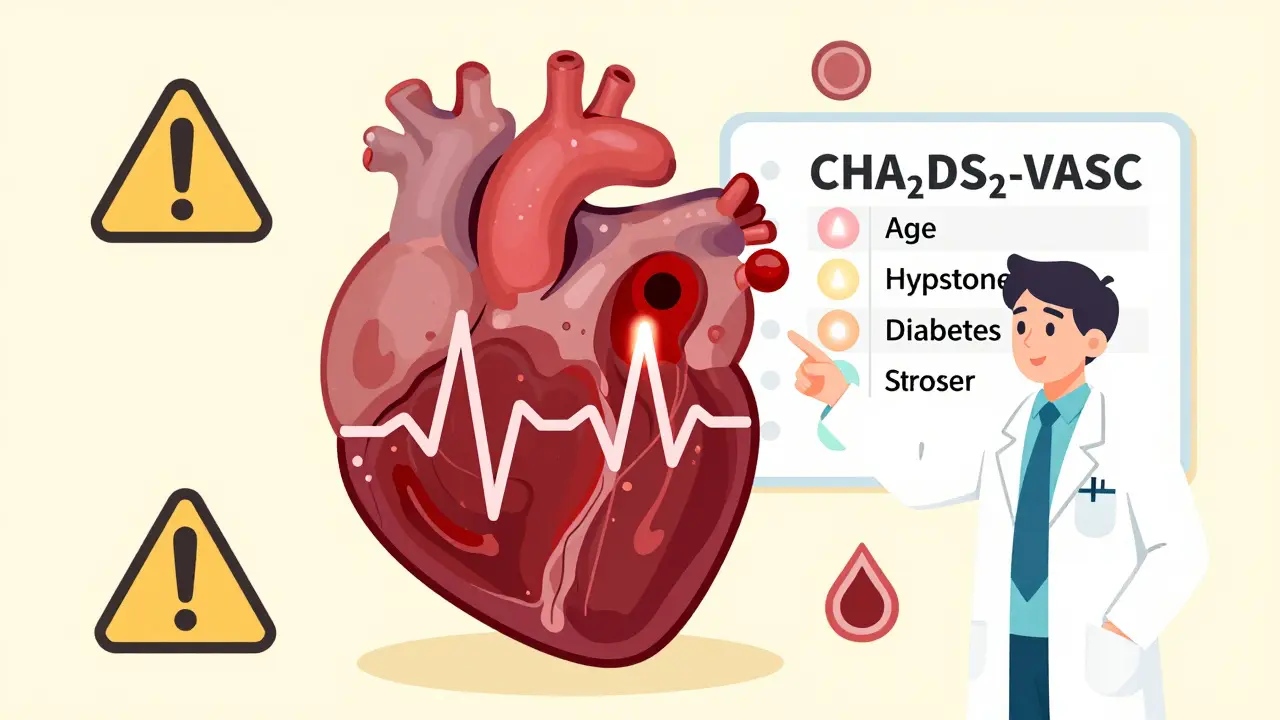
Every year, over 900,000 people in the U.S. have a stroke caused by a blood clot. For many, that clot forms because of atrial fibrillation - a chaotic heartbeat that lets blood pool and clot in the heart. Left untreated, this condition can turn a quiet morning into a life-altering emergency. But there’s a powerful tool to stop it: anticoagulants, often called blood thinners. These aren’t magic pills. They’re precise, powerful drugs that require understanding, not just taking. And today, the choices have changed dramatically.
Why Blood Thinners Matter for Stroke Prevention
Not all strokes are the same. Ischemic strokes - caused by clots blocking blood flow to the brain - make up about 87% of cases. In people with atrial fibrillation (Afib), the risk jumps fivefold. That’s why doctors don’t just watch the heartbeat; they look at the risk of clots forming. The CHA₂DS₂-VASc score is the tool they use. It counts things like age, high blood pressure, diabetes, and past strokes. If your score is 2 or higher, guidelines say you should be on a blood thinner. The goal isn’t to make your blood "thin" like water. It’s to slow down the clotting process just enough to stop dangerous clots without turning you into someone who bleeds too easily. Done right, anticoagulants cut stroke risk by about two-thirds compared to doing nothing. That’s not a small win - it’s life-changing.The Two Generations of Blood Thinners
For decades, warfarin (brand name Coumadin) was the only game in town. It’s been around since the 1950s. It works by blocking vitamin K, which your body needs to make clotting proteins. Simple in theory, messy in practice. Warfarin demands constant attention. You need regular blood tests - usually every 2 to 6 weeks - to check your INR (International Normalized Ratio). The target range is 2.0 to 3.0. Too low, and you’re still at risk for stroke. Too high, and you could bleed internally without warning. Even small changes in diet - eating a big plate of kale or spinach - can throw your INR off. Many patients struggle to stay in range. Real-world data shows less than 65% of people on warfarin spend enough time in that safe zone. Then came the DOACs - direct oral anticoagulants. Also called NOACs. These are the new kids on the block: apixaban (Eliquis), rivaroxaban (Xarelto), dabigatran (Pradaxa), and edoxaban (Savaysa). They hit specific targets in the clotting cascade - either factor Xa or thrombin - without needing vitamin K interference. And here’s the big difference: no routine blood tests. No dietary restrictions. Just take your pill, once or twice a day, and go.Which One Is Better? The Data Says
It’s not about which drug is "best" - it’s about which one fits you. But the evidence is clear: for most people, DOACs outperform warfarin. A 2021 review of over 2 million patients found DOACs reduced stroke risk by 23%, lowered overall death rates by 29%, and cut major bleeding by 32% compared to warfarin. The biggest win? Intracranial bleeding - bleeding inside the brain - dropped by 54%. That’s huge. A brain bleed from a stroke or fall is often fatal or permanently disabling. Warfarin carries a higher risk of that. Among the DOACs, apixaban stands out. In head-to-head studies, it had the lowest rate of major bleeding. It’s also the most prescribed in the U.S. today, with 42% of new Afib prescriptions going to it. Dabigatran, while effective, has a higher rate of stomach upset - about 1 in 3 users report nausea or indigestion. Rivaroxaban is taken once daily, which helps with adherence, but carries a slightly higher risk of gastrointestinal bleeding. Warfarin still has its place. If you have a mechanical heart valve or severe mitral stenosis, DOACs aren’t safe. The RE-ALIGN trial showed dabigatran doubled the risk of clots in people with mechanical mitral valves. For those patients, warfarin remains the gold standard.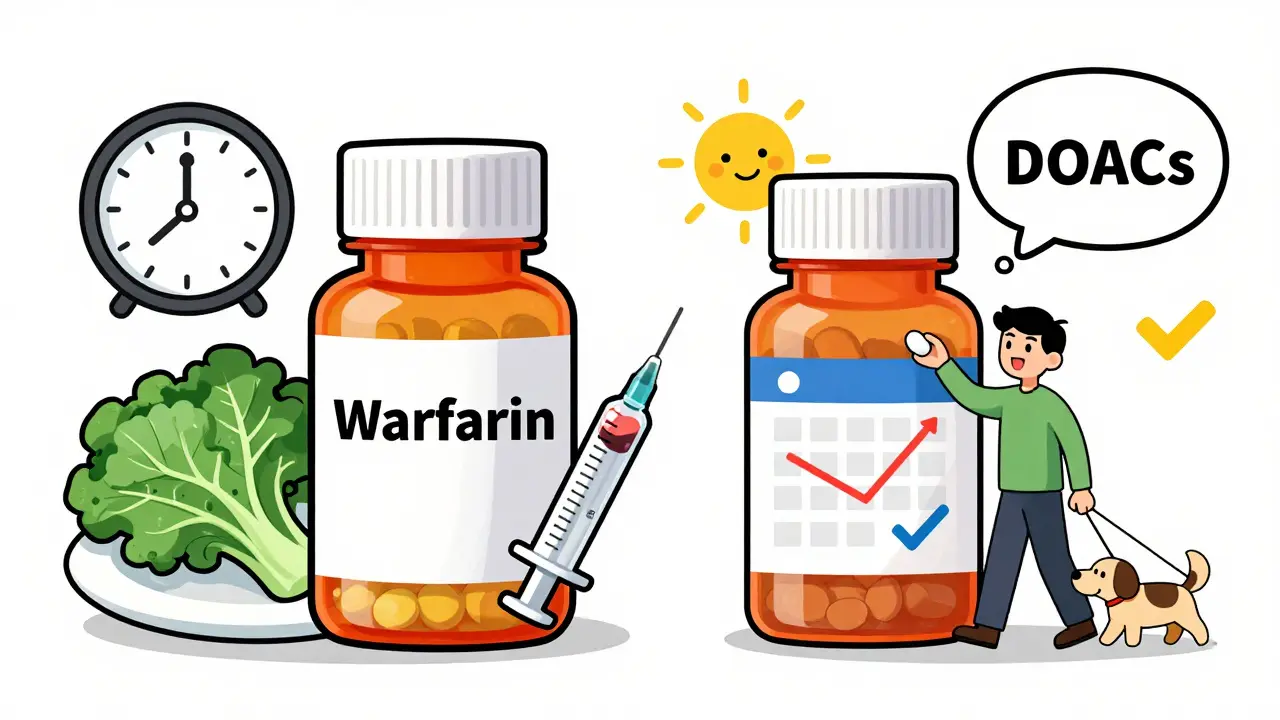
Cost and Accessibility: The Real-World Equation
Cost used to be the biggest reason people stayed on warfarin. Brand-name DOACs could cost $600 a month. But that changed in 2023 and 2024. Generic versions of apixaban, rivaroxaban, and dabigatran hit the market. As of early 2024, generic apixaban costs around $450-$500 per month - not cheap, but now comparable to warfarin when you factor in the cost of monthly blood tests. Warfarin itself is under $10 a month. But add in 12-16 INR tests a year at $20 each, plus doctor visits, and you’re looking at $300-$400 annually. That’s not a big difference from the generic DOACs. But the hidden cost of warfarin is time, stress, and missed work. One patient on Reddit wrote: "Switched from warfarin to apixaban after 10 years. No more worrying about broccoli or monthly blood draws. My neurologist says my bleeding risk is 50% lower." For people on Medicare or without good insurance, cost still matters. But now, the choice isn’t just between "expensive" and "cheap." It’s between "convenient and safer" versus "cheap but high-maintenance."Who Should Stick With Warfarin?
DOACs are great - but not for everyone. Here are the exceptions:- People with mechanical heart valves - DOACs are dangerous here.
- Those with severe kidney disease (CrCl under 15 mL/min) - DOACs build up in the body, increasing bleeding risk.
- Patients with extreme body weight - under 60 kg or over 120 kg - where dosing isn’t well studied.
- People who need frequent, unpredictable drug interactions - like those on long-term antifungals or HIV meds - where warfarin’s INR monitoring gives more control.
What About Bleeding Risks?
Yes, all blood thinners increase bleeding risk. But the fear of bleeding shouldn’t stop you from taking them if you need them. The real question is: which is riskier - a stroke or a bleed? DOACs have built-in reversal agents. Idarucizumab (Praxbind) can instantly reverse dabigatran. Andexanet alfa (Andexxa) reverses factor Xa inhibitors like apixaban and rivaroxaban. These aren’t perfect, and they’re expensive - but they exist. Warfarin can be reversed with vitamin K and fresh frozen plasma, but it takes hours to work. The bottom line: if you’re at high stroke risk, the benefit of anticoagulation almost always outweighs the bleeding risk. The HAS-BLED score helps doctors assess bleeding risk. A score of 3 or higher means you need extra caution - not avoidance. Many patients with high HAS-BLED scores still benefit from anticoagulants.
What You Need to Do
If you’re on a blood thinner - or might be - here’s what to focus on:- Know your score. Ask your doctor your CHA₂DS₂-VASc and HAS-BLED scores. Understand what they mean.
- Ask about DOACs. If you’re on warfarin and have no contraindications, ask if switching makes sense.
- Don’t skip doses. Missing pills increases stroke risk more than you think. Use a pill organizer or phone reminders.
- Carry a medical ID. If you’re in an accident, paramedics need to know you’re on a blood thinner.
- Know the signs of bleeding. Unusual bruising, pink or red urine, black stools, headaches, dizziness, or vomiting blood - call your doctor immediately.
The Future Is Coming
The next wave of anticoagulants is already in trials. Milvexian, a factor XIa inhibitor, showed promise in 2023 - it cut bleeding risk by 22% while keeping stroke protection just as strong. Abelacimab, a monoclonal antibody targeting factor XI, reduced major bleeding by nearly half compared to apixaban in early trials. These drugs could be available within 3-5 years. Genetic testing is also moving into the clinic. Some hospitals now test for CYP2C9 and VKORC1 genes to predict how well you’ll respond to warfarin. Soon, we may test for ABCB1 variants to choose the best DOAC for your body. This isn’t science fiction. It’s personalized medicine - and it’s coming fast.Are blood thinners the same as aspirin?
No. Aspirin is an antiplatelet drug - it stops platelets from clumping. Blood thinners like warfarin and DOACs work on the clotting cascade itself. For stroke prevention in atrial fibrillation, aspirin is not enough. Studies show it reduces stroke risk by only about 1.7% compared to placebo, while anticoagulants reduce it by 60-70%. The American Heart Association no longer recommends aspirin for stroke prevention in Afib patients.
Can I drink alcohol while on blood thinners?
Moderation is key. One drink a day is usually fine for most people on DOACs. But alcohol can irritate your stomach lining and increase bleeding risk, especially with dabigatran. With warfarin, heavy drinking can throw off your INR. If you drink regularly, talk to your doctor. They may advise you to cut back or avoid it entirely.
Do I need to stop my blood thinner before surgery?
Sometimes, but not always. For minor procedures like dental work, you usually keep taking it. For major surgery, your doctor will decide based on your stroke risk and bleeding risk. DOACs are often stopped 1-3 days before surgery because they leave your system faster than warfarin. Never stop on your own - always follow your doctor’s instructions.
What happens if I miss a dose?
If you miss one dose of a DOAC, take it as soon as you remember - but only if it’s within 6 hours of your usual time. If it’s more than 6 hours late, skip the missed dose and take your next one at the regular time. Never double up. For warfarin, missing a dose can be riskier because it builds up slowly. Always call your doctor if you miss more than one dose.
Can I take supplements or herbal products with blood thinners?
Many can interfere. Garlic, ginkgo, ginger, ginseng, and St. John’s wort can increase bleeding risk. Vitamin K supplements can make warfarin less effective. Always tell your doctor and pharmacist about every supplement you take - even if you think it’s "natural" or "harmless."
Let’s cut through the noise. DOACs aren’t magic. They’re just less inconvenient than warfarin. The data is solid, but let’s not pretend compliance is easy. People forget pills. They skip doses because they’re busy, tired, or just don’t care. No amount of clinical superiority fixes human behavior. The real win isn’t the drug-it’s the system that supports adherence.
OMG this is sooo needed 😭 I’ve been on Eliquis for 3 years and honestly? Life changed. No more monthly blood draws, no more worrying if my spinach salad was too big. My doc said my INR was always a rollercoaster with warfarin. Now I just take it with my coffee and forget about it. Also-yes, generic apixaban is a GAME CHANGER. Saved me $400/month. Thank you for writing this.
The data is statistically significant but clinically overinterpreted. Real-world adherence trumps trial outcomes. The assumption that patients will comply with once-daily regimens ignores socioeconomic reality. This article reads like marketing copy for pharmaceutical corporations.
I’ve been a cardiologist for 18 years. Warfarin still has its place-especially in rural areas where lab access is limited. But for most urban patients? DOACs are clearly superior. The key is individualization. One size doesn’t fit all. And yes, the reversal agents? Absolute game-changers in trauma settings. We used to lose people to intracranial bleeds. Now we have tools to save them.
I’m on rivaroxaban. Took me six months to adjust. No more broccoli anxiety. But I still panic when I miss a dose. What’s the real risk if I skip one? Just curious.
This is the kind of info that saves lives. Seriously. My mom was on warfarin for 12 years. She had three ER trips because of bleeding. Switched to apixaban last year. No more bruises, no more needles, no more fear. I wish every patient had access to this clarity. Thank you for breaking it down so plainly.
So let me get this straight. We spent 70 years perfecting a drug that requires weekly blood tests, dietary yoga, and a PhD in pharmacology… just to replace it with a pill that costs $500/month? Brilliant. The pharmaceutical industry didn’t invent better medicine. They invented better marketing. And we’re all just along for the ride.
Apixaban. No regrets. Took it for 2 years. No bleeds. No tests. Just took it. Life’s too short for INR nightmares.
Let’s be real. This is all just a revenue stream. DOACs are $400/month. Warfarin is $10. The real difference? Profit margins. Hospitals get paid for INR tests. Labs get paid. Pharmacies get paid. But DOACs? They’re just pills. No follow-up. No revenue. So of course the narrative is "DOACs are better." It’s not medicine-it’s capitalism with a stethoscope.
And don’t get me started on "reversal agents." $30,000 per dose? That’s not healthcare. That’s extortion dressed as innovation.
I’m on warfarin. I’ve had 3 strokes in my family. I’m not switching. I know my numbers. I trust my routine. This article makes it sound like warfarin is ancient history. It’s not. It’s reliable. For me, it works.
I’ve been on Eliquis since 2021. My husband died from a brain bleed on warfarin. He was 58. He didn’t even know he had Afib. This isn’t about convenience. It’s about survival. I wish I’d known this five years ago. I’m not grateful. I’m angry. Why wasn’t this explained to us? Why did they let him die with outdated info?
Wait-so you’re telling me the FDA approved these drugs without long-term studies? And now we’re told they’re "safer"? What about the 2019 study from Johns Hopkins that showed increased GI bleeds with rivaroxaban? Or the 2022 whistleblower report about undisclosed bleeding events in the apixaban trials? The industry hides data. Always. You think your doctor knows the truth? They’re fed brochures. This isn’t medicine. It’s a cover-up.
And don’t even get me started on the reversal agents. They’re expensive because they’re designed to fail. So you keep paying. Always paying. It’s a trap.
I’ve been on warfarin since 2016. I’ve had 18 INR tests this year. I’ve had two nosebleeds, one GI bleed, and a scary episode where I passed out from low INR. My wife says I’m obsessed. Maybe I am. But I’d rather be obsessed than dead. I don’t trust DOACs. I don’t trust the labs. I don’t trust the guidelines. I trust my numbers. My body. My routine. This article? It’s slick. But it doesn’t speak to the people who’ve lived this.
There’s a deeper question here: Are we treating disease-or managing risk? Blood thinners don’t cure atrial fibrillation. They manage a symptom of a system-wide imbalance. Maybe we should be asking why Afib is so common in the first place. Poor sleep? Chronic inflammation? Stress? Sedentary lifestyles? We’ve outsourced prevention to pills. We’ve made compliance the goal, not health. We’ve turned medicine into a chore. And now we’re surprised people don’t stick with it.
The real innovation isn’t a new drug. It’s a culture that values prevention over intervention. But that’s harder to sell.
As a nurse in a rural clinic, I see this every day. People choose warfarin because it’s cheap. But they also choose it because it’s familiar. Their grandmas took it. Their doctors still use it. Switching to DOACs? It feels like abandoning tradition. We’ve got to meet people where they are-not where we think they should be. Education matters. But so does trust. And trust takes time. And listening. And not talking down to folks who’ve been managing this for decades.
Also-side note-my cousin took dabigatran and got nauseous every single day. She switched back to warfarin. Said she’d rather test every month than feel sick every morning. No judgment. Just real life.