
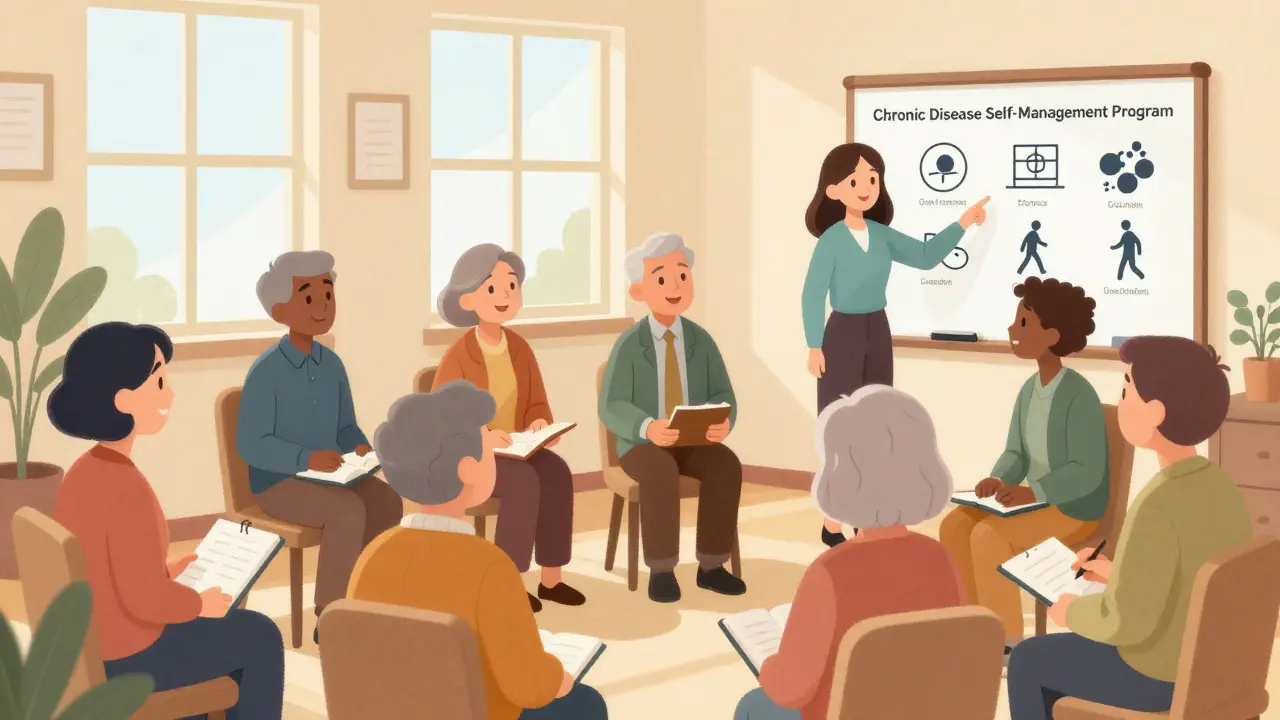
Living with a chronic disease doesn’t mean giving up on daily life. Many people with conditions like diabetes, arthritis, heart disease, or COPD find that their quality of life improves dramatically when they use the right self-management tools. It’s not about curing the illness-it’s about taking back control. You don’t need to be a medical expert. You just need the right skills, the right support, and the right tools to handle symptoms, stay active, and feel more confident every day.
What Exactly Is Chronic Disease Self-Management?
Chronic disease self-management isn’t a one-size-fits-all fix. It’s a set of practical skills that help you live better with your condition. The most proven approach is the Chronic Disease Self-Management Program (CDSMP) a six-week, peer-led workshop developed at Stanford University in the 1990s by Dr. Kate Lorig. It’s been used in 45 U.S. states and is backed by decades of research. The goal? To build your confidence in managing your health-whether you have one chronic condition or five.
The program doesn’t focus on your diagnosis. Instead, it teaches six core skills:
- Problem solving: How to handle setbacks, like a flare-up that ruins your week.
- Decision making: Figuring out what changes are worth trying, and when to ask for help.
- Using resources: Knowing where to find reliable info, support groups, or local services.
- Working with your doctor: Learning how to ask the right questions and speak up about your needs.
- Creating action plans: Breaking big goals into tiny, doable steps.
- Self-tailoring: Adjusting strategies to fit your life, not the other way around.
These aren’t abstract ideas. They’re tools you use every day-like deciding whether to walk today, how to read your blood sugar log, or what to say when your doctor suggests a new medication.
How the CDSMP Workshop Works
The classic CDSMP program runs for six weeks, with one 2.5-hour session each week. It’s led by trained peer leaders-people who also live with chronic conditions. There’s no doctor in the room, no lecture. Instead, you sit in a circle with others who get it. You share stories. You practice. You leave with a 230-page workbook, videos, and real exercises you can use at home.
Participants don’t just talk-they do. One week, you might map out your daily routine and find where you’re wasting energy. Another week, you write an action plan: "I will walk for 10 minutes after breakfast, three days this week." Then you report back. Did it work? What got in the way? That feedback loop is what makes it stick.
And it works. According to the Self-Management Resource Center (SMRC) the nonprofit that maintains the CDSMP model, 72% of people finish the full program. Those who do report:
- 23% better symptom management skills compared to those who don’t participate
- More physical activity-many increase daily steps by 300% or more
- Stronger communication with doctors
- Less feeling of being overwhelmed
And the effects last. Follow-up studies show these improvements hold up after 12 months.
Digital Tools: Online Programs and Apps
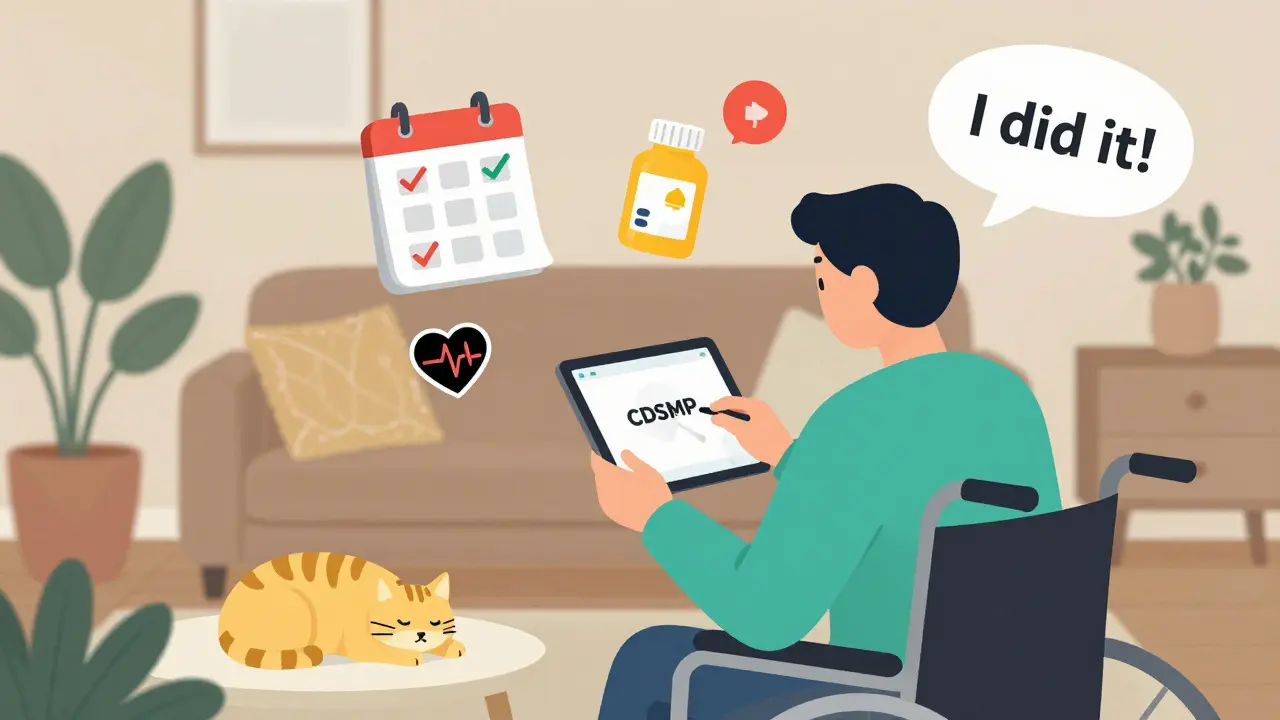
Not everyone can make it to a weekly in-person class. That’s where digital tools come in. The Better Choices, Better Health® the online version of CDSMP offers the same curriculum but through a website you log into 2-3 times a week. Each lesson takes about 2 hours total per week. You watch videos, join discussion boards, and complete exercises on your own schedule.
It’s not perfect. Completion rates are lower-58% compared to 72% for in-person. But it reaches people who can’t travel: rural residents, those with mobility issues, or caregivers juggling too many responsibilities. In rural areas, online programs reach 37% more people than in-person ones.
Then there are newer apps like ProACT a digital platform with mobile apps and clinician dashboards designed for older adults with multiple chronic conditions. It tracks symptoms, reminds you to take meds, and even syncs with wearables. One study showed users improved their self-management behaviors by 28% over 12 months.
And apps like Mun Health an AI-powered companion with culturally adapted modules are starting to address emotional needs-something traditional programs often miss. Early users reported 85% satisfaction with its ability to offer emotional support, not just task reminders.
But here’s the catch: digital tools struggle with health literacy. A 2022 study found 41% of people with chronic conditions have trouble understanding basic medical info. If an app uses complex language or too many menus, it won’t help-it frustrates.
What Works Better: In-Person or Online?
There’s no single winner. It depends on what you need.
| Feature | In-Person CDSMP | Online CDSMP (Better Choices) | Digital Platforms (e.g., ProACT) |
|---|---|---|---|
| Completion Rate | 72% | 58% | Varies (50-65%) |
| Reach in Rural Areas | Low | High (37% more than in-person) | High |
| Social Support | Very High | Moderate | Low |
| Medication Adherence | High (peer accountability) | Moderate | High (with reminders) |
| Emotional Support | Moderate | Moderate | High (AI companions) |
| Cost | Often free or low-cost | Free | Varies (some require subscription) |
If you need motivation, accountability, or just someone who gets it-go in-person. If you’re isolated, live far from a clinic, or can’t sit through long meetings-try online. And if you’re tech-savvy and want 24/7 reminders, a smart app might be your best bet.
Getting Started: Your First Steps
You don’t need to overhaul your life overnight. Start small.
- Take a quick self-assessment. Ask yourself: What’s one thing that makes your day harder? Is it fatigue? Pain? Forgetting meds? Feeling alone?
- Choose one area to focus on. Don’t try to fix everything. Pick one habit: walking 10 minutes a day, writing down symptoms each night, or calling your doctor once a month.
- Build your first action plan. "I will walk after breakfast on Monday, Wednesday, and Friday. I’ll use my phone to set a reminder. I’ll mark it off on my calendar."
- Find a tool that fits. Look for the CDSMP workshop in your area. Check if your local hospital or senior center offers it. If not, try the free online version at BetterChoicesBetterHealth.org.
- Track progress. Use a notebook, a free app, or even your phone’s notes. Did you walk? How did you feel? What got in the way? That’s your data-and it’s powerful.
One Reddit user shared how writing down small goals helped them go from 1,200 steps a day to 5,800 in eight weeks. That’s not magic. That’s a simple plan, tracked consistently.
Common Challenges and How to Overcome Them
It’s not easy. Many people quit because they feel overwhelmed. Here’s what gets in the way-and how to fix it.
- "I can’t keep up with all the tasks." You don’t have to. Focus on one habit for four weeks. Once it sticks, add the next. Habit stacking works: "After I brush my teeth, I’ll check my blood pressure."
- "I forget to track my symptoms." Set a daily alarm. Use voice notes. Tape a sticky note to your fridge. The goal isn’t perfection-it’s awareness.
- "I don’t know how to adjust my meds." Never change meds on your own. But you can learn to recognize patterns. "My knees hurt more after I eat pasta." Share that with your doctor. It’s not a symptom-it’s data.
- "I feel alone." This is where peer programs shine. In North Dakota, 78% of rural participants said the group made them feel less isolated. If you can’t find a local group, join an online forum like r/ChronicIllness. You’re not the only one.
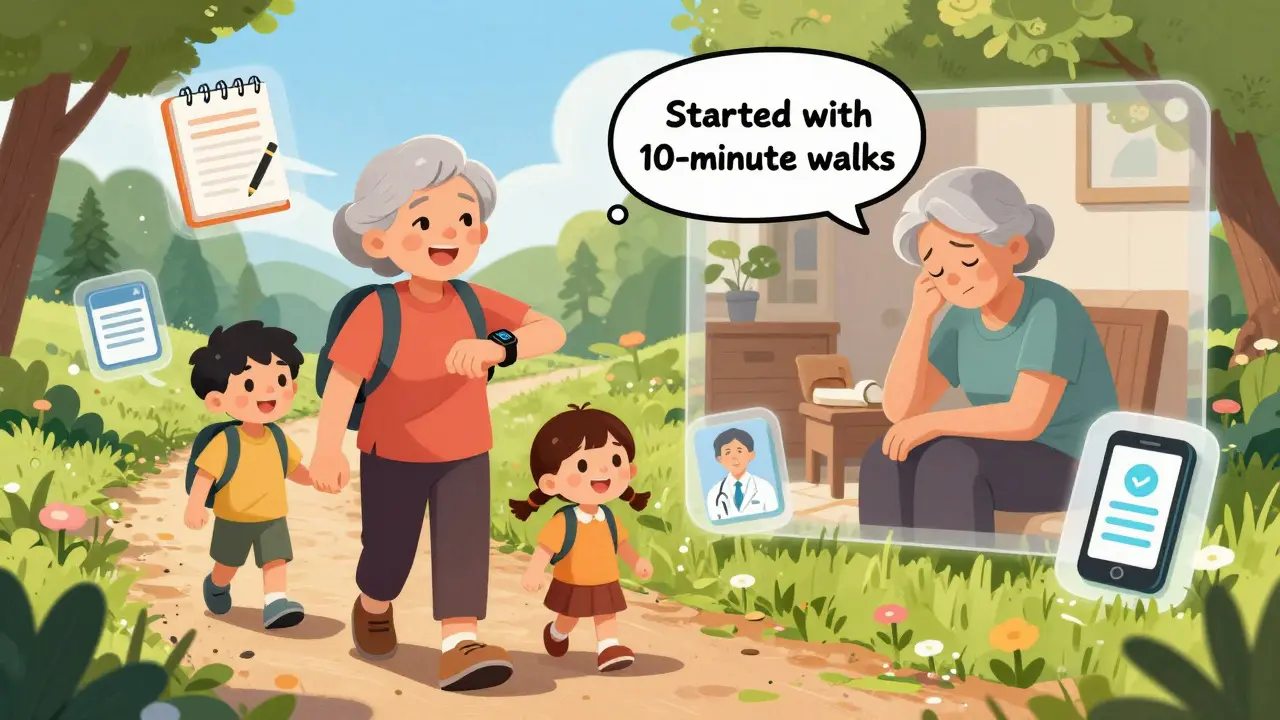
- "It feels too much like work." It is work. But it’s work that gives you back your life. One Tennessee participant said, "At first, checking my blood sugar, adjusting meds, and foot care felt impossible." She started with one task a week. Now, she’s hiking with her grandkids.
What’s Next: Where the Field Is Headed
The future of self-management is personal, integrated, and smarter. The CDC now recommends self-management education as a core part of care-not an add-on. Medicare covers programs like Diabetes Self-Management Training, and over 1.2 million people used it in 2022.
More programs are now:
- Using AI to adapt to your mood, energy, and symptoms
- Offering culturally tailored content-for Hispanic, Black, and Asian communities
- Connecting directly to your doctor’s electronic record
- Being built into primary care visits, not just separate classes
By 2030, 171 million Americans will have multiple chronic conditions. We can’t rely on doctors alone. We need tools that empower you-every day, in your home, in your rhythm.
Can I join a self-management program if I have more than one chronic condition?
Yes. Programs like CDSMP and ProACT are designed for people with multiple conditions. The skills you learn-problem solving, action planning, communication-are the same whether you have diabetes, arthritis, and heart failure. In fact, people with multiple conditions benefit the most because they’re juggling more tasks. The program helps you prioritize and simplify.
Are these programs free?
Many are. The in-person CDSMP workshop is often free or costs less than $25, funded by health departments or nonprofits. The online version, Better Choices, Better Health®, is completely free. Some digital apps have free versions, but advanced features may require payment. Medicare and Medicaid cover certain programs, especially for diabetes and COPD. Check with your local health department or visit www.selfmanagementprogram.org for options in your area.
Do I need to be tech-savvy to use digital tools?
No. Online CDSMP uses simple menus, large buttons, and clear instructions. Most users over 65 find it easy after a few tries. If you’re unsure, ask a family member to help you set up your account once. After that, you can do it alone. Many programs also offer phone support. You don’t need to know how to code-you just need to click "next."
What if I can’t attend all six sessions?
It’s okay. Life with a chronic condition is unpredictable. If you miss a session, most programs let you catch up with recordings or one-on-one help. The key is to show up for at least three sessions. You’ll still get the core skills. Even one session can give you a new idea that changes your routine.
How long until I see results?
Most people notice small changes within two weeks-like feeling less anxious about symptoms or remembering to take meds. Bigger changes-like walking more, sleeping better, or talking more openly with your doctor-usually take 4 to 8 weeks. The real payoff? After three months, you’ll feel more in control. That’s when confidence starts to build.
Chronic disease doesn’t have to mean giving up your life. With the right tools, you can live better-today, tomorrow, and for years to come.
OMG, this post hit me right in the feels!!! 💖 I’ve been doing CDSMP for 6 months now, and honestly? It’s the only thing that’s kept me from spiraling. I used to think I was failing because I couldn’t do everything… but now? I just pick ONE thing. Walk after coffee. That’s it. And guess what? I’ve gone from 800 steps to 6,200. I even started gardening again!!! 🌱🌻
Also-AI companions? YES. I use Mun Health and it texts me things like, "Hey, you got through yesterday’s pain flare. Proud of you." Like… who does that?? My mom? No. My app does. 😭
Let’s be real: this whole "self-management" movement is just corporate healthcare’s way of offloading responsibility onto the sick. The system doesn’t fund proper care-it funds workshops. And don’t get me started on "peer leaders."
Who trained them? A 3-hour Zoom course? I’ve seen people with Type 1 diabetes being told to "just eat less sugar" by someone who’s had prediabetes for 2 years. It’s dangerous. And the data? 72% completion rate? That’s not success-that’s attrition bias. The people who drop out are the ones who needed it most.
And apps? They’re designed for people with smartphones, stable Wi-Fi, and cognitive bandwidth. Most of us are just trying not to pass out before dinner.
Larry, you’re not wrong… but you’re also ignoring the data. The CDC’s own 10-year longitudinal study shows that even people who only attended 3 sessions had statistically significant improvements in self-efficacy, hospitalization rates, and medication adherence.
And yes, peer leaders aren’t MDs-but they’re not supposed to be. They’re facilitators. They’ve lived it. That’s the point. You don’t need a doctor to tell you how to manage pain on a rainy Tuesday. You need someone who’s been there.
Also-your tone is exhausting. Maybe try a nap before you type?
YESSSSSSS to the emotional support apps!!! 🙌 I used to cry every time I opened my med app because it just said "Take Metformin" like I was a robot.
Then I tried Mun Health. It asked me: "How’s your heart feeling today?" and let me pick from emojis. I chose 😔. It responded: "That’s okay. Today, just sit by the window and breathe. That’s enough."
I cried again. But this time… it felt healing.
Also-don’t let anyone tell you you’re "too much" for needing this. You’re not. You’re human.
Interesting approach. I come from South Africa, where access to these programs is extremely limited. We don’t have peer-led workshops in rural areas. We have one clinic serving 20,000 people.
But I’ve seen what happens when people are given simple tools: a printed action plan, a phone number to call, and someone who says, "I’ve been there too."
It’s not fancy. It’s not digital. But it works.
Maybe the future isn’t AI-it’s just connection.
so i tried the online cdsmp thing… honestly? it was kinda boring. but i stuck with it because i didn’t want to let myself down.
turned out, the real magic wasn’t the videos. it was the forum. someone wrote "i missed my walk today and i felt like a failure" and i replied "same. i ate a whole pizza. then walked 5 mins. that’s progress." weirdly… that made me feel better.
also-i still forget meds. but now i have a sticky note on my toothbrush. it says "brush. walk. breathe."
not perfect. but better.
One thing I’ve learned: self-management isn’t about doing more. It’s about doing less… but doing it with intention.
I used to think I needed to track everything-blood sugar, steps, mood, sodium intake. I was burning out.
Now? I pick one thing. One. Last month it was hydration. This month it’s sleep. Next? Maybe movement.
It’s not about perfection. It’s about showing up for yourself, even when it’s messy.
You’re not failing. You’re learning.
This is a feel-good article for people who don’t understand chronic illness. Real patients don’t need "action plans." They need systemic care, not pep talks.
And apps? They’re designed by tech bros who think "reminders" fix insulin resistance.
Stop glorifying band-aids.
Who funds these programs? Big Pharma? Because every time I see a "self-management" campaign, the next month a new drug hits the market.
And why are the peer leaders always middle-class white women? Where are the Black, Indigenous, and disabled voices?
This isn’t empowerment. It’s distraction. They want you to think you’re in control… while the system keeps raising co-pays and cutting Medicaid.
Wake up.
Of course it works-because they cherry-pick the people who are already motivated. The ones who can’t get out of bed? The ones with no transportation? The ones with no internet? They’re invisible.
This isn’t healthcare. It’s virtue signaling wrapped in a workbook.
And don’t even get me started on "AI companions."
Next they’ll replace therapists with chatbots that say "I’m here for you" in 14 different languages.
Pathetic.
What if the real breakthrough isn’t the tool… but the quiet realization that you’re not broken?
I used to think my fatigue was laziness. My forgetfulness was failure. My anger was weakness.
Then I joined a workshop. And someone said: "You’re not failing. You’re adapting."
That changed everything.
Self-management isn’t about fixing yourself. It’s about learning how to live with yourself-on your terms.
That’s not a program. That’s a revolution.
Why are we even talking about this? The government should be fixing the healthcare system-not giving us apps and sticky notes.
My cousin died because she couldn’t afford her insulin. No workshop fixes that.
Stop pretending this is enough.
I’m from India. We don’t have CDSMP here. But we have something better: family. My mom checks my sugar. My sister reminds me to move. My neighbor brings herbal tea.
No app. No workshop. Just love.
Maybe the future isn’t digital.
Maybe it’s human.