
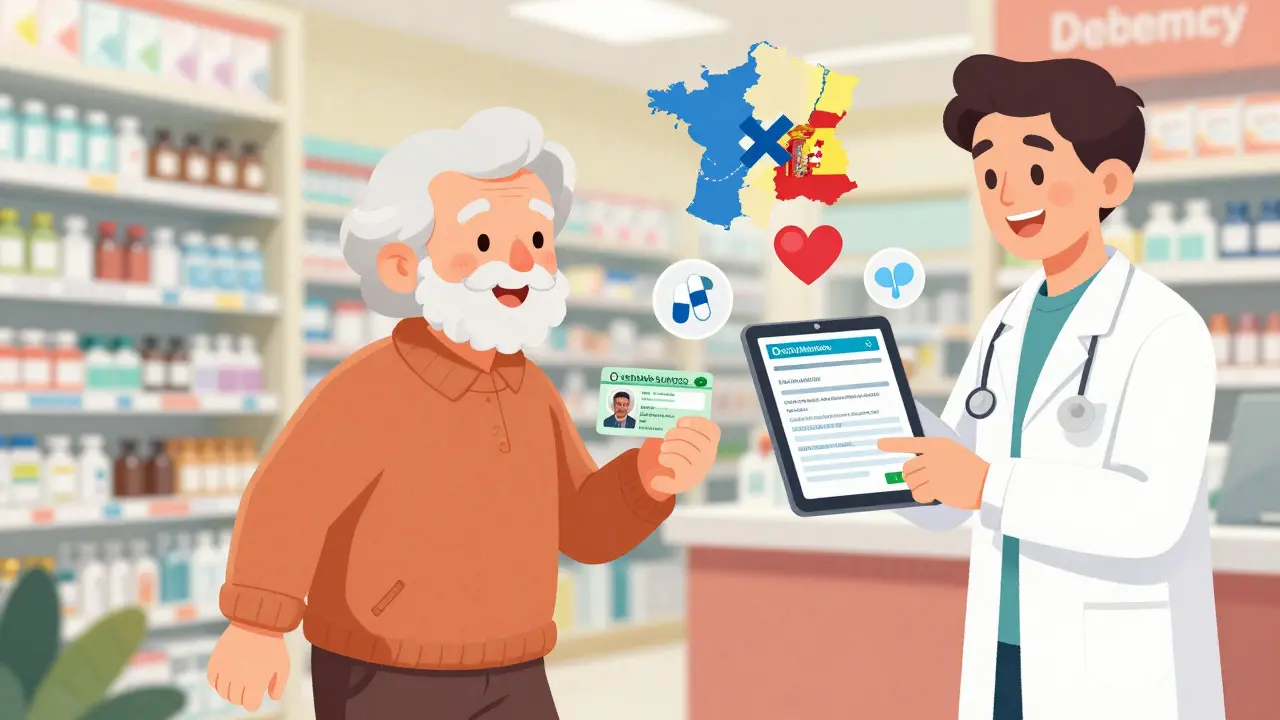
Imagine you’re on vacation in Belgium and your blood pressure medication runs out. Back home in Germany, your doctor e-signed a prescription that’s already waiting for you at the local pharmacy across the border. No paperwork. No delays. Just walk in, show your ID, and pick up your pills. This isn’t science fiction-it’s real in the EU today, thanks to the ePrescription system. But here’s the catch: not everyone can use it, and not every country plays by the same rules.
How cross-border pharmacy services actually work
The EU’s cross-border pharmacy system is built on two digital tools: ePrescription and Patient Summaries. Together, they let you get your generic drugs in another EU country using your home country’s prescription. The system runs on the eHealth Digital Service Infrastructure (a secure digital network connecting national health systems across the EU), branded as MyHealth@EU. It’s active in all 27 EU countries plus Iceland, Norway, and Liechtenstein.Here’s how it works step by step:
- Your doctor in France issues an electronic prescription linked to your national health ID.
- You travel to Spain and visit a participating pharmacy.
- The pharmacist logs into the MyHealth@EU portal using your European Health Insurance Card (EHIC) number.
- The system pulls up your ePrescription and your Patient Summary-showing allergies, current meds, and past treatments-in Spanish.
- The pharmacist dispenses the generic version of your drug, and the transaction is recorded back in France.
This isn’t just convenient. It saves lives. In border regions like the Netherlands-Germany border, 78% of patients report successfully filling prescriptions abroad, compared to just 42% elsewhere in the EU. The system cuts down on medication errors by 22% and improves adherence to chronic disease treatments by 17%.
Why generic drugs are the backbone of this system
Generic drugs make cross-border mobility possible because they’re identical in active ingredients, dosage, and safety to brand-name versions-but cheaper and more widely available. A patient in Sweden might need a generic version of metformin for diabetes. In Germany, that same drug is sold under a different brand name, but the active ingredient is the same. The EU’s strict bioequivalence rules ensure that a generic pill bought in Poland works the same as one bought in Finland.But here’s the problem: not every country stocks every generic. A drug approved in Italy might not be available in Romania. Pharmacists can’t just substitute any generic-they must match the exact formulation listed in the ePrescription. That’s why Patient Summaries are so critical. They show not just the drug name, but the manufacturer and batch number. If the pharmacy in Portugal doesn’t carry the exact version, they can’t legally dispense it.
The regulatory patchwork: 8 countries lead, 19 lag
The EU has a single law for cross-border healthcare-Directive 2011/24/EU-but implementation is a mess. Only 8 EU countries have clear rules for how pharmacists should handle e-prescriptions from abroad. Germany, France, Austria, the Netherlands, Belgium, Denmark, Luxembourg, and Estonia have fully integrated systems. In these places, pharmacists get training, clear guidelines, and digital tools to verify foreign prescriptions.In the other 19? It’s a gamble. Pharmacists in Greece, Bulgaria, or Croatia may not even know how to access the MyHealth@EU portal. Some don’t have the software. Others lack training. Patients report being turned away because the pharmacist “didn’t recognize the foreign prescription format.”
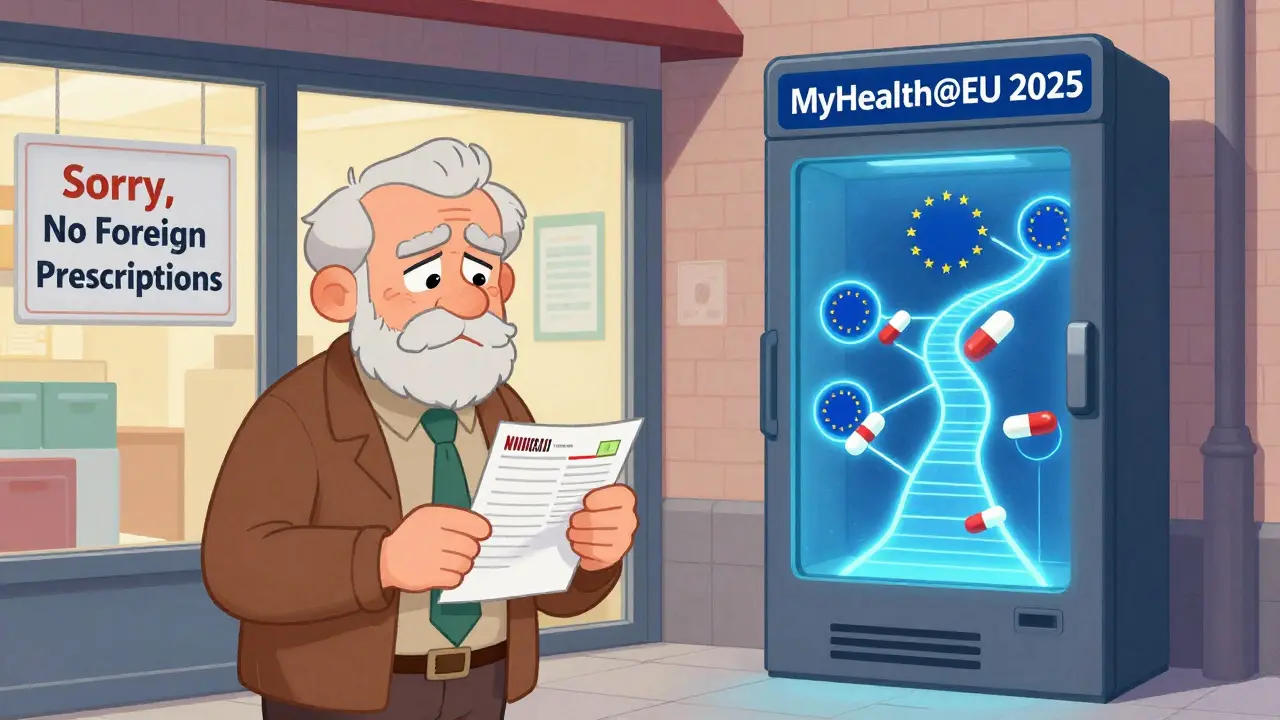
And it’s not just about software. Regulations vary wildly. In Ireland, prescriptions from UK telehealth services are invalid-even if the doctor is licensed and the prescription is real. Why? Because the UK left the EU’s digital health network. The same goes for Switzerland and Norway: not part of the EU, so their ePrescriptions don’t connect. Even within the EU, some countries require patients to manually authorize data sharing for each trip. Others do it automatically. It’s confusing. And dangerous.
The new rules changing everything in 2025
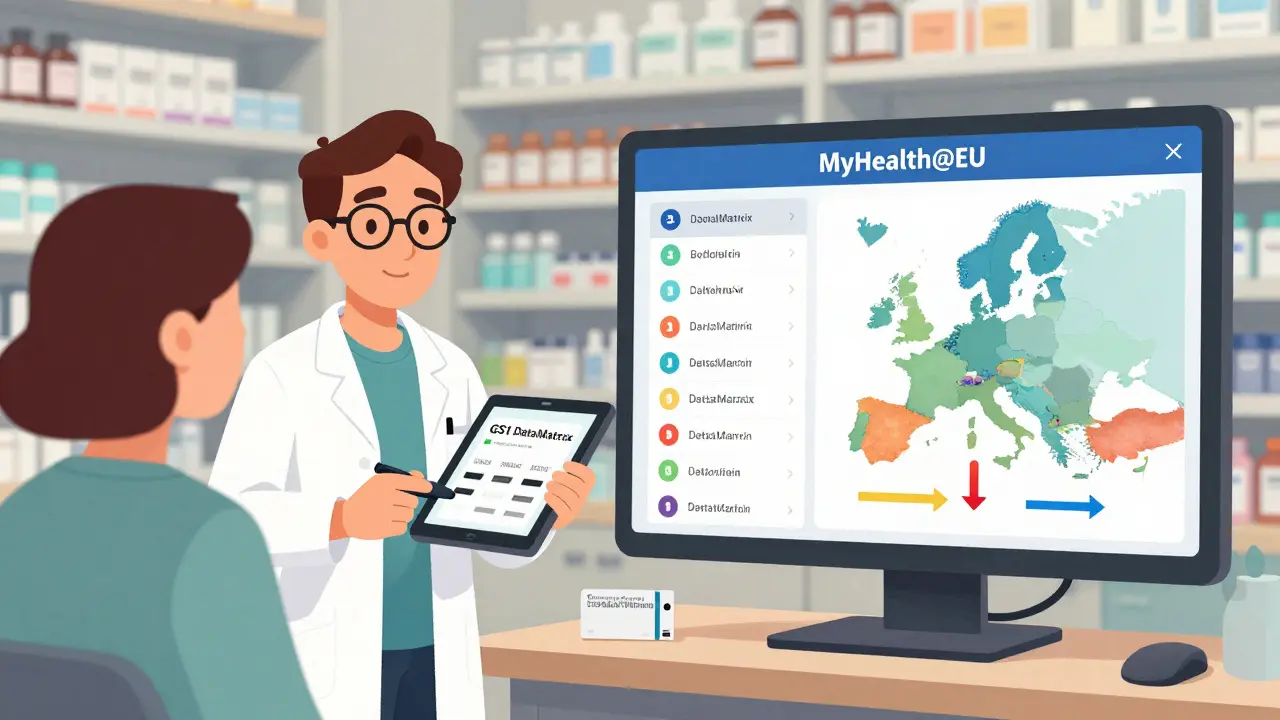
This year, the EU rolled out major updates. The Critical Medicines Act (a regulation requiring manufacturers to report supply and demand data across borders) forces drugmakers to track shortages in real time. If a generic drug runs out in Spain, the system flags it. Pharmacies in neighboring countries can then redirect patients to stock that’s available elsewhere.Italy now uses GS1 DataMatrix codes (scannable 2D barcodes replacing paper stickers on prescriptions). These codes hold more data than old paper labels-dosage, batch, expiry, even the prescriber’s license number. It’s harder to fake. Pharmacists scan the code, and the system auto-verifies everything.
Meanwhile, the European Shortages Medicines Platform (a centralized database tracking drug availability across all EU states) went live in January 2025. It’s already helped reroute 12,000 prescriptions in the first three months, mostly for generics used in heart disease and diabetes.
What goes wrong-and who gets left behind
The biggest issue? Awareness. Only 38% of EU citizens know they can get their meds abroad. In non-border areas, that number drops below 20%. Most people think they need to go back home to refill prescriptions. They don’t realize they can walk into a pharmacy in Croatia and get their German-prescribed insulin.Then there’s language. A patient from Poland with a prescription for a generic anticoagulant might not understand the label in Czech. Patient Summaries help-they translate your medical history-but not all countries use them properly. Some only show the summary if the patient manually requests it. Others don’t translate at all.
And let’s not forget the elderly. Many don’t have smartphones or digital IDs. They rely on paper prescriptions. If they travel, they’re stuck. The system doesn’t yet support paper-to-digital conversion across borders. A 72-year-old in Hungary with arthritis might have to fly home just to refill a generic painkiller.
What’s next? The road to 2030
By 2027, MyHealth@EU will expand beyond prescriptions. You’ll be able to access lab results, imaging scans, and hospital discharge summaries while abroad. Imagine showing up at a clinic in Portugal with a heart condition, and the doctor instantly sees your echocardiogram from your home hospital in Sweden.The market is growing fast. The EU cross-border pharmacy sector is expected to grow 14.3% per year until 2030. More seniors are traveling. More people have chronic diseases. More generics are being approved. But growth won’t mean equity unless the EU fixes the fragmentation.
Right now, the system works best where it’s been tested: in border towns, in countries with strong digital health systems, and for patients who know their rights. For everyone else? It’s still a gamble.
Until every pharmacy in every country can reliably access your prescription and understand your medical history-no matter where you’re from-the promise of cross-border mobility remains incomplete.
Can I get my EU prescription filled in a non-EU country like the UK or Switzerland?
No. The EU’s ePrescription system only works between EU member states and the EEA countries (Iceland, Norway, Liechtenstein). The UK left the system after Brexit. Swiss prescriptions are not recognized either. If you’re traveling to the UK or Switzerland, you’ll need to carry enough medication or get a new prescription from a local doctor.
Do I need special software or an app to use cross-border pharmacy services?
No. You don’t need an app. You just need your European Health Insurance Card (EHIC) and your national digital identity (like a health ID card or eID). The pharmacy scans your card or enters your ID number into their system, which connects automatically to your home country’s database. You just show up, show your ID, and pick up your meds.
Are generic drugs from another EU country as safe as my home country’s version?
Yes. All generics sold in the EU must meet the same strict standards for quality, safety, and effectiveness. They contain the same active ingredient, in the same dose, and are absorbed the same way in your body. The EU’s European Medicines Agency (EMA) monitors this. A generic metformin from Poland works the same as one from Finland.
What if the pharmacy doesn’t have the exact generic I need?
They can’t substitute it. Even if another generic has the same active ingredient, the system requires the exact formulation listed on your ePrescription. If it’s not available, the pharmacist must contact your home pharmacy or doctor to resolve it. This prevents errors from mixing different formulations.
How do I know if my country participates in the ePrescription system?
All 27 EU countries plus Iceland, Norway, and Liechtenstein are legally required to participate. But not all have fully implemented it. Check your national health authority’s website. Look for "ePrescription" or "MyHealth@EU". If you’re unsure, call your pharmacy before you travel-they’ll know if it works in your case.
Finally, someone acknowledges the EU’s digital health infrastructure-though I’m shocked anyone still uses paper-based systems in 2025. 🤦♂️ The fact that 19 countries can’t even access MyHealth@EU is embarrassing. India’s Ayushman Bharat could’ve done this better. At least we have Aadhaar-linked e-prescriptions. This EU system? Half-baked. And don’t get me started on how they still require EHIC cards. QR codes. Biometrics. Come on. 🇮🇳
Look, I’m all for tech, but this whole thing is a bureaucratic nightmare disguised as progress. You’re telling me a guy in Bulgaria can’t just give someone their metformin because the batch number doesn’t match? That’s not healthcare-that’s compliance theater. And why does every country need its own digital fingerprint for a pill? Just let pharmacists use their judgment. We’re not sending rockets to Mars. It’s a generic drug. 🤷♂️
THIS IS THE FUTURE. 🚀 Imagine a world where your medicine follows you across borders like your Spotify playlist. No more panic in Croatia because your German insulin doesn’t have the same label. The EMA is quietly building a medical utopia-and most people are too busy complaining about the Wi-Fi to notice. This isn’t policy. This is liberation. The 19 lagging countries? They’re not broken. They’re just not ready for the 21st century. And honestly? I’m kinda proud of the EU for doing this right. 🇪🇺❤️
So let me get this straight. I can’t get my prescription filled in the UK but I can in Poland? Cool. And Switzerland? Nope. But I can go to Norway? Wait, what? Why does this feel like a bad game of musical chairs with pills? And why is no one talking about how this only helps people who have smartphones and internet access? Elderly people? Immigrants? Poor people? Guess they just don’t deserve to live. 🤡
There’s a lot of nuance here that’s being missed. The system works because it’s interoperable-not because it’s perfect. The real win is the GS1 DataMatrix codes and the shortages platform. Those are game-changers. The fact that 12k prescriptions were rerouted in 3 months? That’s not bureaucracy. That’s supply chain intelligence. And yeah, the 19 lagging countries need help-but they’re not failures. They’re work in progress. We need to fund their tech upgrades, not shame them. The EU’s goal isn’t uniformity. It’s resilience. And honestly? That’s kind of beautiful.
Oh wow, another EU fairy tale. Let me guess-next they’ll tell us the system prevents overdoses and also makes you lose weight. 🤭 The ‘exact formulation’ rule? That’s why 78% of border patients succeed. Because they’re already getting the same damn drug from the same manufacturer. The rest? They’re just getting confused by paperwork. And ‘Patient Summaries’? Sure. Until the Spanish pharmacist can’t read Polish. Then what? You gonna translate your diabetes into Catalan? This isn’t innovation. It’s a PR stunt wrapped in a regulatory Rube Goldberg machine.
Biggest win here? The real-time shortage tracking. If Spain runs out of metformin, Finland can redirect patients. That’s life-saving. And the 2D barcodes? Genius. No more guessing if a pill is legit. Just scan. Done. The language and elderly barriers? Yeah, they’re real. But the tech’s there. Now we just need to train pharmacists and build voice-assisted kiosks for seniors. Simple. Doable. And honestly? Way better than what the US has. We still fax prescriptions.
As someone from India, I’ve seen how messy health systems can be. But the EU’s approach? It’s actually impressive. Not perfect, but structured. The fact that they’re using GS1 codes and centralized databases? That’s what we’re trying to build here. The real lesson isn’t about pills-it’s about trust. If your system can verify a prescription from another country, you’ve built something rare. And yeah, the elderly and non-digital users? They need bridges, not barriers. Maybe paper-to-digital kiosks at train stations? Just a thought.
Y’all know this is all a scam right? The EU doesn’t care about your meds. They just want to track you. That ‘MyHealth@EU’ thing? It’s a spy tool. Your prescription history gets uploaded to some server in Brussels and then sold to Big Pharma. And ‘generic drugs are the same’? Lol. Ever heard of fillers? Binders? The active ingredient might match-but the rest? Total crap. I got a pill from Poland once. Felt like I swallowed a rock. They’re all fake. Just like the vaccines. 👁️👄👁️
Simple version: if you have a prescription and an EHIC card, you can get your meds in most EU countries. The rest is noise. The system works. Some places are slow. Fix them. Don’t overcomplicate it. Just scan, verify, give the pill. That’s it.