
Drug Side Effect Timeline Calculator
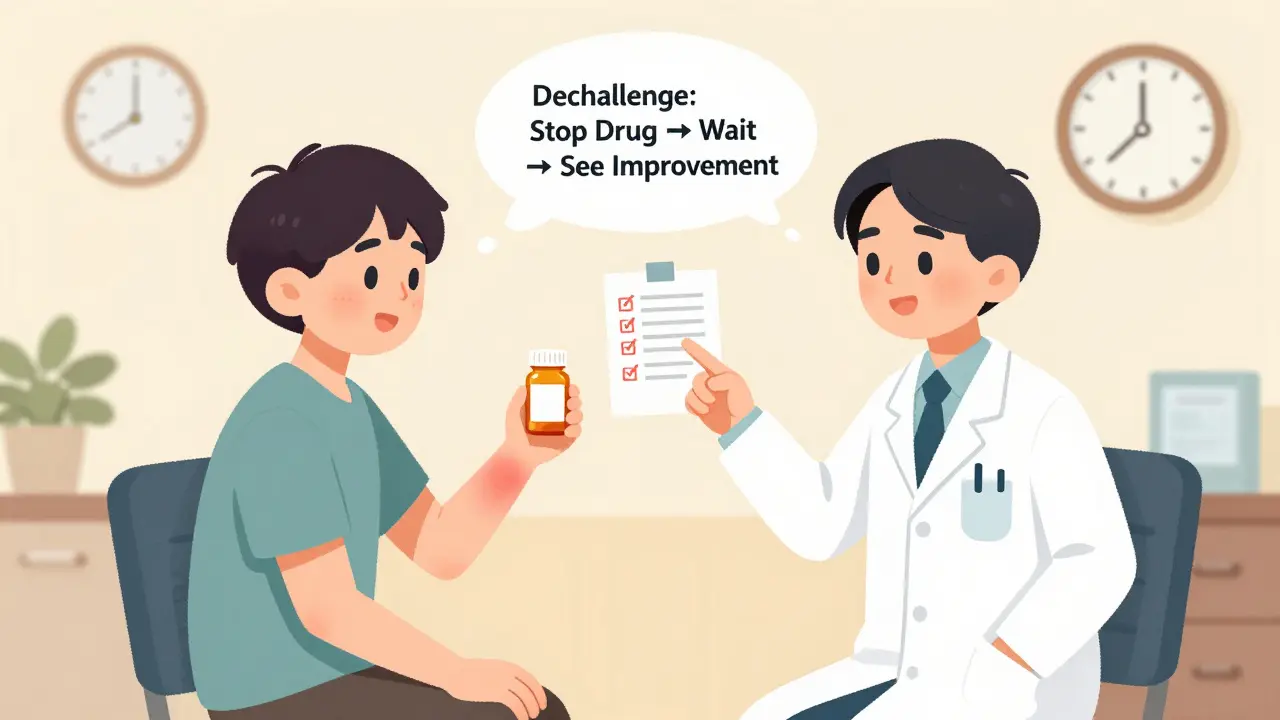
This tool helps estimate when symptoms might resolve after stopping a medication (dechallenge), based on drug half-life and symptom onset timing. The dechallenge process is the first step to determine if a drug caused a side effect.
Important: This is for educational purposes only. Never stop or restart medications without consulting your healthcare provider. Rechallenge (restarting the drug) can be dangerous for severe reactions and should only be done under medical supervision.
Dechallenge Timeline
Estimated Time for Symptoms to Resolve:
Rechallenge Warning: Rechallenge (restarting the drug) is generally only done for non-severe reactions under medical supervision. In 97% of cases, successful rechallenge proves drug causality, but it's dangerous for serious reactions like Stevens-Johnson Syndrome or liver failure.
Have you ever stopped taking a medication because you felt worse after starting it-only to wonder if the drug was really to blame? You’re not alone. Millions of people experience unexpected side effects from prescription drugs, but figuring out which one caused the problem isn’t always easy. That’s where dechallenge and rechallenge come in. These aren’t fancy lab tests or high-tech scans. They’re simple, powerful clinical tools used by doctors and pharmacists to prove whether a drug actually caused an adverse reaction. And when done right, they can turn suspicion into certainty.
What Is Dechallenge?
Dechallenge is the act of stopping a drug to see if symptoms get better. It’s the first step in figuring out if a medication is responsible for a side effect. Let’s say you start taking a new antibiotic and develop a nasty rash a week later. Your doctor suspects the drug. So they tell you to stop taking it. If the rash fades over the next few days or weeks, that’s a positive dechallenge. It means the drug likely caused the reaction. But here’s the catch: timing matters. A rash from a drug like metronidazole might clear up within 5 to 10 days after stopping. A liver reaction could take weeks. If symptoms don’t improve after the drug’s half-life has passed-meaning it’s mostly out of your system-and you’re still feeling bad, that’s a negative dechallenge. It suggests something else is going on. In dermatology, where skin reactions are common, dechallenge is used in about 87% of cases. It’s the go-to tool because it’s safe, non-invasive, and gives clear clues. But it’s not foolproof. If you’re taking five different meds and stop them all at once, you can’t tell which one was the culprit. That’s why doctors need to know exactly what you took, when you started, and when symptoms appeared.What Is Rechallenge?
Rechallenge is when you take the drug again-on purpose-to see if the side effect comes back. If the rash returns exactly the same way, within the same timeframe, that’s powerful proof the drug caused it. In the case of a fixed-drug reaction documented in the Indian Journal of Dermatology, a patient developed a rash in the same spot on their leg every time they took metronidazole. After stopping the drug, the rash faded. When they took it again three months later, the exact same rash appeared in the same spot within two days. That’s rechallenge in action. Rechallenge is the gold standard for proving causality. According to WHO-UMC guidelines, a successful rechallenge raises the likelihood of drug causality from “probable” to “definite” in 97% of cases. No algorithm, no statistical model can match that kind of clinical proof. But here’s the problem: it’s risky. Rechallenge means intentionally exposing someone to a drug that made them sick before. If the reaction was life-threatening-like Stevens-Johnson Syndrome, toxic epidermal necrolysis, or drug-induced liver failure-rechallenge is almost never done. The FDA reports that deliberate rechallenge is approved in only 0.3% of serious adverse event investigations. Even in milder cases, it requires strict oversight: informed consent, an ethics board review, and emergency care on standby.Why These Tests Matter
Most people think side effects are just “bad luck.” But in reality, up to 30% of hospital admissions are linked to adverse drug reactions. Many of these could be prevented if we knew which drugs were causing harm. Dechallenge and rechallenge help doctors avoid prescribing dangerous drugs to the same person again. They help pharmacists flag risky combinations. They help regulators pull unsafe drugs off the market. These tests are built into global safety systems. The FDA’s 21 CFR 310.305 and the EU’s GVP Module VI require that all drug safety reports include dechallenge and rechallenge data when available. Pharmaceutical companies now track this information in real-world studies. In 2023, 82% of major drug manufacturers required dechallenge outcomes in their post-marketing safety reports. Without these tools, we’d be stuck guessing. Temporal association-just because a symptom appeared after taking a drug-doesn’t prove causation. A patient might develop a headache after starting a new blood pressure pill, but the headache could be from stress, lack of sleep, or an unrelated illness. Dechallenge separates coincidence from cause.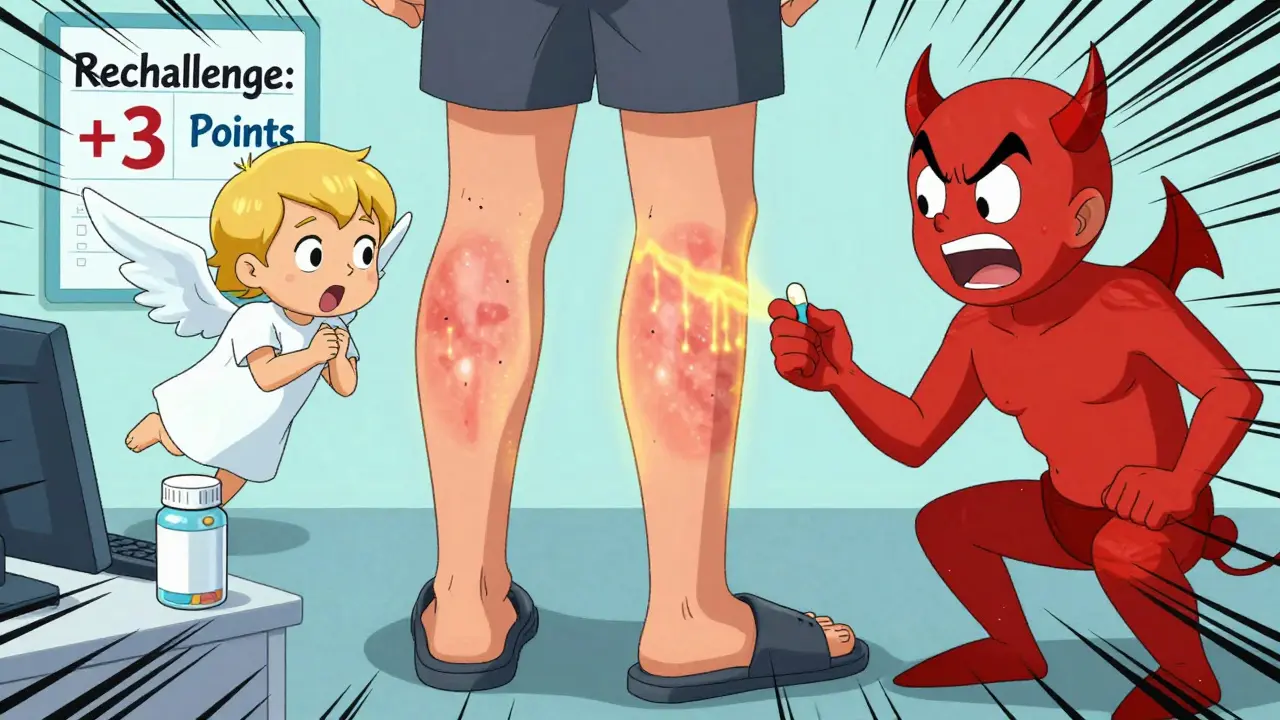
When Rechallenge Isn’t an Option
Not every patient can be rechallenged. That’s why dechallenge is the workhorse of pharmacovigilance. In psychiatry, for example, stopping an antidepressant can trigger severe withdrawal or relapse. Rechallenge isn’t ethical. In these cases, doctors rely on dechallenge alone, combined with biological plausibility and known side effect profiles. There’s also the issue of timing. If a patient forgets to report a reaction until weeks later, the drug may already be out of their system. Rechallenge becomes impossible. Or, worse, they might have taken a different drug in the meantime, muddying the waters. That’s why structured reporting matters. Electronic health records now include prompts for clinicians to document: When did symptoms start? When was the drug stopped? Did symptoms improve? When was the drug restarted? Did they return? These fields are now mandatory in electronic adverse drug reaction reports under ICH E2B(R3) guidelines.What’s Changing in 2026
New tech is helping, but not replacing, these classic methods. Wearable sensors can now track heart rate, skin temperature, and inflammation markers in real time during dechallenge. A 2023 study showed these devices detected symptom resolution in 78% of cases, compared to just 52% with patient self-reports. That means faster, more accurate decisions. Scientists are also developing alternatives to rechallenge. Blood tests that measure how immune cells react to drugs in a lab dish can now predict with 89% accuracy whether someone will have a reaction-without ever taking the drug again. This is huge for people with severe allergies or autoimmune risks. Still, experts agree: no algorithm can replace the clinical reality of watching a rash fade after stopping a pill-or return after restarting it. As Dr. Elena Rodriguez from the WHO put it in 2024: “No algorithm can substitute for the clinical reality of symptom resolution after drug discontinuation-dechallenge remains the cornerstone of causality assessment that all emerging technologies must validate against.”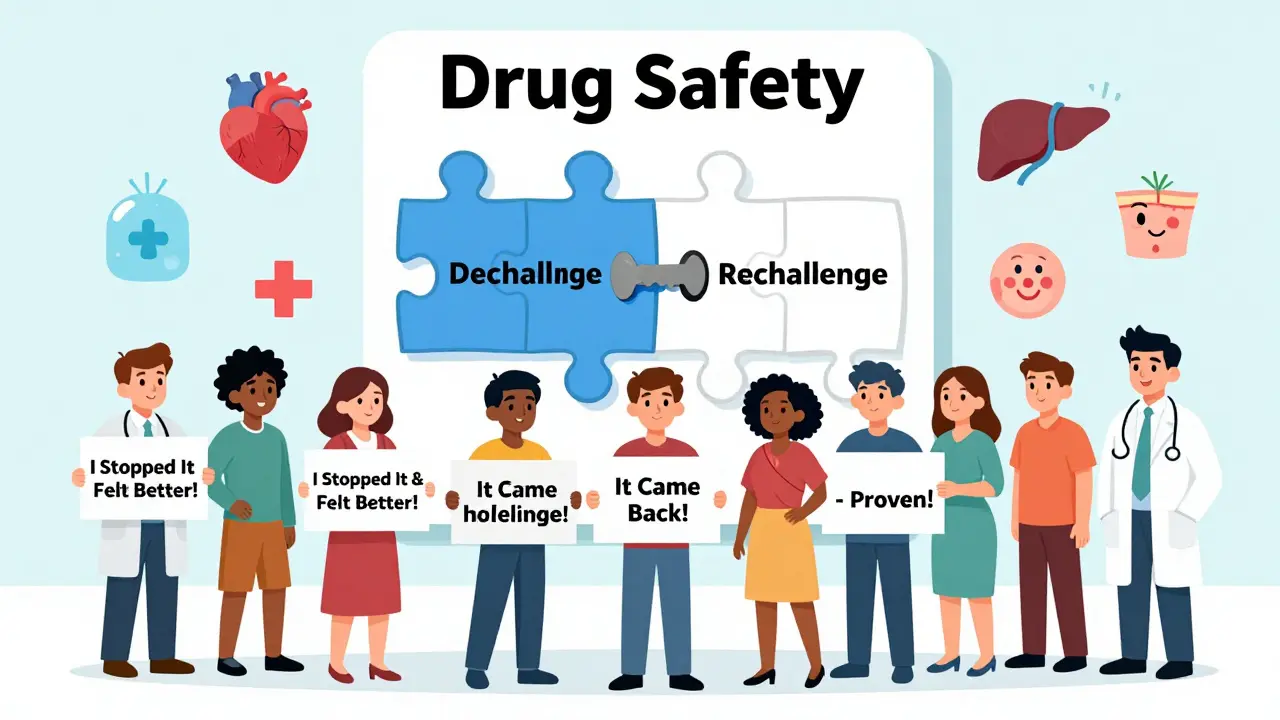
What You Can Do
If you’ve had a strange side effect, don’t ignore it. Write down: what drug you took, when you started, when symptoms began, how bad they were, and when they improved after stopping. Bring this to your doctor. Ask: “Could this be from the medication? Should we try stopping it to see?” Don’t stop a drug on your own-especially if it’s for blood pressure, diabetes, or mental health. Talk to your provider. If you’re being prescribed a drug you’ve reacted to before, speak up. Your history matters. Pharmacovigilance isn’t just for experts. It’s for patients who pay attention. Your observations, your timeline, your memory-those are the data points that save lives.How These Tests Fit Into Bigger Systems
Dechallenge and rechallenge are part of a four-part framework used globally to assess drug safety:- Temporal relationship: Did the reaction happen after taking the drug?
- Dechallenge: Did symptoms improve after stopping it?
- Rechallenge: Did symptoms return when the drug was restarted?
- Biological plausibility: Does this reaction match what we know about how the drug works?
Dechallenge is basically the medical version of ‘hey, did you try turning it off and on again?’ But like… if your laptop was your liver and the crash was a full-blown anaphylaxis. 😅
Still, it’s wild how often docs just guess instead of doing this. I’ve seen people stay on meds for years because ‘it’s probably not that.’ Spoiler: it was.
And rechallenge? That’s like asking someone to lick a live wire to prove it’s electrified. Brave. Stupid. Brilliant.
Man, I used to think side effects were just ‘bad vibes’ until my cousin got that rash from amoxicillin. Stopped it-poof, gone in 72 hours. Tried it again? Same damn rash, same spot, like the drug remembered her skin. It’s creepy how precise the body is. Like it’s whispering, ‘I told you so.’
Dechallenge ain’t rocket science-it’s just listening. And most of us ain’t trained to hear the whispers.
Isn’t it tragic how we’ve outsourced our intuition to algorithms? We’ve forgotten that the body speaks-if only we’d stop talking long enough to listen.
Dechallenge is the silence after the storm. Rechallenge? The reckless echo that dares to summon it back.
Perhaps the drug is not the enemy… but the mirror. And we fear what it reflects.
so like i stopped my zoloft once just to see if my brain fog was from it
turned out it was just me being tired and eating too much pizza
but still… kinda wild how easy it is to blame the pill
maybe we should all just nap more
AMERICA NEEDS TO STAND UP FOR PATIENT SAFETY 🇺🇸
THEY’RE LETTING BIG PHARMA GET AWAY WITH THIS 😤
RECHALLENGE ISN’T RISKY-IT’S JUSTICE 😤
WHY AREN’T WE MAKING THEM DO THIS ON EVERY DRUG?!?!
MY COUSIN’S SISTER’S DOG GOT A RASH FROM A VET MED AND THEY DIDN’T EVEN TRY STOPPING IT 😭
WE NEED A MOVEMENT 🚨💊✊
So I’m curious-when they say ‘positive dechallenge,’ do they mean the symptoms improved, or just that they didn’t get worse?
Also, what’s the window for ‘improvement’? Like, if the rash fades from red to pink after 10 days, is that enough?
And if someone’s on 7 meds, how do you even isolate the culprit? I feel like this whole system is built on hope and good notes.
Let’s be real-dechallenge and rechallenge are the only things in pharmacovigilance that aren’t statistically manipulated garbage.
Everything else? Naranjo Scale? WHO-UMC? E2B(R3)? All just glorified checklists.
The only gold standard is: stop it, wait, see if it goes away. Then try it again. If it comes back, congrats-you’ve got causality.
Everything else is just noise. And no, AI can’t predict a fixed drug eruption from a blood test. Not yet.
Okay, so I just want to say-this is the most important thing I’ve read all year. I mean, think about it: every time you take a pill, you’re basically saying ‘I trust you’ to a molecule that doesn’t even know what a human is.
And then you get a rash, or a headache, or you feel like you’re drowning in your own skin-and you just assume it’s stress?
No. No no no. We need to train EVERYONE-patients, nurses, pharmacists, even the guy at the CVS-to ask: ‘Did you stop the drug?’
And if they say no-then we’ve got work to do.
This isn’t just medicine-it’s a cultural shift.
And I’m here for it. I’ve been telling my mom to write this stuff down for years. She finally started. It’s beautiful.
Also, wearables? YES. I got a Fitbit and it told me my heart rate spiked 20 beats after my new blood pressure med. I called my doctor. They were like ‘oh wow, we didn’t even think of that.’
So yeah. Let’s do this.
And if you’re reading this-you’re part of the change.
Thank you.
Dechallenge is the quiet rebellion against medical arrogance.
Rechallenge? That’s the daredevil who says ‘I’ll do it again… but only if you promise to be ready.’
Most docs won’t even ask if you stopped the med. They just write a new script.
And we let them.
It’s not ignorance. It’s laziness.
And we’re the ones paying for it-in rashes, in ER visits, in lost sleep.
Write it down. Even if it’s just a note on your phone.
That’s your power now.
Why are we even talking about this? Just ban the bad drugs.
Why put people through rechallenge? That’s just playing Russian roulette with their organs.
If a drug makes you sick once, it’s dangerous. Period.
Stop pretending we need proof. Just take it off the market.
And stop blaming patients for not remembering when they took the pill.
It’s the system that’s broken.
Not us.