

For people managing diabetes, the daily routine used to be simple: poke your finger, test the strip, guess what’s next. But today, that’s changed. CGMs-continuous glucose monitors-are no longer a luxury for Type 1 diabetes. They’re now a standard tool recommended for nearly everyone on insulin, including those with Type 2, pregnant women, older adults, and even kids. The shift isn’t just about convenience. It’s about survival. A 2025 study from the University of Miami showed that CGMs reveal glucose patterns doctors never saw before-fluctuations that lead to hospital visits, nerve damage, and heart problems. Now, we know what those spikes and drops look like, and we can stop them before they hurt.
How CGMs Work and What’s New
CGMs don’t measure blood directly. Instead, they track glucose in the fluid between your cells, called interstitial fluid. That’s why there’s a lag-usually 5 to 15 minutes-between your actual blood sugar and what the device shows. But that’s changing. A new implantable sensor called Glucotrack, still in trials, goes straight into the bloodstream. It’s about the size of three nickels, inserted just under the skin by a provider, and designed to last up to three years. Early results show it matches the accuracy of today’s top external devices, with a MARD score of 7.7%. That’s better than most fingerstick tests.
Right now, the most common devices are Dexcom G7, Abbott FreeStyle Libre 3, and Medtronic Guardian 4. The Libre 3 has a MARD of 8.1%, meaning its readings are, on average, just 8.1% off from lab results. Sensors last 14 days for Libre 3, 10 days for Dexcom, and 7 days for Medtronic. Each costs between $150 and $300 out-of-pocket, and without insurance, that adds up to $300 a month. But here’s the real win: users spend 3.2 more hours per day in their target glucose range (70-180 mg/dL) than people still using fingersticks. That’s not just numbers-it means fewer headaches, less fatigue, and more stable energy.
Smart Pens and the Missing Link
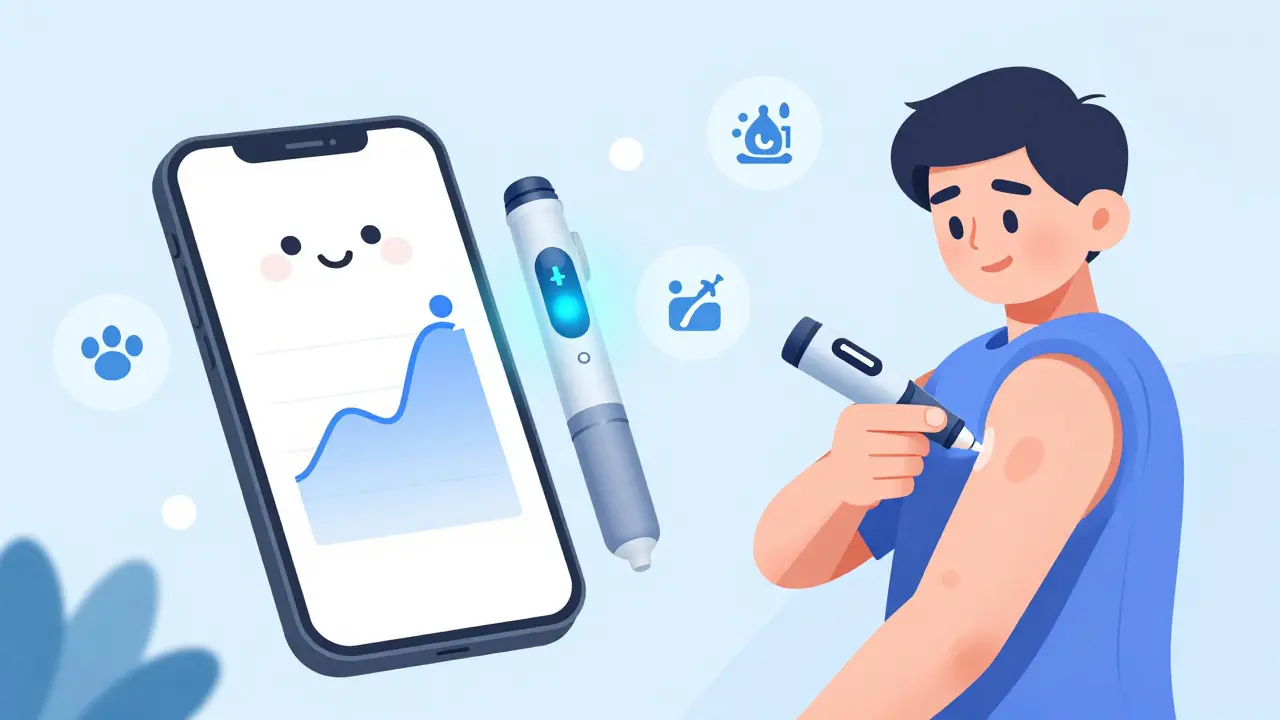
CGMs tell you what’s happening, but they don’t fix it. That’s where smart insulin pens come in. The InPen by Medtronic tracks every dose you give, logs your carb intake, and even suggests how much insulin to take based on your CGM data. It’s like a personal assistant for your insulin. But here’s the catch: only 15% of insulin users use them. Why? Cost. Complexity. Lack of awareness. Most people still use regular pens or syringes. And while CGMs have exploded in use-especially after Medicare expanded coverage-smart pens haven’t kept pace. They’re powerful, but they need to be easier to get and simpler to use.
Apps That Connect the Dots
CGMs and smart pens generate tons of data. That’s where apps like mySugr and One Drop come in. They turn numbers into graphs, trends, and alerts. But not all apps work with all devices. A 2025 conference found only 43% of third-party apps fully integrate with all major CGMs. If your app doesn’t talk to your device, you’re stuck manually entering data. And that’s a dealbreaker for most people. The best systems now auto-sync: your sensor sends data to your phone, your app logs it, and your doctor gets a weekly report. No more printing strips or guessing what happened at 3 a.m.
Real-Life Impact
People aren’t just using this tech-they’re changing their lives. On Reddit’s r/diabetes community, 78% of users said they sleep better because their CGM wakes them up when their sugar drops too low. 63% say they feel less anxious about unexpected highs and lows. One remote program helped participants drop their A1c from 10.4% to 7.5% in just three months. Foot wounds healed 72% faster in CGM users than in those without. That’s not just improvement-it’s prevention.
But it’s not perfect. Nearly half of users struggle with sensors falling off, especially in heat or during workouts. Insurance still blocks access for 37% of commercially insured patients. And for low-income users, even with Medicaid expansion, 41% still can’t get a CGM. There’s also the issue of too many alerts. 68% of new users feel overwhelmed at first. That’s why the American Diabetes Association now says: customize your alerts. If you work nights, your low-sugar alarm should be different than someone who works days. One size doesn’t fit all.

What’s Coming Next
The future is faster, smarter, and more connected. Dexcom and EarlySense are teaming up to release a predictive model in mid-2026 that can forecast glucose changes 30 minutes ahead with 89% accuracy. Imagine getting a warning before your sugar crashes-not after. Vaxess Technologies is testing a needle-free patch for semaglutide (Ozempic), which could make weight-loss drugs easier to take. And Glucotrack’s implantable sensor could be FDA-approved by 2028, eliminating the need to change sensors every two weeks.
But here’s the big question: will everyone get access? Right now, 63% of CGM systems have data security flaws. Someone could hack your glucose readings. That’s not theoretical-it’s been proven. And while the market is growing fast-projected to hit $21.3 billion by 2030-equity remains the biggest hurdle. Medicare coverage jumped from 2.1% to 28.7% in just five years. That’s progress. But if the same tech is out of reach for people without insurance, or in rural areas, or with limited tech literacy, then we’re just creating a new kind of divide.
Getting Started
If you’re considering CGM, start with your doctor. Ask if you qualify under the 2025 ADA guidelines. Most insurers now cover it for Type 1, insulin-using Type 2, and pregnant people. If you’re uninsured, check if Abbott or Dexcom offer patient assistance programs. Many give free sensors for the first month. Don’t skip the training. 78% of people who stick with CGM used formal education. Learn how to interpret trends, not just numbers. Set your alerts slowly-start broad, then narrow them down. And remember: this isn’t about perfection. It’s about awareness. The goal isn’t to never have a high or low. It’s to know when they’re coming-and act before it’s too late.
Can CGMs replace fingerstick tests completely?
For most people using modern CGMs like Dexcom G7 or Abbott Libre 3, fingerstick tests are no longer needed for daily decisions. These devices are accurate enough to guide insulin dosing, food choices, and activity. However, you should still use a fingerstick if your CGM reading doesn’t match how you feel-like if you’re dizzy or shaky but the device says your sugar is normal. Calibration is rare now, but symptoms still matter.
Are CGMs covered by insurance?
Yes, for most people who meet ADA guidelines. Medicare and Medicaid cover CGMs for Type 1 and insulin-dependent Type 2 diabetes. Private insurers also cover them, but prior authorization is common. If you’re denied, ask for a letter of medical necessity from your doctor. Some manufacturers, like Abbott and Dexcom, have patient support teams that help fight denials.
Do smart pens work with all CGMs?
Not yet. The InPen by Medtronic works with Dexcom and Abbott CGMs, but not all third-party pens support every device. Always check compatibility before buying. Some pens only connect via Bluetooth to one brand’s app. If you already have a CGM, make sure the pen you choose integrates with it. Otherwise, you’ll end up juggling two separate apps.
Can CGMs prevent emergencies like diabetic ketoacidosis (DKA)?
Yes, especially when paired with alerts. A 2024 study from the T1D Exchange registry found CGMs reduced DKA hospitalizations by 40% in Type 1 diabetes patients. By spotting rising glucose trends early, users can take insulin before ketones build up. CGMs don’t stop DKA entirely, but they give you the time to act before it becomes an emergency.
Are implantable CGMs available now?
Not yet in the U.S. Glucotrack is still in clinical trials and targeting a 2028 launch. The Eversense E3 sensor, which lasts six months, is FDA-approved and available, but it’s implanted under the skin and requires a reader. True implantables like Glucotrack, which don’t need external hardware, are still years away. For now, external sensors are the standard.
I've been using Libre 3 for 8 months. No more finger pokes. My energy is steady. I used to crash at 3 p.m. Now I know why. Just check the graph. Done. No drama.
The MARD scores are impressive, but let’s not ignore the real-world noise. Interstitial fluid lag is still a beast, especially during rapid glucose shifts-post-meal spikes or insulin boluses. Even with 8.1% error, that’s ±15 mg/dL at 180. That’s a full carb adjustment away from being wrong. And don’t get me started on sensor drift during high-intensity exercise. We’re not at ‘set it and forget it’ yet.
Bro, I got my Dexcom G7 last month and it’s like having a tiny psychic in my arm. I was like ‘yo why is my sugar spiking at 2am??’ and turns out I was eating that midnight burrito without realizing it. Now I’ve got alerts for ‘sneaky snacks’ and ‘crash before gym’. Life changed. Also, the app auto-logs my coffee. I didn’t even know it could do that. 🤯☕
Let’s be real: this tech is a godsend… for those who can afford it. Meanwhile, I’m watching my cousin in rural Alabama still using a $10 glucometer from Walmart because her insurance ‘doesn’t cover the new stuff.’ This isn’t innovation-it’s a luxury tier system. And they call it progress? We’re not healing diabetes. We’re just making it more expensive.
OMG I just had to comment because this article made me cry 😭 I went from A1c 10.8 to 6.9 in 5 months thanks to my Libre 3 and mySugr. I used to be terrified of sleep. Now I sleep through the night. I even started hiking again. Thank you to everyone who made this possible. You’re not just numbers-you’re people. And we’re getting better. 💪❤️
So we’re all supposed to be thrilled about a device that costs $300/month and falls off when you sweat? I’ve had three sensors detach mid-workout. My gym locker looks like a medical supply closet. And the alerts? I turned them all off. Too much noise. I’ll just keep poking my finger. It’s cheaper. And less annoying.
The real revolution isn’t the sensor. It’s awareness. Before CGMs, we treated diabetes like a static condition. Now we see it as a dynamic system-fluid, responsive, alive. That shift changes everything. It’s not about perfect numbers. It’s about understanding rhythm. Your body isn’t broken. It’s communicating. And now, finally, we’re learning to listen.
Smart pens are the unsung heroes here. I’ve seen people spend $2,000 on a CGM and still use a regular pen like it’s 1998. The InPen doesn’t just log-it teaches. It says, ‘Hey, you took 4 units after a taco. Your glucose went from 110 to 240. Want to try 3.5 next time?’ That’s not tech. That’s coaching. And yes, it’s expensive. But so is an ER visit. You choose.
I’ve been following this space since 2018. The progress is real. But we’re missing a key insight: technology doesn’t change behavior. Education does. I’ve met people with CGMs who check their app once a week. They’re drowning in data but don’t know what to do with it. The real gap isn’t access-it’s literacy. We need more peer-led training. Not just apps. Not just devices. Communities.
Wait wait wait-so you’re telling me I can get a patch for Ozempic that doesn’t need a needle? That’s like the holy grail for people who hate shots. I’ve been on it for 6 months. My arm looks like a pin cushion. If this patch works, I’m gonna hug the inventor. 🤗💉➡️🩹