
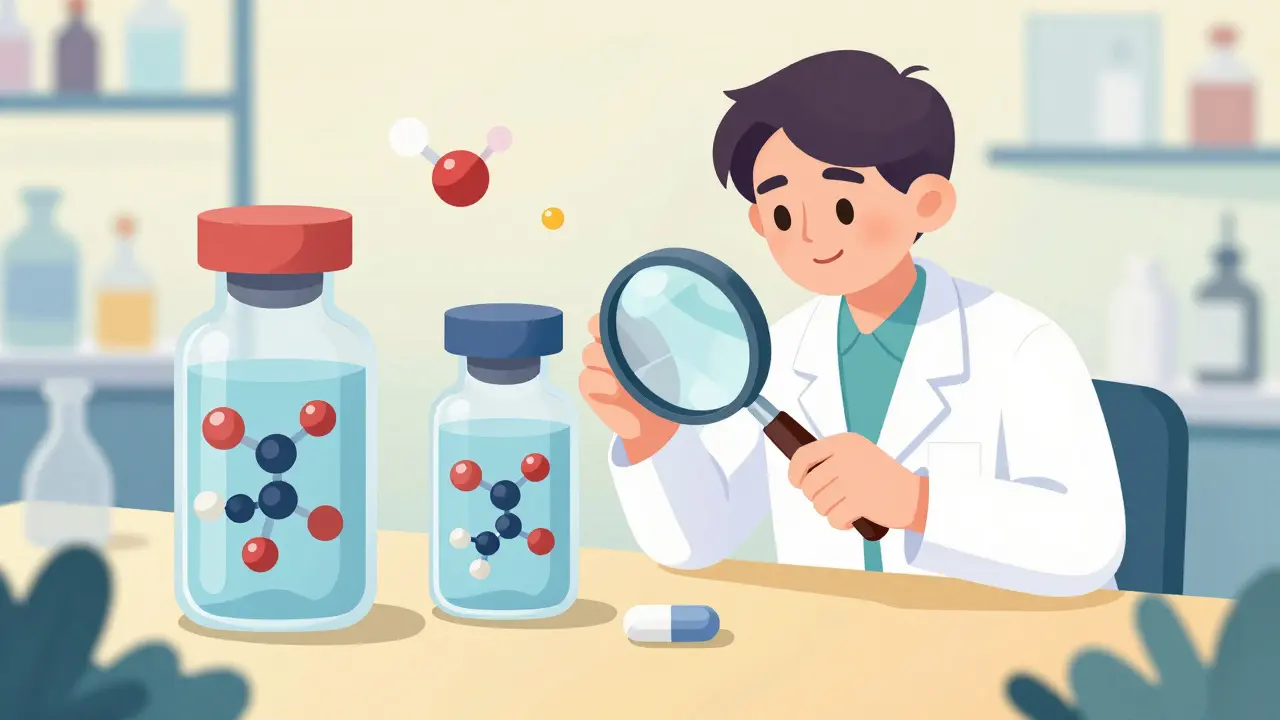
Right now, the FDA U.S. Food and Drug Administration has approved 76 Biosimilars highly similar, lower-cost alternatives to biologic drugs, yet they only make up 23% of the market for biologic alternatives-compared to 67% in Europe. Why the gap? Because the process of biosimilar approval has been complex and costly. But recent changes are speeding things up. In October 2025, the FDA released major updates to how it reviews biosimilars, which could save the healthcare system $250 billion over the next decade.
What Are Biosimilars and How Do They Differ from Generics?
Biosimilars are complex biological drugs made from living cells, designed to work like a reference biologic drug. Unlike generic drugs-which are chemically identical copies of small-molecule medications-biosimilars can’t be exact duplicates. This is because biologics are made from living organisms, and tiny differences in manufacturing can affect how the drug behaves in the body. For example, a biosimilar for the cancer drug Avastin (bevacizumab) might have minor structural variations but must still deliver the same clinical results as the original. The FDA requires rigorous testing to prove these differences don’t impact safety or effectiveness.
How the FDA’s Approval Pathway Works Under BPCIA
The BPCIA Biologics Price Competition and Innovation Act passed in 2010 created the legal framework for biosimilar approval. Under this law, companies must prove a biosimilar is “biosimilar” to the reference product through three types of evidence: analytical studies to compare molecular structure, toxicity assessments, and clinical studies to confirm safety and effectiveness. Historically, this meant lengthy clinical trials comparing the biosimilar directly to the reference drug in patients-often taking 3-5 years and costing $100-$300 million per product.
Key Changes in the FDA’s 2025 Draft Guidance
The FDA’s U.S. Food and Drug Administration October 2025 draft guidance made the biggest shift to biosimilar rules in over a decade. Instead of requiring full-scale clinical efficacy studies for every biosimilar, the FDA now says analytical data and pharmacokinetic studies (which track how the body absorbs and processes the drug) can often prove biosimilarity. This applies when three conditions are met: the reference product and biosimilar are made from clonal cell lines and are highly purified; scientists understand how the drug’s structure affects its function; and a human pharmacokinetic study is feasible. For example, a biosimilar for the rheumatoid arthritis drug Humira (adalimumab) could skip lengthy patient trials if analytical tests show near-identical molecular properties and pharmacokinetic studies confirm similar blood concentration levels.
Interchangeability: What It Means and How It’s Changing
Interchangeability a regulatory designation allowing pharmacists to substitute biosimilars without doctor approval has been a sticking point. Previously, the FDA required separate “switching studies” to prove patients could safely alternate between the reference drug and biosimilar. But in October 2025, the FDA announced it would no longer routinely require these studies for interchangeability designation. Commissioner Marty Makary stated, “Every biosimilar should have the designation of interchangeable” at a conference, though the FDA still evaluates evidence on a case-by-case basis. The first dual interchangeability approvals for denosumab biosimilars (used for osteoporosis) happened in October 2025, showing this new approach in action.
Global Comparisons: FDA vs. European Medicines Agency
The European Medicines Agency European regulatory body for medicines (EMA) has approved over 100 biosimilars since 2006. Historically, the FDA’s process was stricter, especially for clinical studies. The EMA typically requires only one pharmacokinetic study to confirm similarity, while the FDA previously demanded full efficacy trials. The 2025 guidance brings the FDA closer to the EMA’s approach. This alignment cuts development time from 8-10 years to 5-7 years and reduces costs to $50-$150 million per biosimilar, according to Wilson Sonsini’s analysis. However, challenges remain for complex drugs like antibody-drug conjugates, where structure-function relationships are less clear.
Current Market Impact and Challenges
Despite the progress, adoption hurdles persist. U.S. hospitals like Mayo Clinic report 37% cost savings after switching to biosimilars for oncology treatments-saving $18 million annually. Yet only 23% of patients use biosimilars when available, compared to 67% in Europe. Why? State laws in 34 states restrict pharmacists from substituting biosimilars without doctor approval, even when the FDA designates them as interchangeable. Patient surveys show 78% are satisfied with biosimilar effectiveness, but 41% initially worried about safety. On the industry side, 42% of biosimilar applications get “complete response letters” from the FDA requiring more data, though the new guidance aims to lower this rate. Patent disputes also delay market entry; the FTC reported 68% of approved biosimilars face litigation before launch.
What’s Next for Biosimilars in the U.S.?
The U.S. biosimilar market is growing fast, projected to hit $62.3 billion by 2029. The FDA’s streamlined pathway could increase annual approvals from 8-10 to 15-20, with McKinsey forecasting 40-50% market share by 2030. The Biosimilars Council’s technical assistance program has helped 87 small companies navigate the process since 2023. However, resolving interchangeability confusion and patent thickets remains critical. With the FDA’s Biosimilars User Fee Amendments (BsUFA III) funding through 2027, the path forward looks promising-especially for well-understood drugs like monoclonal antibodies used in cancer or autoimmune diseases.
How are biosimilars different from generic drugs?
Biosimilars and generic drugs both lower costs, but they’re fundamentally different. Generics are exact chemical copies of small-molecule drugs (like aspirin), while biosimilars are complex biological products made from living cells. Because they’re produced in living systems, biosimilars can’t be identical to the reference biologic-only “highly similar.” This means biosimilars require more rigorous testing to ensure safety and effectiveness, including analytical studies and pharmacokinetic data. Generics don’t need this level of scrutiny because their chemistry is simpler and fully replicable.
What does the FDA require to approve a biosimilar?
The FDA requires three types of evidence: analytical studies comparing molecular structure and function, toxicity assessments, and clinical data proving safety and effectiveness. Under the 2025 guidance, full-scale efficacy trials in patients are no longer routine. Instead, companies can use analytical data and pharmacokinetic studies (which track drug levels in blood) to prove biosimilarity when the reference product is well-characterized and the manufacturing process is consistent. For example, a biosimilar for a diabetes drug might only need lab tests and blood concentration studies instead of lengthy patient trials.
What is interchangeability, and how does it work?
Interchangeability means a pharmacist can swap a biosimilar for the reference drug without a doctor’s input, just like swapping generic drugs. Before 2025, the FDA required separate “switching studies” to prove patients could alternate between products safely. Now, the FDA says these studies aren’t always needed. For instance, two denosumab biosimilars received interchangeability designations in October 2025 based on analytical data and pharmacokinetic studies alone. However, state laws still control whether pharmacists can actually substitute them-34 states have restrictive rules that block automatic switching.
Why do biosimilars cost less than biologics?
Biologics like Humira or Enbrel cost $50,000-$100,000 per patient yearly because they’re expensive to develop and manufacture. Biosimilars leverage the reference drug’s existing data, so companies don’t need to repeat all the initial clinical trials. The FDA’s 2025 guidance further cuts costs by reducing testing requirements. For example, a biosimilar for a cancer drug might save $15,000-$20,000 per year per patient compared to the original biologic. This is why hospitals like Mayo Clinic report 37% lower biologic drug costs after switching to biosimilars.
Are biosimilars as safe as the original biologics?
Yes. The FDA requires rigorous testing to prove biosimilars have no meaningful differences in safety, purity, or potency. Patient surveys show 78% of those using biosimilars for conditions like rheumatoid arthritis report comparable effectiveness to the reference drug. Minor differences, like injection site reactions, are possible but rare and usually not clinically significant. For example, a 2025 Arthritis Foundation survey of 1,247 patients found 68% of safety concerns disappeared after talking to their doctor. The FDA monitors biosimilars closely after approval to catch any unexpected issues.