
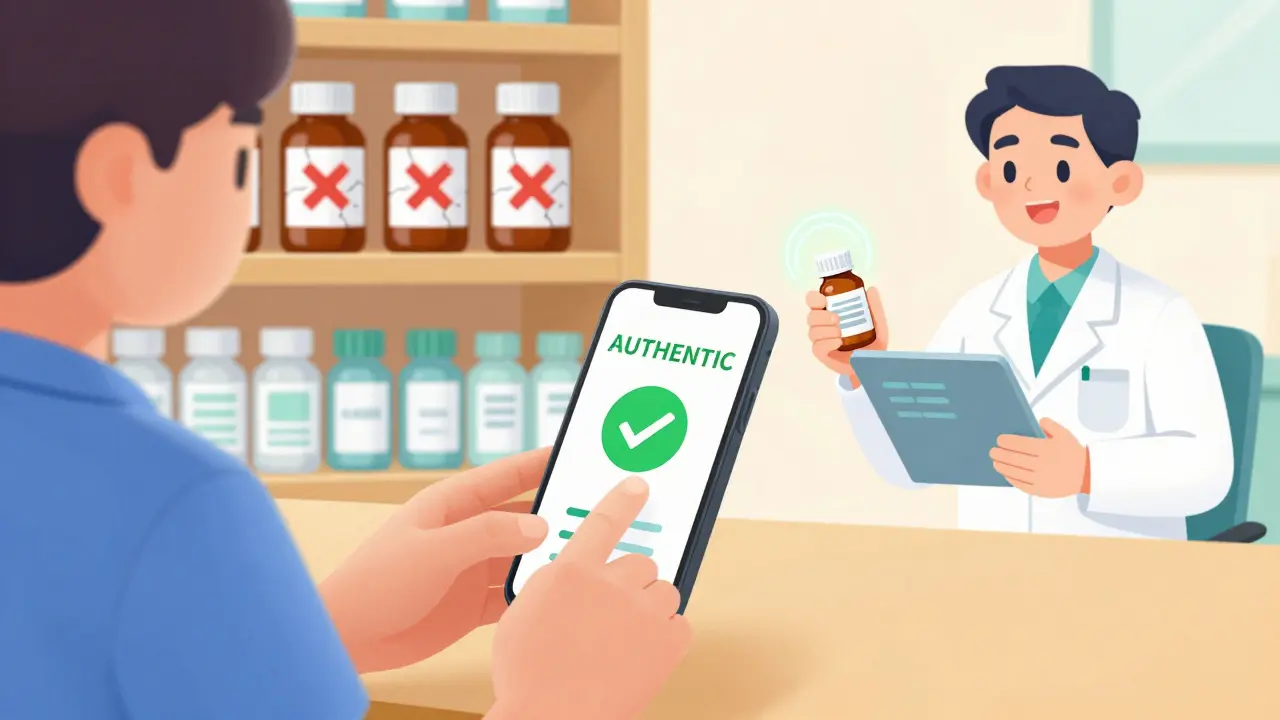
Every year, millions of people around the world take pills that don’t contain the right medicine-or worse, contain something dangerous. Counterfeit drugs aren’t just a problem in remote villages or shady online pharmacies. They’re slipping into legitimate supply chains, even in wealthy countries. In low- and middle-income nations, 1 in 10 medical products is fake or substandard, according to the World Health Organization. That’s not a distant threat. It’s happening now. And the tools to stop it are changing faster than ever.
What’s Really in Your Pill Bottle?
Counterfeit drugs come in many forms. Some are filled with chalk, sugar, or toxic chemicals. Others contain the right active ingredient but at the wrong dose. A fake antibiotic might not kill the infection. A fake heart medication might cause a stroke. The packaging often looks perfect-same colors, same logos, same barcodes. That’s why simple visual checks don’t work anymore.Traditionally, manufacturers relied on holograms, color-shifting inks, or tamper-evident seals. These are still used, but they’re easy to copy with modern printers and scanners. A QR code on a box? Counterfeiters scan it, print a copy, and slap it on a fake bottle. In fact, 78% of pharmaceutical QR codes fail security audits because they lack encryption. It’s like locking your door with a key made of plastic-looks real, but anyone can copy it.
The Rise of Serialization: Unique IDs for Every Pill
The biggest shift in anti-counterfeit tech isn’t flashy. It’s basic: every single package gets a unique digital identity. This is called serialization. Since 2023, the U.S. Drug Supply Chain Security Act (DSCSA) has been rolling out a requirement: every prescription drug package must have a unique serial number, starting with batch-level tracking and moving to unit-level by November 2025. The EU’s Falsified Medicines Directive already does this.Each serial number is tied to a digital record in a secure database. When a pharmacy scans the code at the point of sale, the system checks: Is this package real? Was it shipped from the manufacturer? Has it been diverted? If the system says no, the drug is pulled. This isn’t theoretical. Companies using full serialization report 60% faster recalls and far fewer counterfeit incidents.
But it’s not cheap. Implementing serialization means upgrading packaging lines, installing new software, training staff, and connecting to national databases. One European distributor spent €2.3 million and 14 months just to get their system working. Throughput dropped by 37% during the transition. Small manufacturers struggle to afford it-only 43% of mid-sized pharma companies have adopted full serialization as of 2025.
NFC: The Smartphone That Checks Your Medicine
The most user-friendly breakthrough? Near Field Communication (NFC) chips embedded in medicine packaging. These tiny chips hold encrypted data. You don’t need a scanner. Just tap your phone on the box. In under two seconds, an app tells you if the drug is real. No barcode. No scanning. No copying.ForgeStop’s 2025 demo at CPHI Frankfurt showed NFC authentication working with 99.98% accuracy. In Latin America, a pharmacy chain using NFC saw counterfeit incidents drop by 98% in six months. Pharmacists now verify 1,200+ packages daily-adding just 3 to 5 seconds to each transaction. And because the data is cryptographically signed, you can’t fake it. Even if someone prints a perfect label, the chip won’t respond unless it’s the original.
Smartphones have made this possible. By 2025, 89% of all new phones sold globally support NFC. That means the verification tool is already in your pocket. No extra hardware. No training. Just tap and know.
Blockchain: The Unbreakable Ledger
Think of blockchain as a digital notebook that no one can erase or alter. Every time a drug moves-from factory to warehouse to distributor to pharmacy-it’s recorded on this ledger. Temperature checks from IoT sensors. Time stamps. Who handled it. Where it was stored. All stored permanently.This isn’t just about tracking. It’s about proving authenticity at every step. If a bottle shows up in a rural clinic with no record of ever being shipped there, the system flags it. Companies like De Beers used blockchain to track diamonds. Now, pharma is doing the same.
But blockchain has a catch: it’s slow to set up. Gartner says full integration takes 18 to 24 months. That’s because it needs to connect with existing ERP and WMS systems, which were never built for this. Still, for large companies managing global supply chains, the long-term payoff is worth it. The EU’s upcoming Digital Product Passport rule, requiring lifecycle data on every drug by 2027, will push more companies to adopt it.
DNA Markers and Forensic Tech: The Ultimate Security Layer
Some companies are going beyond electronics. They’re using biology. DNA-based authentication involves embedding a synthetic DNA sequence into the packaging or even the drug itself. This marker is invisible, undetectable without a lab, and impossible to replicate without the original code.It’s like a fingerprint at the molecular level. Only authorized labs with the right reader can verify it. This is the gold standard for security. But it’s expensive-$0.15 to $0.25 per unit-compared to $0.02 to $0.05 for standard serialization. That’s why it’s mostly used for high-value drugs like cancer treatments or vaccines, not everyday pills.
Other forensic tools include UV and infrared inks, microtext only visible under magnification, and specialized embossed patterns. These are layered with digital systems. The goal isn’t one perfect solution. It’s multiple layers. If one fails, another catches it.
AI and Smart Cameras: The Eyes on the Line
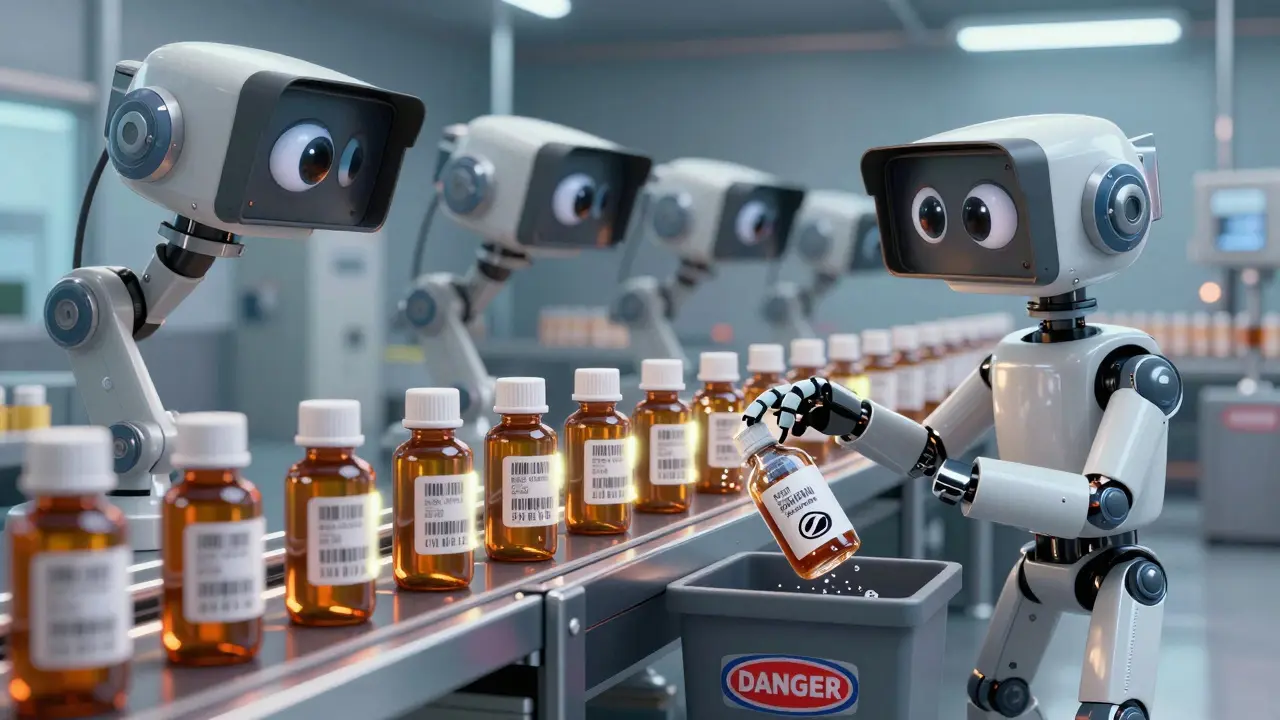
At the factory, AI-powered cameras are now scanning every package as it rolls off the line. These systems don’t just check barcodes. They analyze the shape of the cap, the texture of the foil, the exact shade of the ink, even the way the label is glued down. In controlled tests, they catch 99.2% of fakes.But real-world conditions are messy. Lighting changes. Packaging gets bent. Dust gets on the camera lens. Accuracy dropped from 99.2% in labs to 94.3% in real warehouses by mid-2025. Still, it’s a powerful tool when combined with serialization and NFC. It catches mistakes before the product leaves the plant.
Why Some Solutions Fail-and How to Avoid It
Not every tech works. A major U.S. drugmaker in 2025 rolled out QR codes without encryption. Fraudsters copied them, flooded the market with fake pills, and triggered a $147 million recall. The lesson? If your security doesn’t have cryptography, it’s not security-it’s theater.Another pitfall? Poor training. One company spent millions on a serialization system but didn’t train their warehouse staff. Employees kept scanning the wrong code. The system flagged 40% of real packages as fake. It took three months to fix.
And don’t ignore regional differences. In the U.S. and EU, regulations force adoption. But in Africa and Latin America, governments are catching up fast. Brazil started mandatory serialization in January 2025. Nigeria followed in Q3 2025. Companies ignoring these trends will lose market access.
The Future: Layered, Smart, and Sustainable
The future of anti-counterfeit tech isn’t one magic bullet. It’s a stack:- **Overt**: Tamper-evident seals and holograms-visible proof something’s wrong.
- **Covert**: UV inks, microtext, and DNA markers-hidden layers only experts can detect.
- **Digital**: NFC chips and blockchain records-real-time verification anyone with a phone can do.
- **AI**: Cameras and sensors that catch anomalies before the product ships.
By 2027, 83% of pharmaceutical companies plan to use this multi-layered approach. It’s not optional anymore. Regulators demand it. Patients demand it. And the cost of doing nothing? Lives.
There’s also a new twist: sustainability. More than 60% of new anti-counterfeit packaging now uses recyclable materials. The goal? Protect the medicine without harming the planet. Smart inks that degrade safely. Packaging that can be reused. Security that doesn’t create waste.
What You Can Do
If you’re a patient: Learn to check your meds. Many pharmacies now offer apps that verify drugs via NFC. Ask your pharmacist if they use it. If you bought medicine online, check the website. Legit sites will have a verified seal. If it looks too good to be true-price, packaging, shipping-it probably is.If you’re in the industry: Don’t rely on QR codes alone. Don’t skip training. Don’t wait for a recall to act. Start with serialization. Add NFC. Layer in blockchain where it makes sense. And always test your system with real-world simulations-not just lab conditions.
The fight against fake drugs isn’t won by one technology. It’s won by combining the best of physical security, digital verification, and human awareness. The tools are here. The question is: Are you using them?
How can I tell if my medicine is fake?
Look for tamper-evident seals like induction caps or shrink bands. Check if the packaging has a unique serial number or NFC chip. Many pharmacies now have apps you can use to scan the code and verify authenticity. If the price seems too low, the packaging looks off, or you bought it online from an unknown site, be cautious. Always get prescriptions from licensed pharmacies.
Are QR codes on medicine packaging safe?
Only if they’re cryptographically secured. Most QR codes on drugs today are not. They’re easy to copy and paste onto fake packaging. In 2025, 78% of pharmaceutical QR codes failed security audits because they lacked encryption. NFC and blockchain-based systems are far more secure. If your pharmacy uses QR codes without a verified app or digital signature, don’t trust them alone.
Is blockchain really necessary for drug tracking?
For large companies with global supply chains, yes. Blockchain creates an unchangeable record of every step a drug takes-from factory to pharmacy. It’s required by new EU regulations and helps prevent diversion and theft. But for small pharmacies or local distributors, basic serialization with NFC may be enough. Blockchain adds value, but it’s complex and takes over a year to implement.
What’s the most effective anti-counterfeit tech today?
NFC with cryptographic authentication is currently the most effective for end-users. It’s fast, accurate, and nearly impossible to copy. For manufacturers, serialization combined with AI-powered visual inspection provides the strongest defense at the production level. The best systems combine both-physical and digital layers working together.
Why are tariffs affecting fake drug prevention?
Tariffs on pharmaceutical ingredients and packaging from China and India, imposed in April 2025, raised production costs by 12-18%. This pushed some manufacturers to cut corners-using cheaper materials or skipping security features to stay profitable. It also caused supply delays of 3-6 weeks, creating gaps where counterfeiters can slip in fake products. Regulatory enforcement hasn’t kept pace with these disruptions.
Let me get this straight-you’re telling me we’re trusting our lives to QR codes that can be copied by a 12-year-old with a smartphone? That’s not innovation, that’s negligence. The US and EU think they’re leading the charge, but half the world’s population is still getting fake insulin and fake malaria pills because ‘serialization’ is too expensive for them. Meanwhile, we’re over-engineering packaging for rich folks while kids in Nigeria die from chalk-filled antibiotics. This isn’t tech-it’s a luxury tax on survival.
OMG I just read this and cried 😭 Like, seriously-how many people have to die before we treat medicine like it’s sacred? I work in a pharmacy and we just got NFC scanners last month. My grandma used to say ‘trust your gut’-now I have tech that tells me if her pills are real. It’s not just about money or regulation-it’s about love. We owe it to our moms, our grandparents, our neighbors. This isn’t tech. It’s compassion with a chip inside. 🙏❤️
QR codes are trash. period. I saw a fake bottle at CVS last week-looked legit, scanned fine, but the pill color was off by 2%. AI cameras caught it because they noticed the glue wasn’t spread right. Nobody talks about that. The real hero here isn’t NFC or blockchain-it’s the dumbass camera that noticed the label was glued like a drunk college student. Fix the damn production line before you slap a fancy app on it.
Look-I’ve been in pharma for 20 years. I’ve seen holograms, QR codes, RFID tags, even those stupid UV ink pens. But here’s the truth: none of it matters if the person scanning it doesn’t know what they’re looking at. I trained 87 warehouse workers in Ohio last year. Half of them thought the barcode was the serial number. The system flagged 40% of real meds as fake. We lost $2M in returns. Tech is useless without training. And yes, I know NFC is cool. But if your pharmacist is on their phone scrolling TikTok while scanning, it’s not gonna save anyone. Invest in people first. The rest is just glitter.
It is imperative to acknowledge that the implementation of multi-layered anti-counterfeiting technologies must be harmonized with regional infrastructural realities. While NFC and blockchain offer remarkable advantages in developed economies, their deployment in low-resource settings requires not merely technological adaptation, but also institutional capacity-building, linguistic localization of verification interfaces, and robust public education campaigns. Furthermore, the environmental impact of non-recyclable embedded chips must be rigorously evaluated against the imperative of patient safety. A balanced, context-sensitive approach is not merely advisable-it is ethically non-negotiable.
89% of phones have NFC? So what? 90% of people don’t know what NFC is. And you think they’re gonna tap their phone on a pill bottle? Nah. This whole thing is a tech bro fantasy. Real solution? Train pharmacists. Pay them more. Make them check the batch number manually. No app. No chip. Just eyes and a database. Done.
i just want to say thank you for writing this. i used to be scared to take my blood pressure meds because i bought them online once and they made me dizzy. now my local pharmacy has that tap-to-check thing and i actually sleep at night. it’s not perfect but it’s something. and honestly? that’s enough for now.
While the technological advancements outlined are indeed impressive, I believe we must also consider the human dimension. In rural India, many patients receive medications through community health workers who may not own smartphones. A solution that relies solely on digital verification excludes those most vulnerable. Perhaps a hybrid model-combining NFC for urban centers and printed verification codes with toll-free helplines for remote areas-would ensure equity. Innovation should uplift, not divide.