
Health Literacy Label Decoder
Crack the Code
Enter the exact text found on your bottle to translate "Doctor Speak" into plain English.
📝 Plain English Translation
💡 Your Daily Safety Schedule (UMS)
Aligns doses with natural parts of the day to reduce confusion.🍽️ Food Rules:
✅ The Teach-Back Check
Imagine you are explaining this to a friend. Do you know exactly what to do?
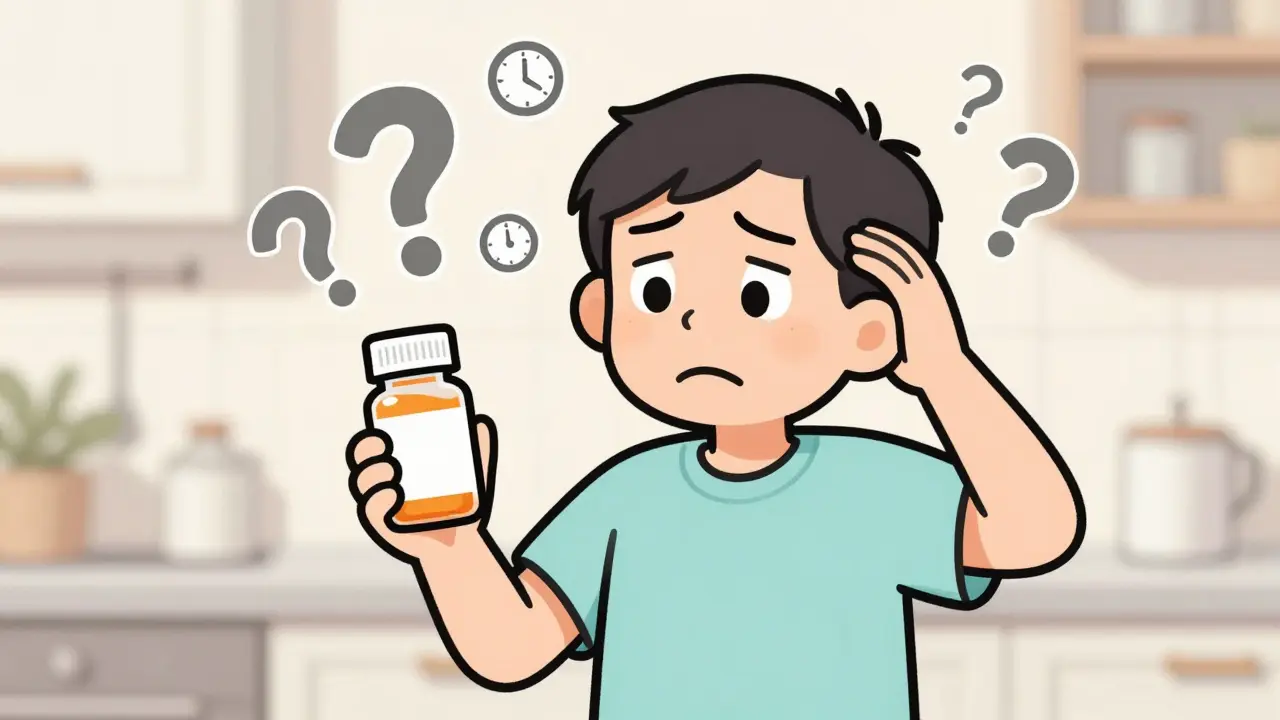
Picture this: You just walked out of the pharmacy. You have a bottle of pills and a small white piece of paper stuck to the front. It says take one tablet by mouth twice daily. Simple enough, right? Now picture yourself at home two weeks later, confused about whether "twice daily" means morning and night, or every twelve hours no matter what. This confusion isn’t just annoying; it is dangerous. Every year, thousands of people end up in the hospital because they misunderstood a label or a dosage instruction.
This confusion points directly to a bigger issue we call Health Literacy. It is defined as the ability to obtain, process, and understand basic health information needed to make appropriate health decisions. In plain English, it is your ability to read a medicine bottle and know exactly what to do. Research shows that less than one-in-five adults in the United States truly understands medical documents well enough to manage complex conditions. If you are reading this, you might be a patient, a caregiver, or someone helping an aging parent. The goal today is simple: give you a safety plan so you never guess wrong about your medicine again.
The Gap Between Doctors and Patients
Why does this happen? Often, doctors and pharmacists write notes using professional jargon that assumes everyone speaks the same language they do. We assume patients understand terms like "q.d." or "prn" without stopping to ask. But the average adult reads at a sixth-grade level, while most medication instructions are written at a tenth-grade level. That is a four-year education gap right there.
A landmark report by the Institute of Medicine back in 2006 established that low health literacy leads directly to medication errors. When a patient cannot read a label clearly, they might take too much, too little, or stop taking it altogether. Think of it like trying to follow a recipe where the ingredients are listed in grams but your measuring cups only show ounces. You get hungry, you get frustrated, and you eventually mess up the dish. With medicine, the mistake doesn’t just ruin the taste; it can stop a heart.
Cracking the Code on Medication Labels
To build a real safety plan, we first need to decode the specific language used on those tiny stickers. The U.S. Pharmacopeia, often called USP, updated its standards in 2023 to require clearer formatting by late 2025. This means you should start seeing better labels soon. However, until every pharmacy updates, here is how you spot the tricks:
- Abbreviations are your enemy. Never trust handwritten notes using Latin abbreviations like "q.i.d." (four times a day) or "b.i.d." (twice a day). Always ask the pharmacist to write out "four times daily" or "every six hours" instead.
- Distinguish “With Food.” Does this mean eat a full meal before? Or just have an apple? For some drugs, food affects absorption completely. Ask specifically: “Do I need a big meal, or just a snack?”
- Volume measurements. Liquid medicines are high-risk. Milliliters (mL) and milligrams (mg) sound similar but measure very different things. One measures space (liquid), the other weighs the drug strength. Always use the spoon or syringe that came with the medicine, not a kitchen teaspoon.
Scheduling Your Meds Like a Pro
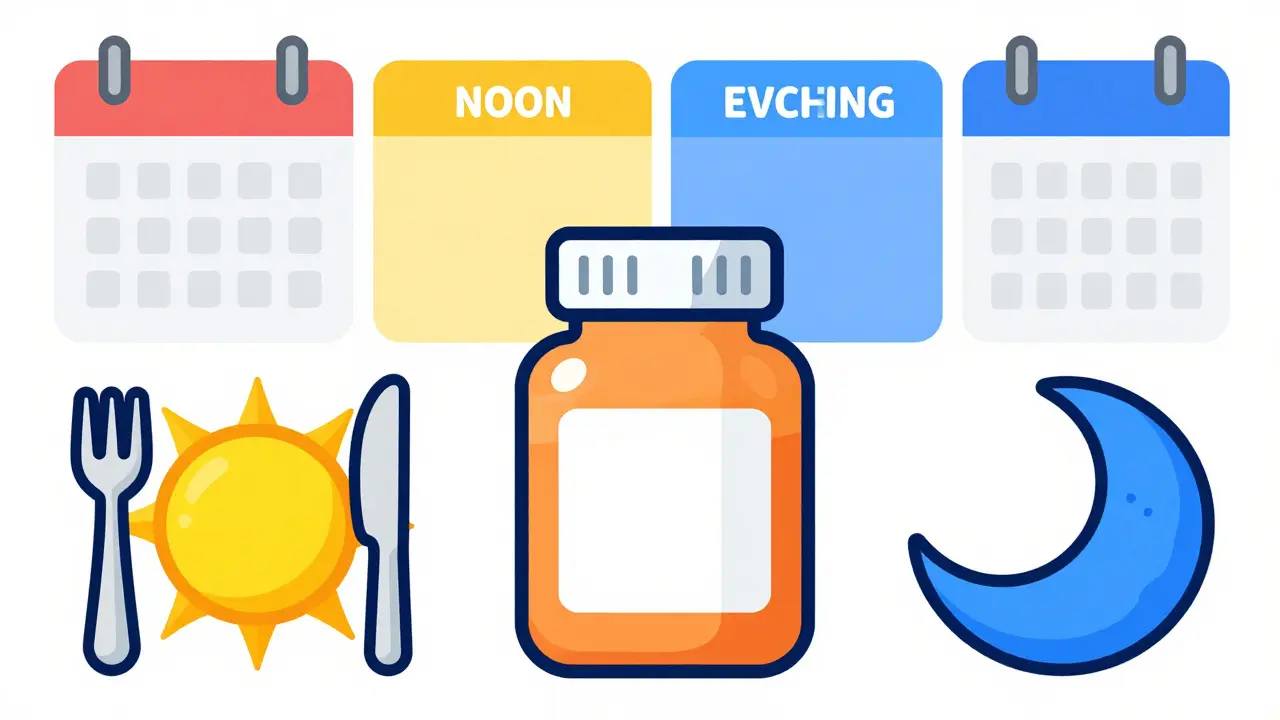
If you take multiple medications, timing becomes even harder. “Every four hours” sounds easy, but when you are asleep, does that mean wake up at 3 AM? This is where the Universal Medication Schedule (UMS) changes everything. Instead of writing “08:00, 14:00, 20:00,” this system aligns doses with natural parts of the day. A study from Wisconsin found that switching to this schedule reduced confusion by nearly half among older adults.
The UMS breaks the day into four clear blocks:
- Morning (between 6 AM and 9 AM)
- Noon (between 10 AM and 1 PM)
- Evening (between 3 PM and 6 PM)
- Bedtime (between 8 PM and 10 PM)
When your label says "Take in the Morning," it fits into that window, regardless of whether you wake up at 6:00 or 8:30. This flexibility is huge for busy families. If you have a pill that strictly requires exact timing, like insulin or antibiotics, the doctor will specify that separately. But for blood pressure pills or vitamins, grouping them into these four buckets prevents missed doses and accidental overdoses.
The Power of Visual Aids
Text alone isn’t always enough. Some people remember images far better than words. Newer research suggests that adding small pictures to labels improves accuracy by almost thirty percent. Imagine a label showing a stomach icon with a fork and knife next to it, meaning "take with food." That is instantly understood across languages and reading levels.
In 2023, the FDA began pushing for standardized icons on prescription bottles. While not every box has them yet, look for these common symbols on your packaging:
- Shaker Bottle Icon: Means shake liquid medicine before pouring.
- Rimmed Cup Icon: Indicates swallowing the tablet whole, do not crush.
- Sun/Moon Icons: Shows daytime vs. bedtime administration.
If you don’t see these visuals, you can create your own. Print a calendar sticker and put X marks on the days you take your meds. Use a red highlighter for critical daily drugs and a blue marker for ones you take only when needed. Making the visual system work for your own eyes helps bridge the gap left by poor labeling.
The Teach-Back Method
This is the single most powerful tool you have in your safety plan. The Institute for Safe Medication Practices (ISMP) recommends asking the provider to explain the plan, and then you repeat it back in your own words. It sounds simple, but it catches mistakes immediately.
Don’t just nod and say, "Yes, I understand." Instead, try saying: "So, I take this blue pill every morning with breakfast, and if I feel dizzy, I skip the dose until tomorrow?" If you got it wrong, the pharmacist can correct you right there. If you didn’t ask and took it the wrong way at home, there is no one to help you.
Why do providers love this? Because it proves the message landed. Studies show that using this method reduces misunderstanding rates by more than 30%. It shifts the relationship from one-way lecturing to a conversation. Even if you are shy, tell the pharmacist, "I just want to make sure I heard you right," and teach-back. They are trained to appreciate this and will not judge you.

Building Your Home Safety Corner
Once you leave the pharmacy, keep your defenses up. A cluttered counter or messy pillbox leads to accidents. Designate a specific spot for your medicines, away from food or cleaning supplies. Keep the original bottles closed tight. Here is a quick checklist to run through before storing anything new:
| Item | Action |
|---|---|
| Expiration Date | Set a reminder on your phone three months before expiry. |
| Appearance | Note the color and shape. If tablets change texture, throw them away. |
| Storage | Keep away from bathroom humidity. Cabinets stay dry; bathrooms get wet. |
| Pillbox | Double-check the weekly container against the bottle before loading. |
Frequently Asked Questions
What is the difference between 'mg' and 'mL' on a label?
Milligrams (mg) measure the weight of the actual medicine powder, while milliliters (mL) measure the volume of liquid. Do not mix these up when giving liquid medicine. Always use the provided measuring cup or syringe to get the correct mL, not a regular kitchen spoon.
Is the Universal Medication Schedule available for all drugs?
It is best for daily maintenance medications like blood pressure or cholesterol pills. It is not suitable for drugs that need precise timing, such as antibiotics that must be taken exactly every 8 hours, or insulin.
How can I check my own health literacy level?
Ask your clinic to administer a test like the Rapid Estimate of Adult Literacy in Medicine (REALM). Alternatively, try reading your own insurance cards or new drug inserts. If you struggle with the words, mark them as needing clarification during your next appointment.
What if I accidentally take the wrong dose?
Call Poison Control immediately at 1-800-222-1222 in the US. Have the bottle in hand when you call. Do not wait for symptoms to appear if you think you took too much, as prevention is faster than cure.
Are digital apps replacing paper labels?
Apps are helpful supplements, but they should never replace physical labels. Apps crash or run out of battery. Keep the paper label on the bottle as your primary guide, and use the app as a reminder or backup.
I actually help my elderly father manage his prescriptions every week. It used to be such a nightmare for him when he would forget what to do. Seeing this breakdown on labels makes so much sense now. I remember how stressed he got whenever we went to the pharmacy counter. The confusion about morning versus night dosing was constant for us too. We often had to wake up in the middle of the sleep cycle just to be safe. That Universal Medication Schedule idea sounds incredibly practical for families like ours. I think visual aids could save lives if more pharmacists adopted them quickly. The part about the teach-back method really resonates with my experience deeply. I tell my dad to repeat instructions back to the pharmacist without hesitation. It feels like the staff appreciate this kind of verification process too honestly. We noticed that mistakes dropped significantly after we started doing this check. I hope everyone here takes note of the distinction between milligrams and milliliters. Getting mixed up on those units can lead to serious harm very quickly indeed. Thank you for sharing this safety plan that helps us stay grounded in reality.
😂 This is SO needed right now!! I hate when doctors write scribbles on papers! 💊 They act like we all speak Greek! I always laugh when I see q.d. written on a label! Seriously who reads that?! 😝 It gives me anxiety just thinking about guessing doses! Thanks for breaking it down tho! 👍👍👍
This is actually common sense really!!!! But people refuse to ask questions......!!! Why is it hard to clarify!!!! Everyone should take responsibility!!!! It is annoying when systems fail because individuals won't engage!!! The USP update is good though!!! Still feels like it should be easier.......
Finally someone wrote down what we already know from living through it.
Why does everything have to be so complicated in our own country?! They make it hard for regular folks!:( My friend took her heart meds wrong and almost died!! You have to fight for clarity sometimes!:( The FDA knows what is happening! They just wait until 2025 to fix things!:( We deserve better now!! Not later!!:)
The text suggests a systemic failure that requires individual remediation. It is frustrating that basic communication relies on patient initiative rather than provider obligation. One wonders why education gaps remain unaddressed by regulatory bodies. The proposed visual aids seem beneficial yet implementation lags behind. Ultimately the burden remains misplaced on the vulnerable population.
USA medicine is safe! 🇺🇸 Just follow the rules! 🛡️ Foreigners cant understand our labels! 😂 Keep it simple for Americans! 💪 Don't listen to bad info!
The shadowy machinations of Big Pharma hide the truth in plain sight! These nebulous dosage instructions are a trap for the unwary masses! They profit from confusion and subsequent medical errors! Visual icons are just a distraction from the real issue of control! We must question the motives behind these standardized schedules! It is a subtle form of behavioral manipulation disguised as safety!
It is fascinating how perception shapes adherence to treatment. The physical act of reading transforms into a mental barrier when literacy diverges from reality. This gap represents a philosophical disconnect between healer and healed. We must bridge this chasm with empathy before technology.
Your emotional outburst is noted but let us focus on progress! Adhering to standard protocols ensures maximum benefit! We must embrace these tools to advance healthcare outcomes positively! Do not let frustration hinder your ability to improve safety! Excellence in medication management starts with clear action now!
The narrative presented ignores the deeper control mechanisms at play. Standardization implies a centralized authority monitoring consumption patterns. Visual aids are merely data collection points for tracking behavior. Trust no official source regarding health protocols blindly. Always verify against independent sources.
You are rite about the scribbles tho! Pharmacist dont care anymore! It shld be easier to read! Stop blaming peopel for reading wrong! The medecine bottle is small and dark! Just give us big fonts please! Thats all we wana hear from u guys!
Oh my god my cousin almost overdosed last month! She cried for three days straight! It is terrifying how close we walk to the edge! Imagine the horror if she hadnt called poison control! You never know what tragedy hides in a bottle cap! Please watch out for each other in these situations!
It seems obvious yet people still struggle. The answer lies within the question itself. Perhaps the problem is human error not design flaws. Whatever the cause it costs us all dearly in the end. Simple solutions are rarely accepted easily.
You must adhere to the principles of rigorous self-verification. Your proactive engagement is mandatory for optimal health results. Implement the teach-back protocol without exception immediately. Failure to comply risks severe complications for your well-being. Success depends entirely on disciplined execution of these guidelines today.