
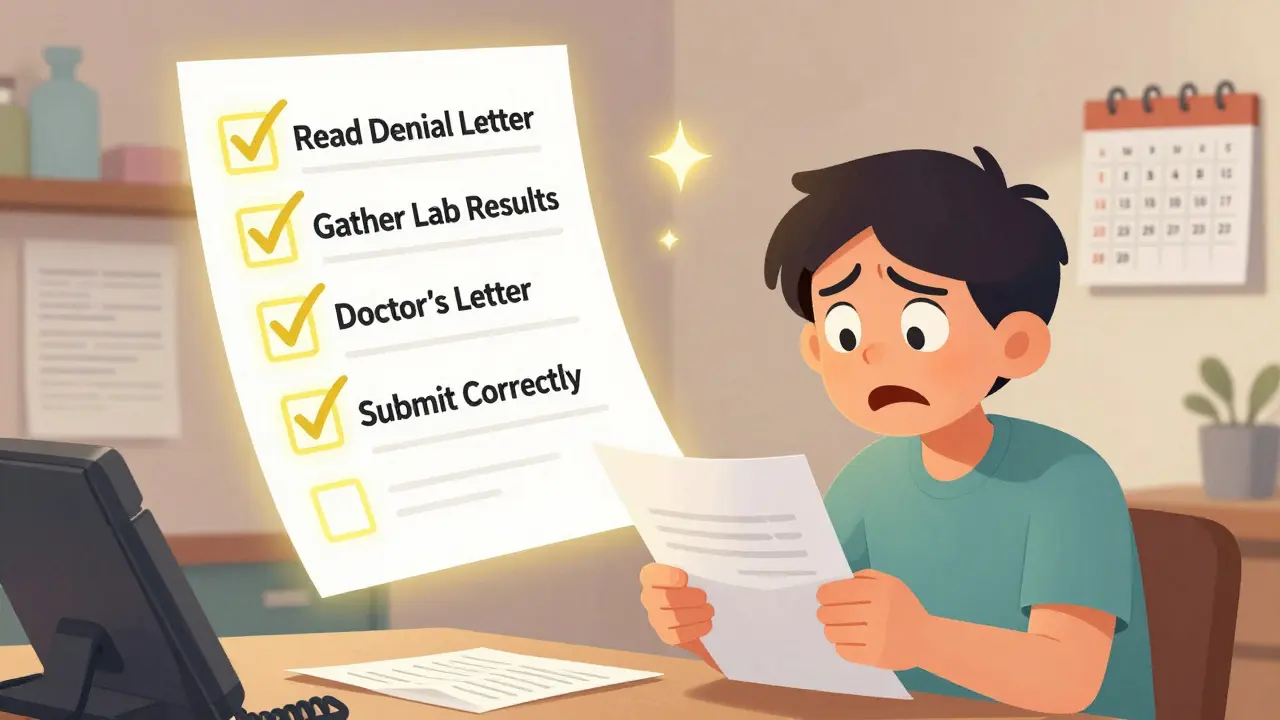
When your doctor prescribes a medication and your insurance says no, it’s not just frustrating-it can be dangerous. You might be staring at a denial letter wondering if you should just give up. But here’s the truth: 82% of prior authorization denials are reversed when you appeal. That’s not luck. That’s a system that’s broken at first glance but fixable if you know how to push back.
Understand Why You Were Denied
The first thing you need to do is read your denial letter. Not skim it. Read it line by line. Most denials fall into three buckets:- Incomplete paperwork (37% of cases): Missing signatures, wrong IDs, or forms not filled out fully.
- Lack of medical necessity (48%): The insurer says your condition doesn’t meet their criteria for this drug.
- Not covered by plan (15%): The drug isn’t on your plan’s formulary at all, or they want you to try something cheaper first.
Gather Every Piece of Medical Evidence
Your appeal isn’t a complaint. It’s a case built on facts. You need to prove your medication is medically necessary. That means collecting:- Your full medical records from the past 12 months
- Lab results, imaging reports, and specialist notes
- A letter from your doctor explaining why this drug is the only option that works for you
- Proof of failed alternatives: If you tried two other drugs and they didn’t work, list them with dates and side effects
Follow Your Insurer’s Exact Process
Every insurance company has its own rules. CVS/Caremark requires appeals to be faxed to 1-888-836-0730 with your full name, ID number, date of birth, and drug name. UnitedHealthcare demands you submit through their online portal. Some require forms you can download from their website. Others accept letters on doctor’s letterhead. Don’t guess. Go to your insurer’s website. Search for “prior authorization appeal process.” Look for the member handbook or provider portal. If you can’t find it, call their member services and ask for the written appeal guidelines. Keep a copy. If you submit the wrong way-say, email instead of fax-they’ll reject it without reviewing the content.Write a Clear, Clinical Appeal Letter
Your appeal letter isn’t a plea. It’s a medical argument. Here’s what it must include:- Your full name, member ID, date of birth
- The name of the medication and the prescribing doctor
- The exact reason for denial (copy it from the letter)
- A point-by-point rebuttal using clinical evidence
- References to the insurer’s own coverage policy
- Doctor’s signature and contact info
Get Your Doctor Involved
This is the single biggest factor in winning an appeal. A letter from your doctor carries far more weight than a patient’s letter. But not all doctor letters are equal. A weak letter says: “Patient needs this drug.” A strong letter says: “Patient has rheumatoid arthritis with inadequate response to methotrexate and adalimumab. CRP elevated at 18 mg/L. Pain score 8/10. Previous trials of etanercept and certolizumab resulted in loss of efficacy and skin reactions. Humira is the only remaining FDA-approved biologic with documented efficacy in this patient profile per ACR guidelines. Denial delays care and risks joint damage.” Keck Medicine’s 2024 analysis found that appeals with direct physician input have a 32% higher success rate. If your doctor refuses to help, ask for a referral to a specialist who will. Sometimes, a rheumatologist or endocrinologist writing on your behalf makes all the difference.Track Everything and Follow Up
Once you submit your appeal, mark your calendar. Insurers have 30 days to respond under federal guidelines-but many take longer. Some don’t respond at all. Keep a log:- Date you submitted
- Method (fax, portal, mail)
- Confirmation number
- Name of person you spoke to
- Next follow-up date
Know Your Next Steps if You’re Still Denied
If your appeal is denied, you’re not out of options. You have two paths:- External Review: You can request an independent third party to review your case. By law, you have 365 days from your final denial to do this. The review is free and binding on the insurer. Healthcare.gov confirms this option is available to all commercial plans.
- State Insurance Commissioner: If your plan is state-regulated (not self-insured), you can file a complaint with your state’s insurance department. In Massachusetts, this process takes 45 days and often forces a reversal.
What to Do If You Can’t Wait
If you’re running out of medication and can’t wait 30-60 days for an appeal, ask your doctor for a 30-day emergency supply. Many insurers allow this if your doctor certifies you’ll be harmed without it. You can also ask your pharmacy if they offer a patient assistance program. Many drugmakers-like AbbVie for Humira or Novo Nordisk for Ozempic-have free or low-cost programs for people who can’t afford their meds.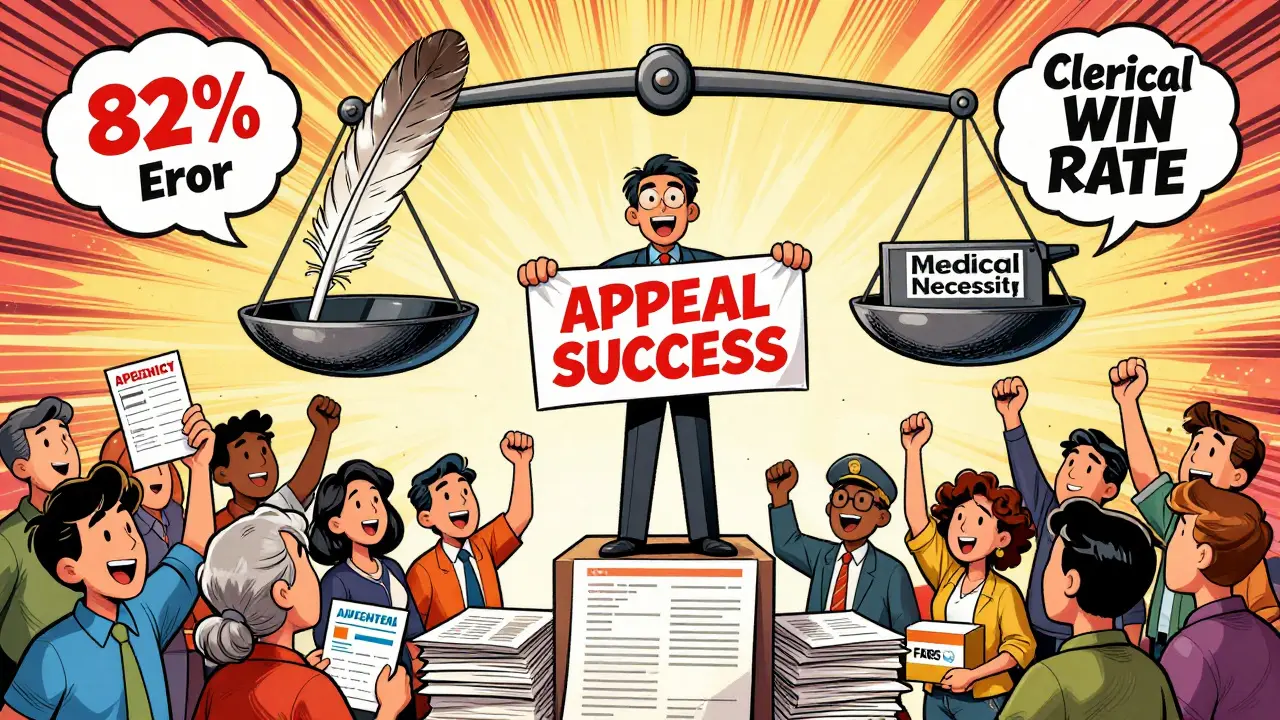
Why So Few People Appeal (And Why You Should)
Only 11% of people appeal a denial-even though 82% win. Why? Because it’s time-consuming. Physicians spend 1-2 days a week just handling prior auths. Patients don’t know where to start. The system is designed to make you give up. But here’s what no one tells you: 41% of initial denials are due to simple administrative errors. A wrong ID number. A missing signature. A form not stamped. These aren’t medical decisions-they’re clerical mistakes. You can fix them. And if you do appeal? You’re not just getting your medication. You’re pushing back on a broken system. The more people appeal, the more insurers have to fix their processes. In 2024, Medicare Advantage plans had to cut prior auth response times from 14 days to 72 hours. That happened because patients and doctors pushed back.Common Mistakes That Kill Your Appeal
- Waiting too long to start. You have 180 days to appeal. Don’t wait until day 179.
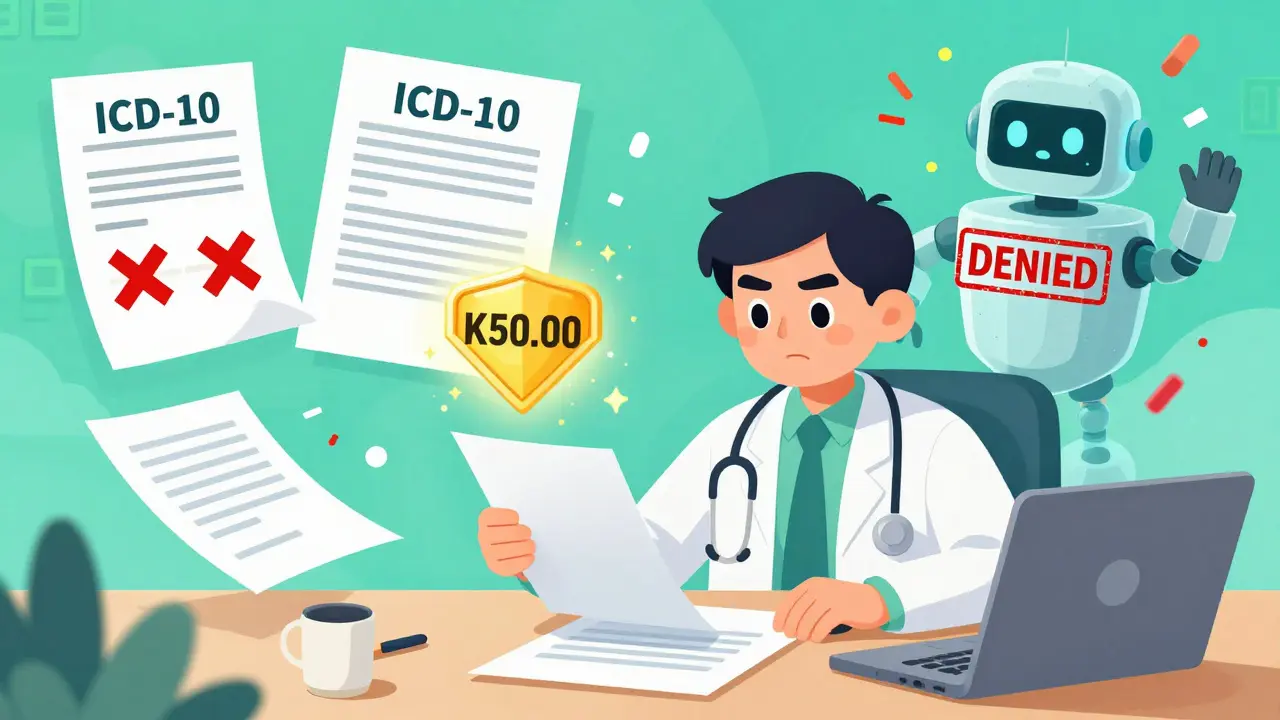
- Not including CPT or ICD-10 codes. 89% of approved appeals include these. Your doctor’s office can give them to you.
- Using emotional language. “I need this to live” won’t help. “I have uncontrolled Type 2 diabetes with HbA1c of 10.2% despite metformin and GLP-1 agonists” will.
- Not following the insurer’s format. Submitting a letter when they require a form = automatic denial.
- Not keeping copies. Always send documents via certified mail or get a submission receipt.
Real Success Story
A patient in Boston, diagnosed with Crohn’s disease, was denied Stelara after two failed biologics. Their first appeal was rejected because they didn’t include the CPT code for the infusion procedure referenced in the denial. They resubmitted with:- A 2-page timeline of failed treatments with dates and lab values
- The exact ICD-10 code for Crohn’s (K50.00)
- A letter from their gastroenterologist citing ACG guidelines
- Proof of prior authorization for the two failed drugs
Final Thought
This isn’t about being stubborn. It’s about being informed. You’re not fighting your insurance company-you’re using the rules they agreed to follow. The system is flawed, but it’s not invincible. You have rights. You have evidence. And you have a better than 8 in 10 chance of winning if you do it right.How long do I have to appeal a prior authorization denial?
You typically have 180 days from the date of the denial letter to file an appeal. This is required by Healthcare.gov for most commercial plans. For Medicare Advantage, the timeline is the same. Always check your plan’s specific rules, but never wait until the last day.
Can I appeal if I’m on Medicare Advantage?
Yes. Medicare Advantage plans are required to follow the same appeal rules as private insurers. In fact, they have a higher appeal success rate-22% higher than commercial plans-according to KFF’s 2024 analysis. You also have the right to request an external review if your appeal is denied.
What if my doctor won’t help me write the appeal letter?
Ask to speak with the office manager or medical records department. They can help you get your medical records and may have templates. You can also request a referral to a specialist who will write the letter. Some patient advocacy groups, like the American Association of Retired Persons (AARP), offer free help with appeals. Don’t take “no” as final-your health is worth pushing for.
Do I need to pay to appeal?
No. All appeals and external reviews are free under federal law. Beware of companies that charge you to file your appeal-they’re not necessary. Your insurer must provide you with the forms and instructions at no cost.
Can I get my medication while waiting for the appeal?
Yes. Ask your doctor for a 30-day emergency supply. Many insurers allow this if your provider confirms you’ll be harmed without the drug. You can also ask your pharmacy about patient assistance programs from the drug manufacturer. Companies like AbbVie, Novo Nordisk, and Eli Lilly offer free or low-cost medications to qualifying patients.
What’s the difference between an appeal and an external review?
An appeal is your first step-your insurer reviews your case again. If they deny it again, you can request an external review by an independent third party, like a doctor not connected to your plan. This review is binding-the insurer must follow it. You have 365 days to request this after your final denial.
Why do insurers deny medications they eventually approve?
Many denials are due to administrative errors, not medical judgment. A missing signature, a wrong code, or a form not filled out correctly can trigger a denial. Even when the drug is clearly needed, the system is designed to slow things down. That’s why 41% of denials are reversed when properly appealed-because the initial denial wasn’t based on medical facts.
Just got my Humira approved after 3 rejections. This post saved my life. Followed every step-got the doctor’s letter with exact lab dates, used the insurer’s form, faxed it with confirmation. Got approved in 9 days. You don’t need to be a superhero. You just need to be meticulous.
I tried this last year after my insulin was denied. Didn’t know about the 82% reversal rate. Thought I was just out of luck. Turns out my denial was because the form had a typo in my middle initial. One corrected fax and it was approved. Why do they make this so hard to figure out
Ugh. People still think this is about ‘medical necessity’? Nah. It’s all about profit margins. They deny everything hoping you’ll give up so they don’t have to pay. The 82% reversal rate? That’s not a win-it’s proof the system is rigged to fail you first.
And yet, the government lets these insurance giants get away with this. It’s not just greed-it’s systemic corruption. They know you’re exhausted, they know you’re scared, and they count on you quitting. But you don’t have to. Fight back. It’s your constitutional right to access care. Don’t let them bully you into silence.
My mom got denied for her RA med last month. I printed this out and helped her go through it. We found the exact CPT code she missed. Submitted it with her doctor’s letter. Approved in 6 days. I didn’t even know these codes existed before. Thanks for the clarity.
For those considering an appeal: this is not a burden. It is an exercise of your rights. The process is designed to be daunting, but it is not insurmountable. Your health is not a commodity. Your voice is not optional. Document everything. Follow the protocol. And if you are met with resistance, escalate with calm precision. You are not asking for a favor. You are enforcing a contract.
As someone who’s helped 12 people appeal denials this year, I can say this: the biggest thing people miss is the doctor’s letter. Not the form. Not the fax. The letter. If your doc just writes ‘patient needs this,’ it’s useless. If they write ‘failed X, Y, Z due to [specific side effect], CRP at [value], per ACR guideline [section],’ you win. Make your doctor do the work. They owe you that.
Thank you for this 🙏 I’ve been through this twice. The second time I followed your steps exactly. Got approved in 5 days. Also found out my drug maker has a free program-got 3 months free meds while waiting. You’re not alone. And yes, it’s exhausting. But you’re worth the fight.
Too much work. I just pay out of pocket now. Cheaper than dealing with all this nonsense.
They’re lying about the 82% success rate. It’s a scam to make you think you have power. Real power? That’s in Washington. These insurance CEOs make millions while you beg for your insulin. They don’t care if you die. They care about quarterly reports. This isn’t healthcare-it’s a financial weapon. And you’re the target.
It is imperative to note that the procedural adherence to the insurer’s stipulated appeal framework is not merely advisable-it is an absolute prerequisite for administrative viability. Failure to comply with the precise submission modality, including but not limited to fax versus portal versus certified mail, constitutes a categorical nullification of the appeal, irrespective of the substantive merit of the clinical justification presented. Therefore, one must engage in exhaustive due diligence prior to submission, ensuring that all identifiers, codes, and documentation conform precisely to the insurer’s published guidelines, as deviations-however minor-will result in immediate and irrevocable rejection without review.
Wait… so if I appeal, they might approve it? But what if they’re secretly tracking who appeals and raising my premiums later? I heard on Reddit that some insurers put ‘appeal flag’ in your file so they can deny you again next year. Is this real?? I’m scared to even try.
They deny it. You appeal. They approve. They raise your premiums. You’re still paying more. The system wins either way. But hey, at least you got your meds. 😏