
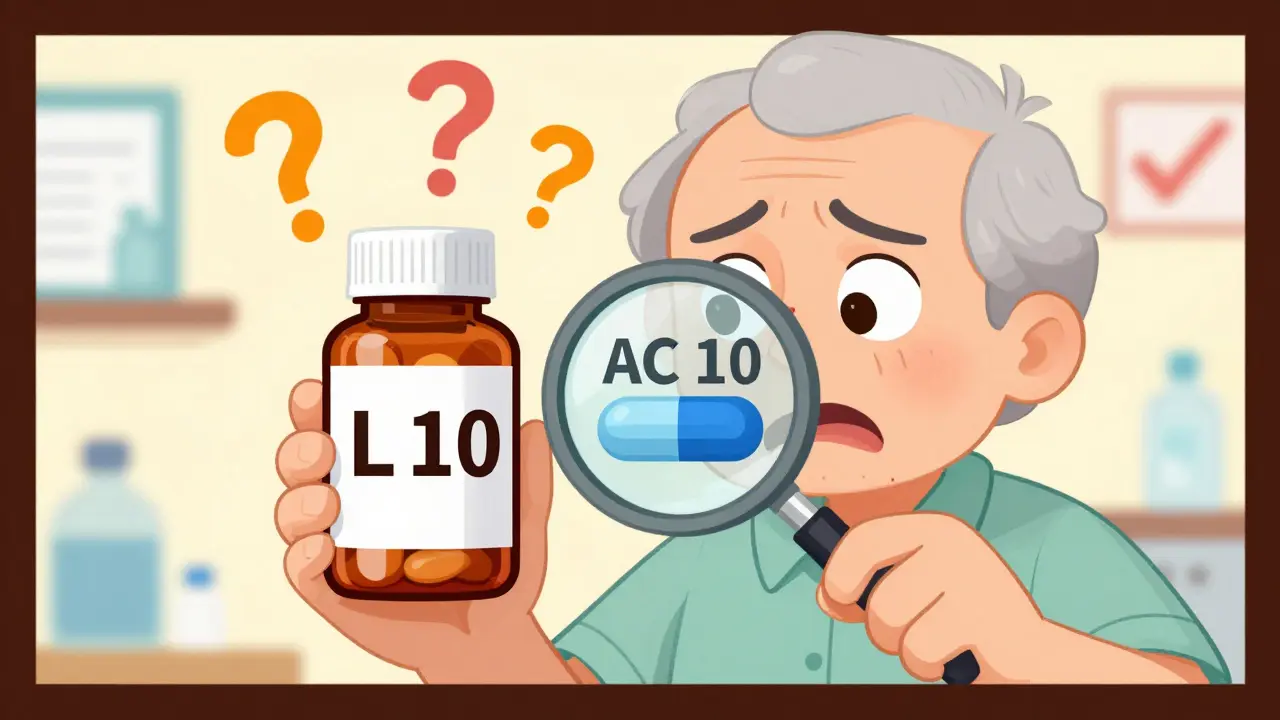
Every time you pick up a refill, your pills might look different. Same medicine. Same dose. But the shape, color, or markings on the pill? Totally changed. That’s not a mistake. It’s generic substitution - and it’s happening in 90% of all prescriptions filled in the U.S. today. The problem? If you don’t check the label, you might think you got the wrong drug. Or worse, you might miss a dangerous change.
Why Your Pills Look Different - And Why It Matters
Generic drugs are cheaper versions of brand-name medicines. They contain the same active ingredient, work the same way, and are held to the same safety standards. But here’s the catch: by law, generic manufacturers can’t copy the look of the brand-name pill. That means your 10mg lisinopril from last month might have been a small white oval with "L 10" stamped on it. This month? A large blue capsule with "AC 10" printed on it. That’s not a problem - unless you don’t know what you’re looking at. For most people, this switch is harmless. But for those taking medications with a narrow therapeutic index - like blood thinners (warfarin), seizure drugs (phenytoin), or thyroid medicine (levothyroxine) - even tiny differences in how the body absorbs the drug can cause serious side effects. The FDA allows these variations because the active ingredient is identical. But experts like Dr. Jerry Avorn from Harvard Medical School warn that for some patients, those small differences matter.What to Check on Every New Prescription Label
Don’t just grab the bottle and go. Take five seconds. Compare the new label to your old one. Here’s what to look for:- Patient name - Make sure it’s yours. Mix-ups happen, especially in busy pharmacies.
- Medication name - Look for both the brand name (like "Lipitor") and the generic name ("atorvastatin"). Both should match your old label.
- Dosage strength - Is it still 10mg? 500mg? 25mcg? Don’t assume. Write it down if you need to.
- Manufacturer - Check the "Mfg:" line. If it says "ACCORD HEALTHCARE" now but used to say "TEVA", that’s normal. But if you’re on a narrow-therapeutic-index drug, note the change. You might want to stick with one manufacturer.
- Rx number - This is unique to your prescription. It helps the pharmacy track your refills. If it’s completely different from last time, ask why.
- Refills remaining - Is it still "2 refills left"? Or did it reset to "4"? That could mean your doctor changed the prescription.
- Directions - "Take one by mouth daily"? Or "Take one twice daily"? Even small wording changes can mean big risks.
- Prescriber and date - Confirm your doctor’s name is still there and the date matches when you last saw them.
What to Do When the Pill Looks Completely Different
You open the bottle. The pill is a different color. Bigger. Smaller. No imprint. Or maybe it’s a liquid now instead of a tablet. That’s not normal - unless you’ve been switched to a different formulation. First, don’t panic. Second, don’t guess. Use the Drugs.com Pill Identifier. It’s free. Just enter the shape, color, and any letters or numbers on the pill. The tool will show you what it is - and if it matches your prescription. You can also search by the drug name and dosage. If the identifier doesn’t match, or you’re still unsure, call your pharmacy. Ask: "Is this the same medication I got last time?" Then ask: "Is this the same manufacturer?" Pharmacists are trained to catch these changes. They’ve seen hundreds of pill variations. They can tell you if it’s safe, or if you need to talk to your doctor.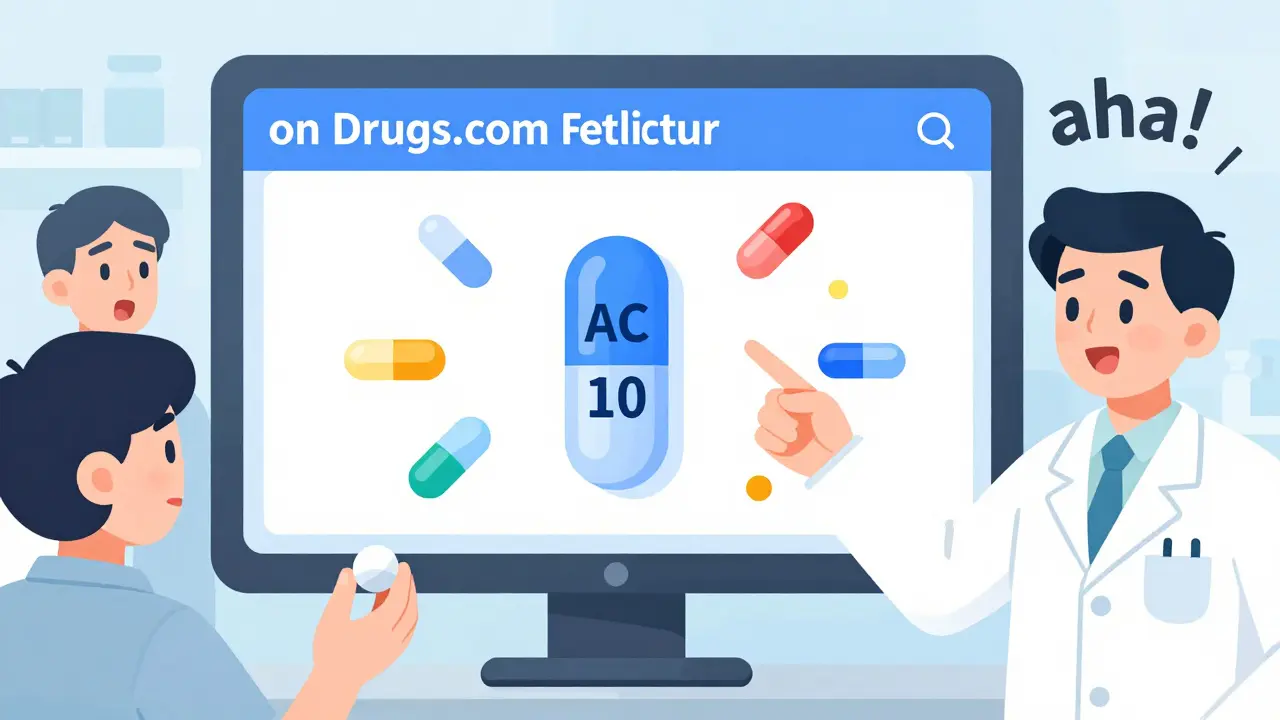
Red Flags That Mean STOP - And Call Your Doctor
Some changes aren’t normal. They’re dangerous. Watch for these:- Different active ingredient - Your old label said "atorvastatin". The new one says "rosuvastatin". These are different drugs. One lowers cholesterol. The other is stronger and has different side effects.
- "Brand substitution not permitted" - If your doctor wrote this on the prescription, the pharmacy is not allowed to switch you to a generic. If you get a generic anyway, it’s a violation.
- Dosage changed without your doctor’s knowledge - You’ve been on 5mg for two years. Now it’s 10mg. No call from your doctor? That’s a red flag.
- Two different pills in the same bottle - This has happened. Someone mixed up bottles. Always check the count. If you were supposed to get 30 pills and there are 60? Don’t take any. Call immediately.
- Missing refill authorization - Your last bottle said "2 refills left." This one says "0." Did your doctor stop the script? Or did the pharmacy make a mistake?
How to Make Comparison Easier - Long-Term Tips
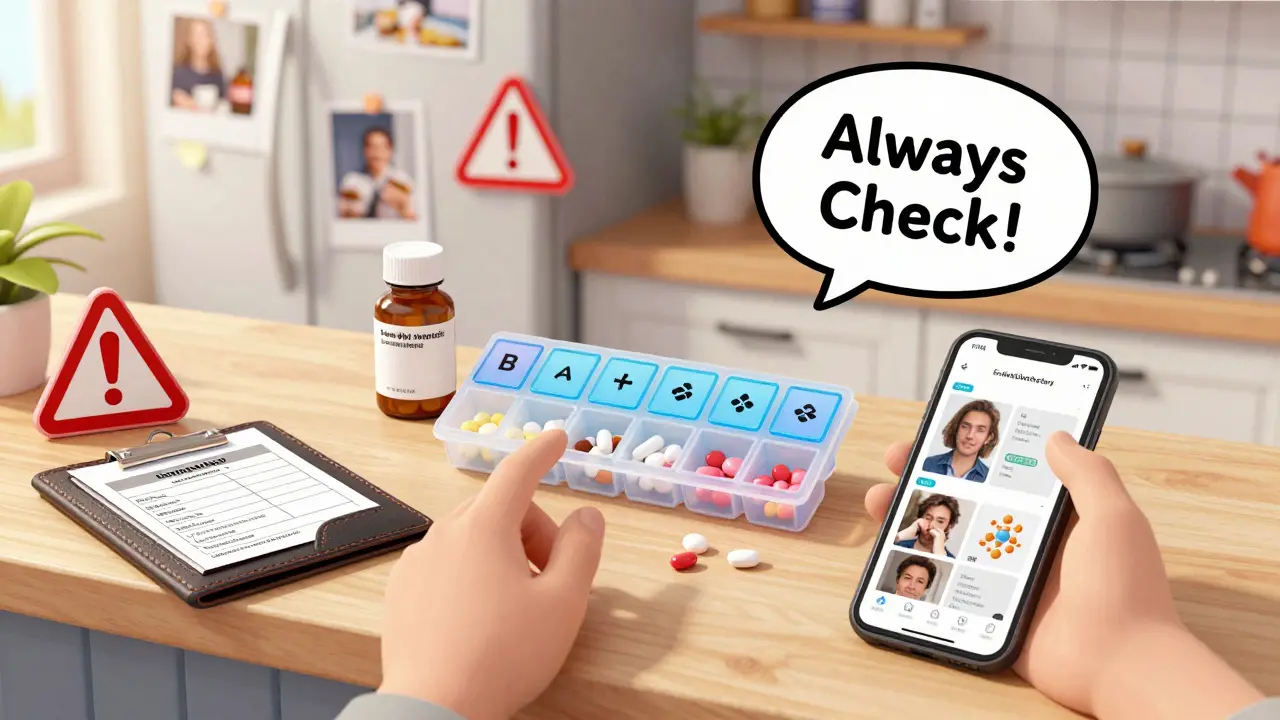
You don’t have to memorize every pill. Here’s how to build a system that keeps you safe:- Take a photo of each new bottle - Front label, pill shape, imprint. Store them in your phone. When the next refill comes, compare side-by-side.
- Use a pill organizer with compartments - Don’t dump all your pills into one container. Keep them in separate slots labeled with the drug name and time of day.
- Ask for a printed medication list - When you see your doctor, ask them to give you a list of every drug you take - name, dose, purpose, and how often. Keep it in your wallet.
- Know your high-risk drugs - If you take warfarin, digoxin, levothyroxine, or seizure meds, tell your pharmacist you want to stay on the same generic manufacturer if possible.
- Use electronic prescriptions - Over 85% of prescriptions are now sent electronically. They’re far less likely to have errors than handwritten ones. Ask your doctor to send them directly to the pharmacy.
Why This Matters More Than You Think
The Institute of Medicine estimates that 1.5 million preventable medication errors happen every year in the U.S. - and poor labeling is a major reason. Most of these aren’t from doctors or pharmacists making mistakes. They’re from patients not knowing what’s in their hand. A 2022 survey found that 42% of adults over 65 rely on the color or shape of a pill to know what they’re taking. If that changes, they might skip a dose - or take two by accident. You don’t need to be a pharmacist to protect yourself. You just need to be curious. A little attention saves lives.What to Do If You Find a Mistake
You spot something wrong. The name is off. The dose is wrong. The pill looks nothing like before. Don’t take it. Don’t throw it out. Don’t wait. Call the pharmacy immediately. Say: "I think there’s an error on my prescription. Can you confirm the medication and dosage?" If they dismiss you, call your doctor. If you still feel unsure, go to another pharmacy and ask them to verify the prescription against your records. Medication errors are preventable. But only if you speak up.Why do my pills look different every time I refill my prescription?
Because most prescriptions are filled with generic drugs, and by law, generic manufacturers can’t copy the shape, color, or size of brand-name pills. Each company makes their version differently - so your 10mg lisinopril might be white and oval one time, then blue and round the next. The active ingredient is the same, but the appearance changes.
Is it safe to switch between different generic manufacturers?
For most medications, yes. But for drugs with a narrow therapeutic index - like blood thinners, seizure meds, or thyroid hormones - even small differences in how the body absorbs the drug can affect your health. If you’re on one of these, ask your pharmacist if you can stick with the same generic brand each time.
How can I tell if a pill is the right one if I don’t know what it looks like?
Use the free Pill Identifier tool on Drugs.com. Enter the shape, color, and any letters or numbers on the pill. It will match it to the correct medication. You can also take a photo of the pill and show it to your pharmacist.
What should I do if the dosage on my new label is different?
Don’t take it. Call your pharmacy and ask if they changed the dosage. If they didn’t, contact your doctor. A change in dosage without your doctor’s approval is a serious error that needs to be corrected immediately.
Can a pharmacy give me a brand-name drug when I asked for a generic?
Only if your doctor wrote "dispense as written" or "brand substitution not permitted" on the prescription. Otherwise, pharmacies are required to substitute generics unless you specifically ask for the brand. Always check the label to confirm which one you got.
Why do some prescriptions have Latin abbreviations on them?
Handwritten prescriptions often still use Latin abbreviations like "q.d." (once daily) or "b.i.d." (twice daily). These can be misread, which is why over 60% of handwritten prescriptions contain errors. Electronic prescriptions, which make up 85% of all prescriptions now, almost never use Latin - they use plain English like "take once daily." Ask your doctor to use electronic prescribing.
I used to panic every time my pills looked different, especially after switching from brand to generic. Now I just snap a pic of the label and keep it in my phone. Saved my ass more than once when the color changed but the imprint stayed the same. Don’t overthink it - just check the name, dose, and manufacturer. Easy.
Wow, you’re telling people to take photos of their pill bottles like they’re some kind of pharmacy detective? Newsflash - most people don’t care. They just swallow what’s handed to them and pray. You think your little photo album is going to stop Big Pharma from swapping generics? Please. The system is rigged. You’re just doing damage control.
It is imperative to underscore the pharmacological significance of bioequivalence thresholds in generic substitution protocols. The FDA's allowance of ±20% variability in AUC and Cmax parameters for narrow therapeutic index agents constitutes a clinically significant deviation when cumulative exposure is unmonitored. Patients on warfarin or levothyroxine must be counselled regarding inter-manufacturer pharmacokinetic heterogeneity, which is frequently underappreciated in primary care settings. Documentation of manufacturer identity is not merely advisable - it is a medico-legal imperative.
My grandma used to mix up her pills because she remembered them by color - blue for blood pressure, white for heart, etc. Then one day the blue pill turned green. She skipped her dose for a week. Ended up in the ER. Now I print out a little card for her with the pill names, doses, and a tiny sketch of what each one looks like. It’s dumb, but it works. Simple stuff saves lives. Also, I take pics of every bottle too. It’s like a pill diary.
Oh good, another American self-help guide on how to not die because your country outsources medicine to the lowest bidder. You know what’s worse than a different-colored pill? Paying $400 for a brand-name drug when the generic costs $4. But sure, let’s all become pill-identification experts so Big Pharma can keep making billions while we’re too busy checking imprints to complain.
Yesss. This. I literally just had a pharmacist say, "Oh, this is just a different generic" - and I said, "Is it Accord or Teva?" She paused. Then said, "...why does that matter?" I stared. I just stared. Because it matters. It matters when your thyroid meds switch from one maker to another and suddenly you’re exhausted and gaining weight. It matters. I don’t care if it’s "technically" the same. Biology isn’t a spreadsheet.
There is a fundamental flaw in the premise of this article: the assumption that patients are capable of or responsible for verifying medication changes. The burden of safety should rest with the prescriber and the pharmacy, not the layperson. The fact that this is even a conversation indicates systemic failure - not patient negligence. Furthermore, the Drugs.com tool is unreliable for pills with no imprint, which are increasingly common. This guide is a band-aid on a hemorrhage.
Consider the nature of trust in modern healthcare: we are asked to ingest substances whose appearance is deliberately obscured by commercial regulation, while being exhorted to become vigilant forensic analysts of our own pharmacology. This is not empowerment - it is the commodification of vigilance. The patient becomes the last line of defense against a system designed for efficiency, not safety. Perhaps the question is not how to identify the pill - but why we are forced to. The answer lies not in our attention, but in the architecture of pharmaceutical policy.