
Running out of your medication halfway through a trip isn’t just inconvenient-it can be dangerous. For millions of travelers managing chronic conditions like high blood pressure, diabetes, anxiety, or ADHD, a missed dose can mean hospitalization, severe symptoms, or even legal trouble. The good news? With the right planning, you can avoid all of it. The bad news? Rules vary wildly from country to country, and what’s legal in the U.S. might get you arrested abroad.
Know What’s Allowed Where
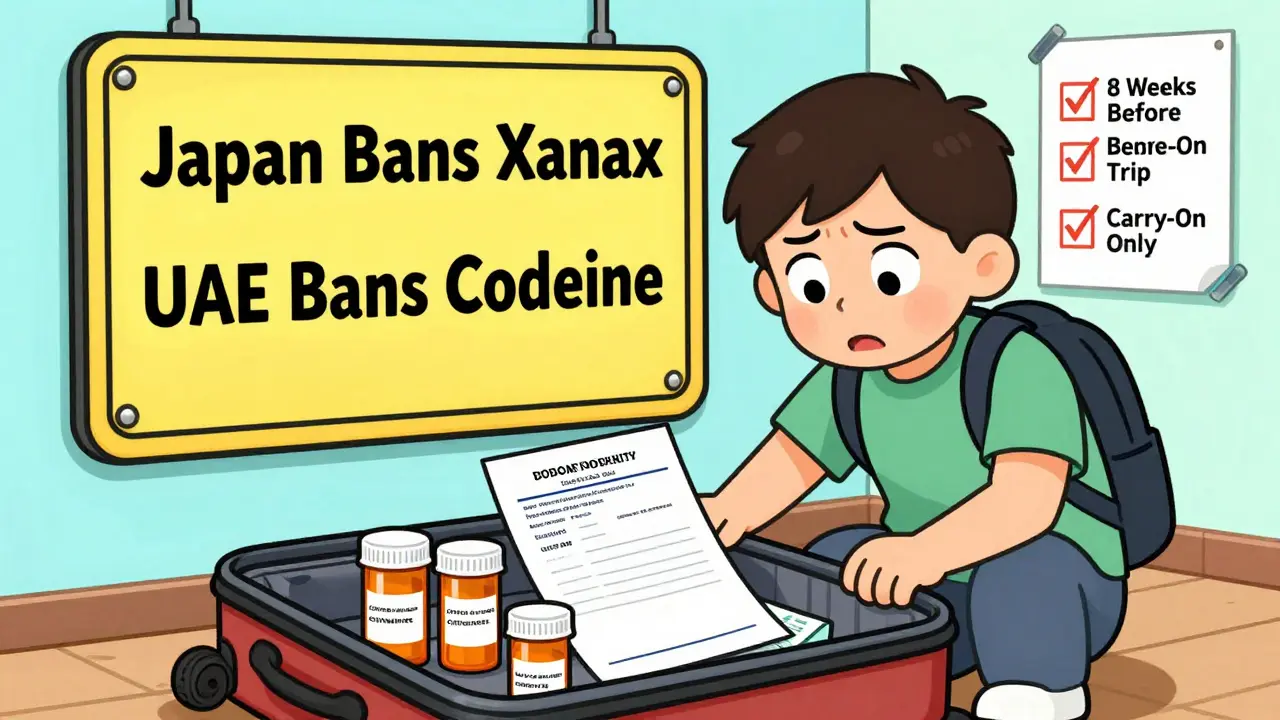
Before you pack your suitcase, check if your medications are even legal in your destination. This isn’t a suggestion-it’s a requirement. Countries like Japan, the UAE, and Thailand have strict lists of banned substances, and many of them include common U.S. prescriptions.For example, alprazolam (Xanax) is illegal in Japan without special permission. Codeine-containing cough syrups are banned in the UAE and can lead to a five-year prison sentence. Even pseudoephedrine, found in cold medicines like Sudafed, is prohibited in Japan and restricted in several European countries. And if you’re taking ADHD meds like Adderall or Vyvanse? You’re in a gray zone-some countries allow them with a doctor’s note, others ban them entirely.
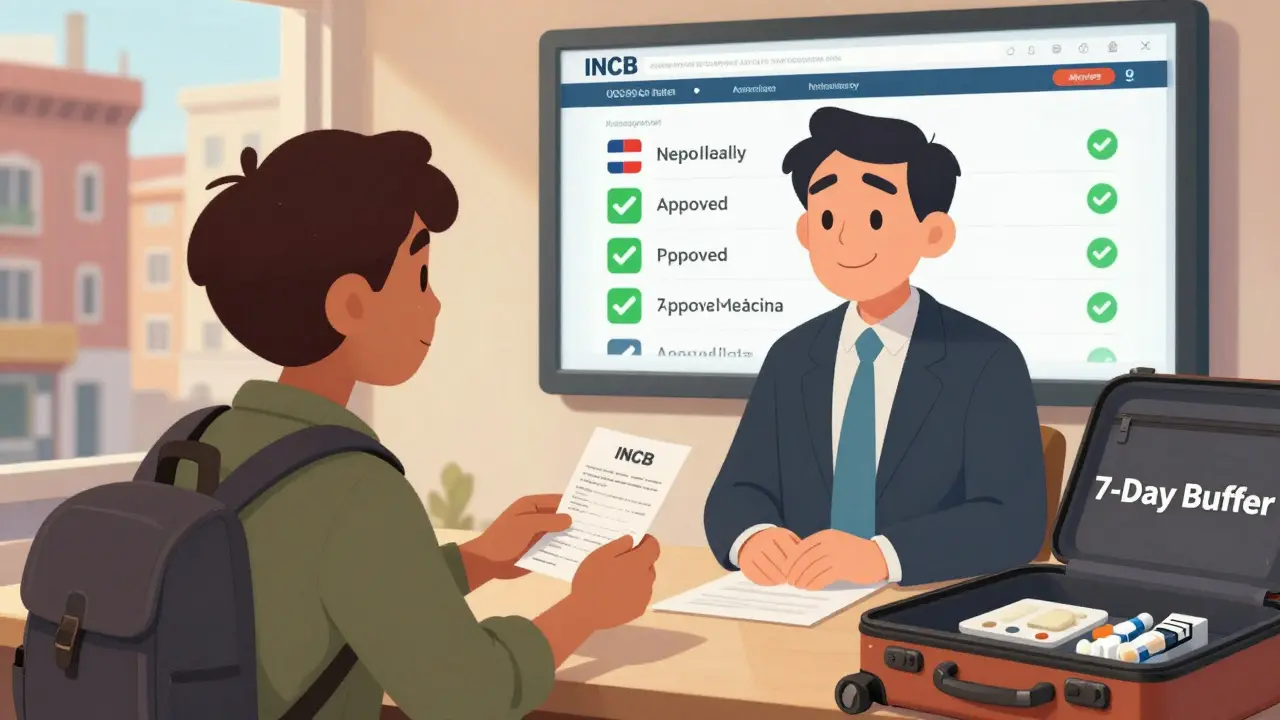
The International Narcotics Control Board (INCB) maintains a free, up-to-date database of country-specific medication rules. Go to their website and search for your destination. Don’t rely on Google or travel blogs-those can be outdated. The INCB database was updated in January 2025 and now includes direct embassy contacts for 87 countries. If your country isn’t listed, don’t guess. Call the embassy directly.
Start Early-At Least 8 Weeks Before
Getting your meds ready isn’t a last-minute task. Some countries require official paperwork, translations, or permits that take weeks to process. The CDC and the International Society of Travel Medicine both recommend starting at least 8 to 12 weeks before departure.Here’s what to do:
- Make a full list of every medication you take-brand name, generic name, dosage, frequency, and reason for use. Include vitamins, supplements, and over-the-counter drugs.
- Call your doctor and ask them to write a letter on official letterhead. The letter should confirm your diagnosis, list your medications, and state the dosage you need for your trip. Include the generic names-some countries don’t recognize brand names.
- Ask for an International Certificate for Medicinal Products (ICMP). About 68% of U.S. pharmacies can provide this. It’s a standardized document that helps customs officials understand your meds. It costs $25-$40 per prescription.
- Contact the embassy of your destination country. Ask: “What documentation is required for [medication name]?” Get their response in writing via email.
Don’t skip step two. In 2024, 63% of travelers who had issues in Asia didn’t have a doctor’s letter. One traveler was held for four hours at Bangkok Airport just because they didn’t have a signed note for their anxiety medication.
Bring Enough-Plus a Buffer
The U.S. Customs and Border Protection (CBP) says you can bring no more than a 90-day supply for personal use. But here’s the catch: what if your trip is 100 days? Or your flight gets delayed? Or you lose your bag?Always bring enough for your entire trip plus at least 7 extra days. If you’re going for 14 days, bring 21 days’ worth. If you’re going for 6 months, bring 7 months. Pharmacies in other countries may not carry your exact brand or dosage. In Germany, a 10mg tablet of your medication might be sold as a 5mg tablet-making it hard to match your dose without a doctor’s guidance.
Don’t try to refill abroad unless you’ve confirmed it’s legal and available. Many travelers assume pharmacies everywhere are the same. They’re not. In Thailand, you can’t buy ADHD meds without a local prescription-even if you have a U.S. one.
Pack Smart-Never Check Your Meds
Always carry your medications in your carry-on. Checked luggage can be lost, delayed, or stolen. If you need insulin, EpiPens, or needles, you need them with you at all times.Here’s how to pack:
- Keep everything in original prescription bottles. Even if you’re not in the U.S., this is your best protection. Some states (California, New York, Texas, Florida, Illinois) legally require this for controlled substances-even on domestic flights.
- Bring a copy of your doctor’s letter and ICMP in your carry-on, separate from your meds.
- If you have liquid meds (like insulin or liquid painkillers), declare them at TSA security. You’re allowed more than 3.4 ounces if they’re medically necessary. Just say, “These are for my medical condition.”
- Don’t put pills in pill organizers unless you also carry the original bottles. TSA and foreign customs don’t recognize unlabeled pills.
Delta Air Lines reported a 37% increase in medication-related calls from 2024 to 2025. The top three issues? Liquid limits, needles, and lack of documentation. You can avoid all three with simple prep.
Watch Out for Transit Countries
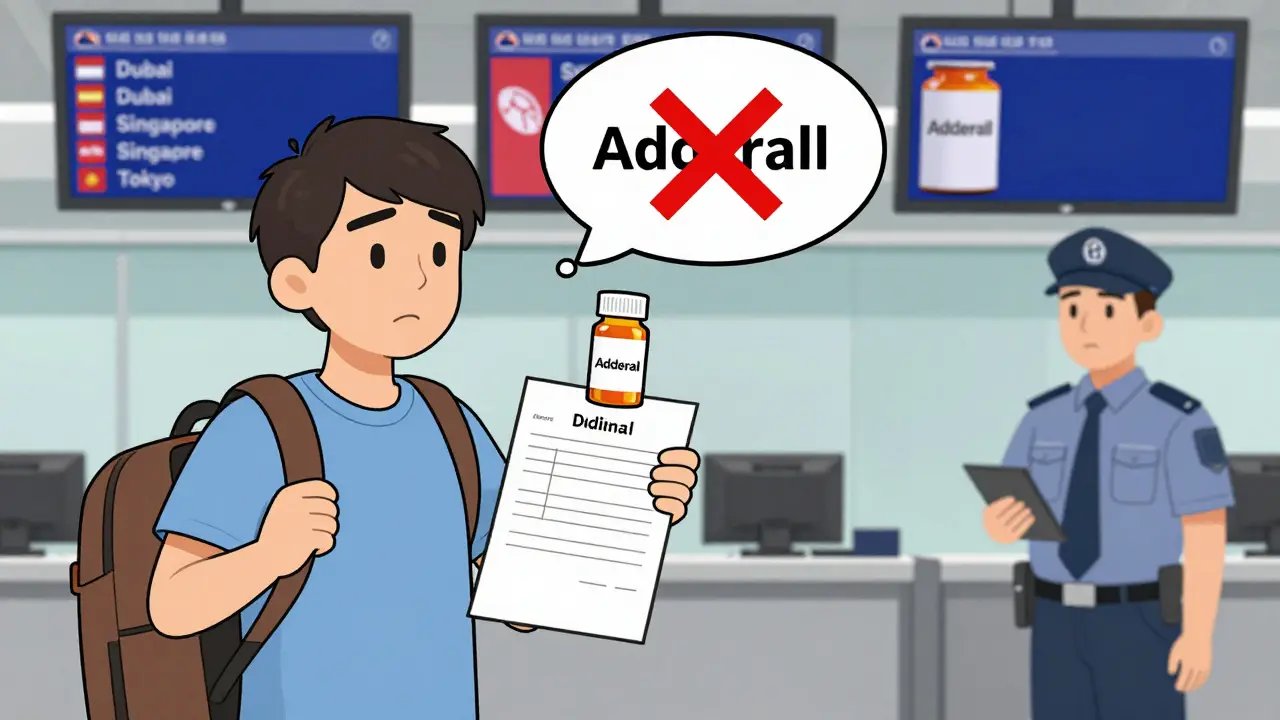
If you’re flying through Dubai, Singapore, or Tokyo on your way to your final destination, you’re subject to those countries’ rules too-even if you don’t leave the airport.One traveler was detained in Dubai for carrying codeine in their checked bag, even though their final destination was Kenya. They had no idea Dubai banned it. Another was stopped in Singapore for carrying melatonin, which is illegal there.
Check the rules for every country on your route. Use the INCB database for transit points too. Don’t assume your final destination’s rules apply everywhere you pass through.
What About CBD and Cannabis Products?
Even if you’re using CBD oil legally in your state, it’s not legal everywhere. In 2024, 19 countries-including South Korea, Malaysia, and Japan-banned all CBD products, even those with zero THC.The U.S. federal government allows CBD, but international borders don’t care. If you bring CBD into a country where it’s banned, you could face fines, detention, or worse. Leave it at home.
What If You Get Stopped?
If you’re questioned by customs:- Stay calm. Don’t argue.
- Hand over your doctor’s letter, original bottles, and any permits.
- Don’t say, “It’s just for anxiety.” Say, “This is my prescribed medication for [condition]. Here’s the letter from my doctor.”
- If they confiscate your meds, ask for a receipt. Contact the nearest U.S. embassy immediately.
The U.S. State Department’s 2024 Travel Warning Database recorded 72 cases of travelers detained for medication violations. In most cases, the person had the right paperwork but didn’t present it clearly. Preparation saves you from panic.
Resources to Keep Handy
- INCB Country Regulations Database - Free, official, updated January 2025.- CDC Yellow Book - Updated annually. Covers medication risks by region.
- U.S. State Department Travel Advisories - Check the “Health” section for each country.
- MedPassport - A digital tool that stores your meds, prescriptions, and embassy contacts. Costs $49/year.
- INCB Emergency Line - +41 22 917 92 92 (24/7, English available).
- Delta Accessibility Line - 404-209-3434 (for questions about flying with meds).
Don’t wait until the airport to figure this out. The system is complex, but it’s not impossible. Thousands of people travel with chronic conditions every year without incident. They just planned ahead.
This guide is solid but I’ve seen too many people ignore the embassy step. You don’t get a second chance when customs confiscates your meds. Do the work before you pack.
Key point missed in most blogs: the ICMP isn’t just paperwork-it’s a legal artifact under the Single Convention on Narcotic Drugs. Pharmacies that don’t issue it are either unaware or cutting corners. Always request it in writing and keep a PDF backup.
Why do Americans think every country plays by our rules? If you’re taking Adderall overseas, you’re gambling with your freedom. Stop acting entitled.
Let’s be real-this whole system is a bureaucratic farce. The INCB database is outdated for 30% of African nations, and the CDC Yellow Book hasn’t been properly updated since 2022. You’re being told to trust institutions that are actively failing you.
And don’t get me started on Delta’s ‘Accessibility Line.’ That’s a PR stunt, not a solution. If you need insulin, you’re still at the mercy of a gate agent’s mood.
Meanwhile, Big Pharma lobbies to keep these rules convoluted so they can control distribution. It’s not about safety-it’s about control.
I’m diabetic and this saved me last year when I flew to Japan. I had my letter, original bottles, and the ICMP. At Narita, they asked me three questions and waved me through. It’s not scary if you’re prepared.
Also, bring a printed copy of the INCB page for your meds. I showed mine to the officer-he’d never seen it before but appreciated that I’d done the homework.
Don’t overthink it. Just do the steps. You’ve got this.
As someone who’s lived in 7 countries, I can tell you: the real issue isn’t the rules-it’s the attitude. Americans assume everyone speaks English and understands our healthcare system. They don’t. A doctor’s letter in English is useless if it’s not translated.
I always get my meds letter translated into the local language by a certified translator before I go. Costs $40 but worth it. One time in Thailand, the pharmacist didn’t speak English, but the translation made him trust me immediately.
Also, carry a small card with your condition and meds in the local language. It’s a tiny thing that prevents hours of stress.
Why are we even doing this? Why can’t we just have one global system? Why do I need 17 documents to carry my antidepressants? This is ridiculous. They’re not drugs, they’re medicine. It’s like needing a permit to breathe.
And who made the INCB the boss of my body? I’m not a criminal. I’m just trying to survive.
Also, CBD is literally plant water. Why is it banned everywhere? This is witchcraft.
While the guidance provided is generally sound, one must acknowledge the structural inequities inherent in the current regulatory framework. The burden of compliance disproportionately falls upon the individual, despite the fact that international pharmaceutical policy is shaped by transnational institutions beyond the reach of the average traveler.
Furthermore, the reliance on embassy contacts-while prudent-is predicated on the assumption of accessible, responsive diplomatic infrastructure, which is not universally guaranteed.
One must also consider the psychological toll of such meticulous preparation, particularly for those with anxiety disorders, who are precisely the demographic most in need of consistent pharmacological support.
OMG I JUST GOT BACK FROM THAILAND AND THEY TOOK MY VYVANSE I WAS CRYING IN THE AIRPORT I DIDNT KNOW IT WAS ILLEGAL I JUST THOUGHT IT WAS A COUGH SYRUP THING
As an Indian traveler, I’ve had to carry my anxiety meds through Dubai, Singapore, and even Nepal. The trick? Always keep the prescription bottle with your name on it, and never, ever put anything in a pill organizer. Once in Singapore, they almost stopped me because my pills were in a plastic bag. I showed the original bottle and they let me go. Don’t make my mistake.
Also, Indian pharmacies sometimes carry generic versions of U.S. meds. But don’t refill unless you’ve confirmed the active ingredient matches. I once got a different salt form and it messed up my whole week.
While the author’s recommendations are, on the surface, pragmatic, they implicitly endorse a neoliberal model of personal responsibility that absolves systemic actors-pharmaceutical conglomerates, international regulatory bodies, and state-sponsored border regimes-of any accountability for the absurd, life-threatening bureaucratic labyrinth that travelers are forced to navigate.
Moreover, the suggestion to ‘call the embassy’ presumes a functional, non-corrupt, and linguistically competent diplomatic apparatus-a fantasy in many of the very countries referenced.
And why, pray tell, is the ‘MedPass’ service being promoted? Is this a covert affiliate scheme? The tone here is dangerously close to corporate wellness propaganda.
Just wanted to add: if you’re flying with needles, bring a note that says ‘insulin’ or ‘epinephrine’ in big letters. TSA agents don’t know what an EpiPen looks like half the time. I once had one ask if it was ‘for weight loss.’ I laughed so hard I almost cried.
Also, don’t forget to pack a small cooler with ice packs if you need refrigerated meds. Some airports have free ones at security if you ask.
Let’s be honest-the real problem is that the U.S. doesn’t regulate drug prices or availability domestically, so people end up needing to fly with 6 months’ supply just to afford it. The system is broken, and now we’re expected to be diplomats for our own prescriptions.
And yes, I’ve been stopped in Ireland with my Adderall. They asked if I’d ‘traded it for weed.’ I said, ‘No, I traded it for my ability to work.’ They let me through. But only because I didn’t flinch.
Did you know the INCB is secretly controlled by the WHO, which is funded by the Gates Foundation, which is tied to Big Pharma? They’re not protecting you-they’re controlling supply chains. That’s why they make it so hard to carry meds abroad. So you have to buy from their approved pharmacies.
And why does Delta have a ‘med line’? Because they’re in on it. They want you to panic so you pay for their ‘premium medical travel insurance.’
Leave your meds at home. Or better yet-don’t travel. It’s safer.
It's a known fact that the U.S. government has been quietly collaborating with foreign customs agencies to monitor the movement of psychotropic substances under the guise of 'public safety'-but what they're really doing is building a pharmacological surveillance network. The ICMP? It's a tracking chip in paper form. Your doctor's letter? It's a digital fingerprint.
And why is CBD banned everywhere? Because it competes with FDA-approved synthetic cannabinoids. The system is rigged. You're not supposed to know this.
That’s exactly why I told my doctor to write the letter in both English and Spanish-I was going through Mexico. They didn’t ask for it, but I had it ready. Always be one step ahead.