
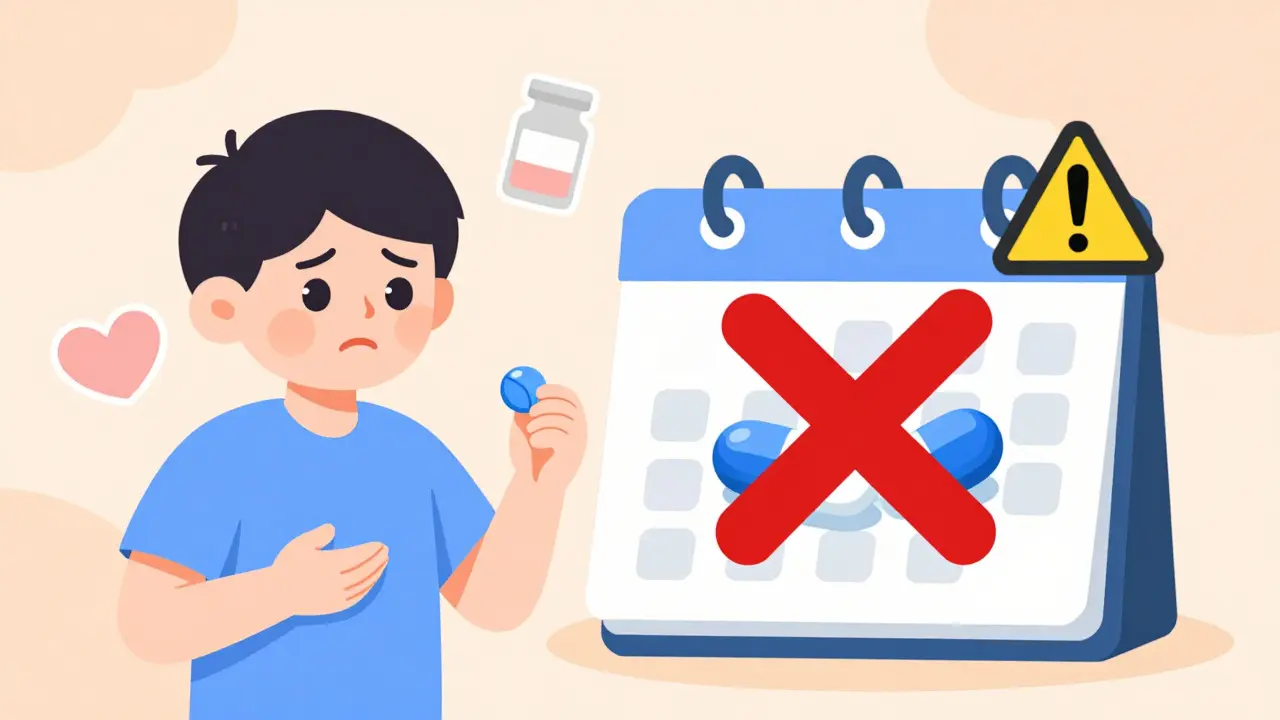
Missing a pill happens. Maybe you were rushed in the morning. Or you traveled across time zones. Or you just forgot. But here’s the thing: never double up to make up for it. That’s not just a suggestion-it’s a safety rule backed by hospitals, pharmacists, and government health agencies. Taking two doses at once can land you in the ER, especially if you’re on blood thinners, seizure meds, or heart drugs.
Why Doubling Up Is Dangerous
Taking two pills when you miss one might feel like a quick fix, but it’s risky. Medications are designed to stay in your system at a steady level. Double the dose? You spike that level. For some drugs, even a small bump can cause serious harm. Take warfarin, for example. It’s a blood thinner with a very narrow window between working and causing bleeding. If your INR (a blood test that measures clotting time) jumps above 5.0, you’re at high risk for internal bleeding. A 2022 study in JAMA Internal Medicine found that 68.4% of people who doubled their warfarin dose ended up with INR levels that dangerous. That’s not rare. It’s common. Same goes for digoxin, used for heart rhythm problems. Too much can cause nausea, confusion, and even fatal heart rhythms. Methotrexate, often used for autoimmune diseases, is another high-risk drug. The NHS explicitly warns: never take a double dose of methotrexate. One extra pill can be toxic. Even if your drug seems harmless-like a blood pressure pill-doubling up can cause your blood pressure to drop too low. Dizziness, fainting, falls. Especially dangerous for older adults.What to Do Instead: The Simple Rules
There’s no one-size-fits-all answer, but there are clear guidelines based on how your body processes the drug. The key is timing and half-life-the time it takes for half the drug to leave your system.- Once-daily meds: If you remember within the same day, take it. If it’s already the next day, skip it. Don’t take two the next morning.
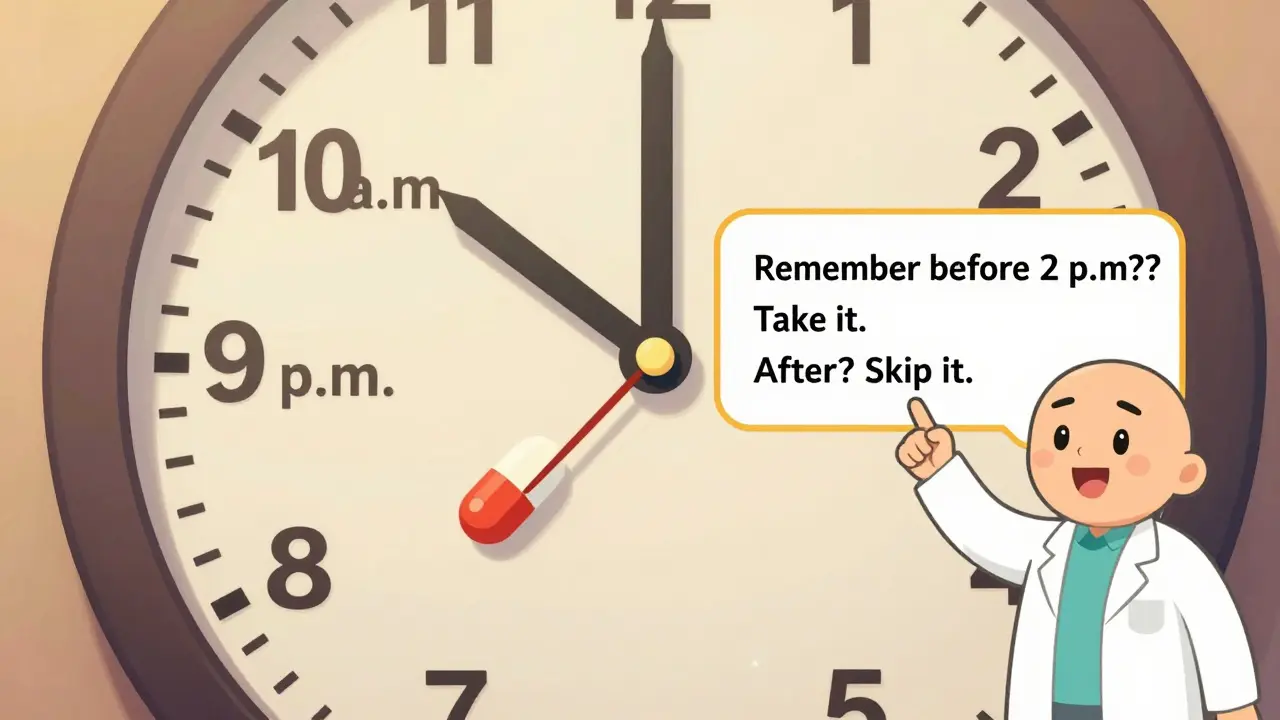
- Twice-daily meds: If you miss the morning dose and remember before 2 p.m. (assuming you take it at 8 a.m. and 8 p.m.), take it. If it’s after 2 p.m., skip it and wait for your evening dose. Same rule applies if you miss the evening dose-take it if you remember before 2 a.m., otherwise skip it.
- High-risk meds (anticoagulants, seizure drugs, immunosuppressants): Always check the specific instructions. For warfarin, if you miss your dose and remember before midnight, take it. After midnight? Skip it. No exceptions.
Why Timing Matters: Half-Life and Therapeutic Index
Not all drugs are created equal. Two factors decide what to do:- Half-life: Short half-life drugs (like amlodipine or metoprolol) leave your body quickly. You have a small window to catch up. Long half-life drugs (like levothyroxine) stay around for days. Missing one dose won’t throw things off.
- Therapeutic index: This is how close the safe dose is to the toxic dose. Narrow index? Tiny mistake = big danger. Warfarin, digoxin, lithium-all have narrow indexes. Broad index? More forgiving. Metformin or statins? Missing one dose usually won’t hurt.
Special Cases: Birth Control, GLP-1s, and Antibiotics
Some meds have their own rules.- Oral contraceptives: If you miss an active pill by less than 12 hours, take it right away. If it’s more than 12 hours late, take it as soon as you remember-but use backup contraception (like condoms) for the next 7 days. You’re not protected anymore.
- GLP-1s like semaglutide or tirzepatide: These weight-loss and diabetes drugs are injected weekly. If you miss your dose, you can take it within 4 days of the scheduled day. After that, skip it. Don’t double up. And if you’ve gone 14 days without it, talk to your doctor before restarting-you might feel sick if you jump back in too fast.
- Antibiotics like amoxicillin: This is one of the few exceptions. Some doctors say if you miss a dose by a few hours, you can take it right away-even if it means taking two doses close together. But only for antibiotics. And only if you’re not on anything else. Always check with your pharmacist first.
Why So Much Confusion?
You’re not alone if you’re confused. A 2021 review found that 25% of high-risk medications don’t even have clear missed-dose instructions in their patient leaflets. Some pills say “take it as soon as you remember.” Others say “skip it.” Pharmacists might give you different advice depending on who you ask. One patient in Boston told a reporter: “I was told three different things about my blood pressure meds by three different pharmacies.” That’s not rare. In fact, a 2022 NHS report found that 41.7% of patient leaflets give conflicting or unclear advice. The problem? Drug companies aren’t required to test how patients handle missed doses. So instructions are often copied from older versions or made up by someone who’s never talked to a real patient.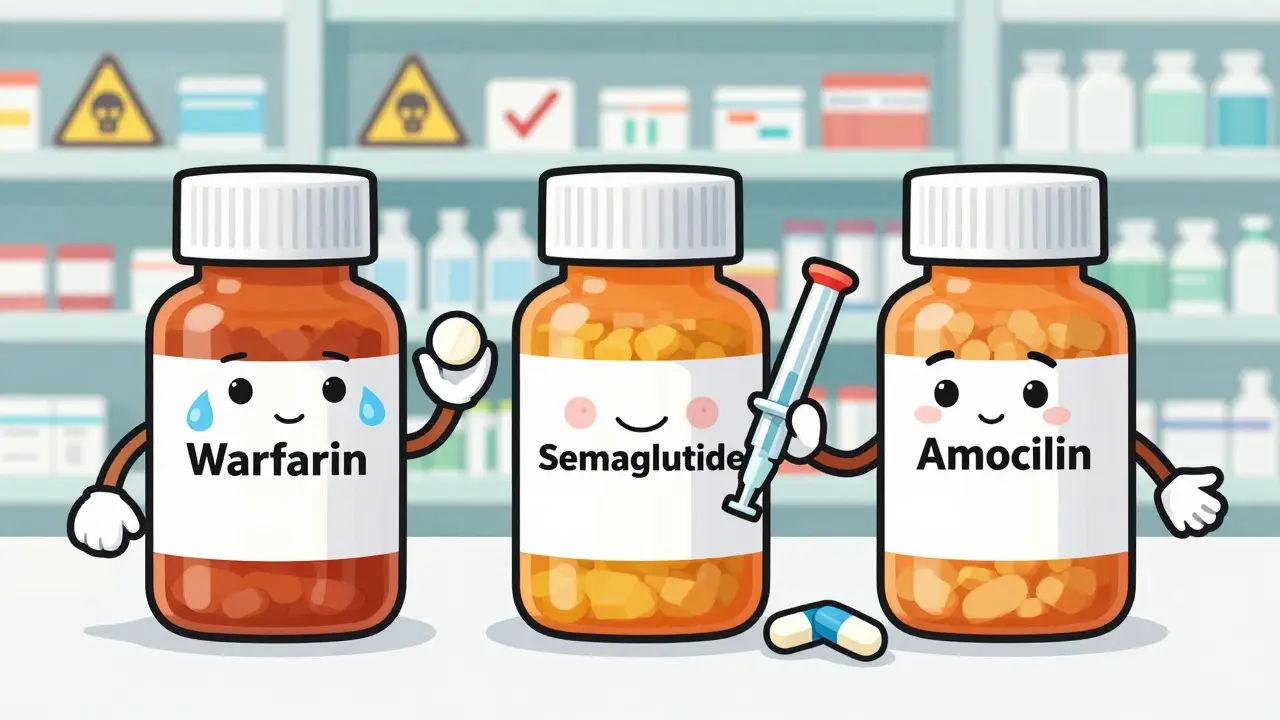
How to Avoid Mistakes
The best way to handle missed doses is to never miss them in the first place.- Use a pill organizer: Simple, cheap, and effective. A weekly box with morning/afternoon/evening slots cuts missed doses by 30% or more.
- Set phone alarms: Label them clearly: “Warfarin 8 a.m.” or “Semaglutide injection.”
- Use a medication app: Apps like MyTherapy track doses and send reminders. Users report a 42% drop in missed doses.
- Ask your pharmacist: When you pick up a new prescription, ask: “What if I miss a dose?” Don’t assume they’ll tell you. Ask.
- Write it down: Keep a small card in your wallet with your meds, doses, and what to do if you miss one. Update it every time your script changes.
What to Do If You Already Doubled Up
If you accidentally took two pills:- Call your pharmacist or doctor immediately. Don’t wait.
- Don’t panic. Most single accidental doubles won’t cause harm-but you need to know if you’re at risk.
- Watch for symptoms: dizziness, nausea, irregular heartbeat, unusual bruising, confusion, extreme fatigue.
- Use the MHRA’s Yellow Card system to report the error. It helps improve safety for everyone.
Final Thought: It’s Not About Perfection
You don’t have to be perfect. Even the best patients miss a dose now and then. What matters is how you respond. Skipping a dose is almost always safer than doubling up. Your body can handle a single missed dose better than you think. The goal isn’t to never miss a pill. It’s to never make a dangerous mistake trying to fix one.What should I do if I miss a dose of my blood pressure medication?
If it’s a once-daily blood pressure pill and you remember within the same day, take it. If it’s already the next day, skip it. For twice-daily pills, take the missed dose if you remember within 6 hours of the scheduled time. If it’s longer than that, skip it and wait for your next dose. Never double up. Blood pressure meds are usually forgiving, but doubling can cause your pressure to drop too low, leading to dizziness or falls.
Can I take a double dose of antibiotics if I miss one?
Rarely. Only a few antibiotics like amoxicillin may allow a double dose if you miss one by a few hours. But this is not standard. Most antibiotics need consistent levels in your blood to work properly. Doubling up won’t make them work faster and could increase side effects like nausea or diarrhea. Always check with your pharmacist before doubling any antibiotic.
Is it safe to skip a dose of my statin?
Yes. Statins like atorvastatin or rosuvastatin have long half-lives and a wide therapeutic index. Missing one dose won’t significantly affect your cholesterol levels. Just take your next dose as scheduled. Don’t double up. The benefit comes from long-term use, not perfect daily timing.
What if I miss a dose of my thyroid medication?
Levothyroxine has a very long half-life (about 7 days), so missing one dose won’t cause immediate problems. If you remember the same day, take it. If it’s the next day, skip it. Don’t take two pills the next day. Taking too much can cause symptoms like a racing heart, anxiety, or trouble sleeping. Consistency matters more than perfection.
Why do some pharmacies give different advice about missed doses?
Because the instructions on patient leaflets are often unclear or missing. Some pharmacists follow general guidelines, others rely on experience. A 2022 NHS report found that 41.7% of patient leaflets give conflicting advice. That’s why it’s important to ask your doctor or pharmacist for written instructions specific to your medication and keep them handy.
How can I remember to take my pills consistently?
Use a pill organizer, set phone alarms, or try a medication app like MyTherapy. Link taking your pills to a daily habit-like brushing your teeth or eating breakfast. If you take multiple meds, ask your pharmacist for a Medicines Use Review. These free consultations help you understand your regimen and reduce errors by nearly 30%.
Are there any medications where doubling up is okay?
Very few. Some antibiotics like amoxicillin may allow it if the missed dose is caught within a few hours, but even that’s not universal. For nearly all other medications-especially those for heart, brain, blood, or immune conditions-doubling up is dangerous. Never assume it’s safe. Always ask your pharmacist first.
What should I do if I miss a dose while traveling across time zones?
Adjust your schedule gradually. If you’re going east and losing hours, take your dose at the local time-even if it’s earlier than usual. If you’re going west and gaining hours, delay it. For critical meds like warfarin or seizure drugs, talk to your doctor before you travel. They can give you a plan. Never double up just to stay on schedule.
bro i doubled my warfarin once bc i thought i missed it… turned out i took it but forgot. ended up in the ER with a 6.8 INR. they gave me vitamin K like it was candy. never again. 🤢💊
this is so important. i used to panic when i missed my pill and would double up. my pharmacist sat me down and explained half-life like i was 5. now i just breathe and check the app. life changed. 🙌
There's a deeper philosophical layer here that most people miss. The fear of imperfection drives us to overcorrect, to compensate, to punish ourselves for forgetting. But medicine isn't a moral test. It's a biological rhythm. The body doesn't care if you're 'bad' at taking pills-it only responds to concentration, to dosage, to time. Doubling up isn't diligence, it's arrogance. Skipping isn't failure, it's humility. And humility, in this context, is the most therapeutic thing you can do.
use a pill box set alarms talk to your pharmacist thats it no drama no stress just do it
I just want to say… thank you for writing this. I’ve been so scared to ask my doctor about missed doses because I felt like I was ‘failing’ at being a good patient. But this? This feels like permission to just… be human. I printed it out and taped it to my fridge. 💛
you people are too soft. in my country we just take two pills if we miss one. if you get sick then you were weak anyway. no need for apps or alarms. just take it and move on. why make it so complicated?
this is why america is falling apart. too many apps, too many rules. in my day we just took the pill when we remembered. if you died then you weren't meant to live. no one cared about INR or half-life. just swallow and shut up.
I used to miss my metformin all the time because I was always running late. Now I keep a little note on my phone that says: "Your pancreas doesn’t care if you’re busy. It just wants its pill." It sounds silly but it works. You got this.
The system wants you scared. They don’t want you to understand half-life-they want you dependent. Pharmacies profit from your confusion. Apps track you. Pills are designed to be hard to remember. You think this is medicine? It’s control.
I missed my thyroid pill for 3 days once. Felt fine. Took my next dose like normal. No drama. Your body is smarter than you think.
I appreciate the thorough breakdown of therapeutic index and half-life. I work in primary care and often see patients who double doses out of anxiety. The guidance here is clinically sound and accessible. Thank you for citing the NHS and JAMA studies-it adds necessary credibility.
In my village in India, people don’t have apps or pill boxes. They tie a knot in their shirt sleeve when they take a pill. One knot per dose. If they forget, they wait. No doubling. No panic. Just rhythm. Maybe we don’t need technology to be wise.
You know who doesn’t want you to understand this? The FDA. They’re in bed with Big Pharma. The ‘never double up’ rule? It’s not about safety-it’s about liability. If you die from a double dose, they don’t get sued. If you miss a dose and live? They lose money. This whole thing is a cover-up.
I take my blood pressure pill at 8 AM. Sometimes I forget until 6 PM. I wait till tomorrow. My doctor says it's fine. I used to stress about it. Now I just drink chai and wait. Life is better this way.
The empirical evidence supporting the recommendation to avoid dose doubling is robust and unequivocal. Adherence protocols should be individualized, yet the cardinal principle remains: therapeutic safety supersedes temporal consistency.