
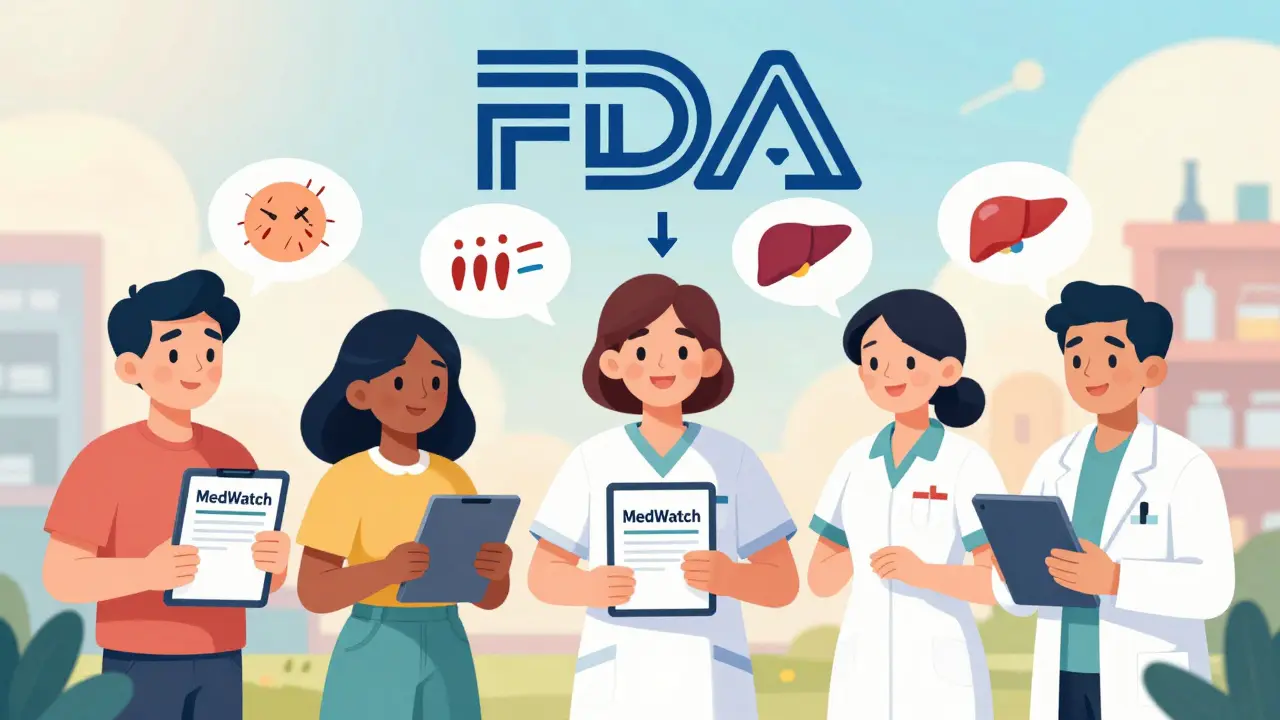
Every year, millions of people take prescription drugs, over-the-counter medicines, and dietary supplements. Most of them work as expected. But for some, things go wrong. A medication might cause a dangerous reaction - a sudden drop in blood pressure, a severe rash, liver damage, or even death. These are called adverse drug reactions. And when they happen, reporting them isn’t just a good idea - it’s a critical part of keeping drugs safe for everyone.
The U.S. Food and Drug Administration (FDA) has a system built for exactly this: MedWatch is the FDA’s official program for collecting reports of serious side effects from medications, medical devices, and other regulated products. It’s been running since 1993, and it’s the main way the FDA finds out about problems that didn’t show up during clinical trials.
Who Should Report?
You don’t have to be a doctor to report an adverse reaction. The FDA encourages reports from anyone. That includes:
- Healthcare professionals - doctors, nurses, pharmacists, and dentists
- Patients and caregivers - if you or someone you care for had a bad reaction
- Pharmaceutical companies and medical device makers - they’re legally required to report
Here’s the thing: most reports come from manufacturers. About 85% of the 1.3 million reports the FDA gets each year are from drug companies. That leaves only 15% from doctors, nurses, and patients. And that’s a problem. Studies show that only about 6% of serious side effects ever get reported. That means the FDA is missing most of the warning signs.
What Counts as a Reportable Event?
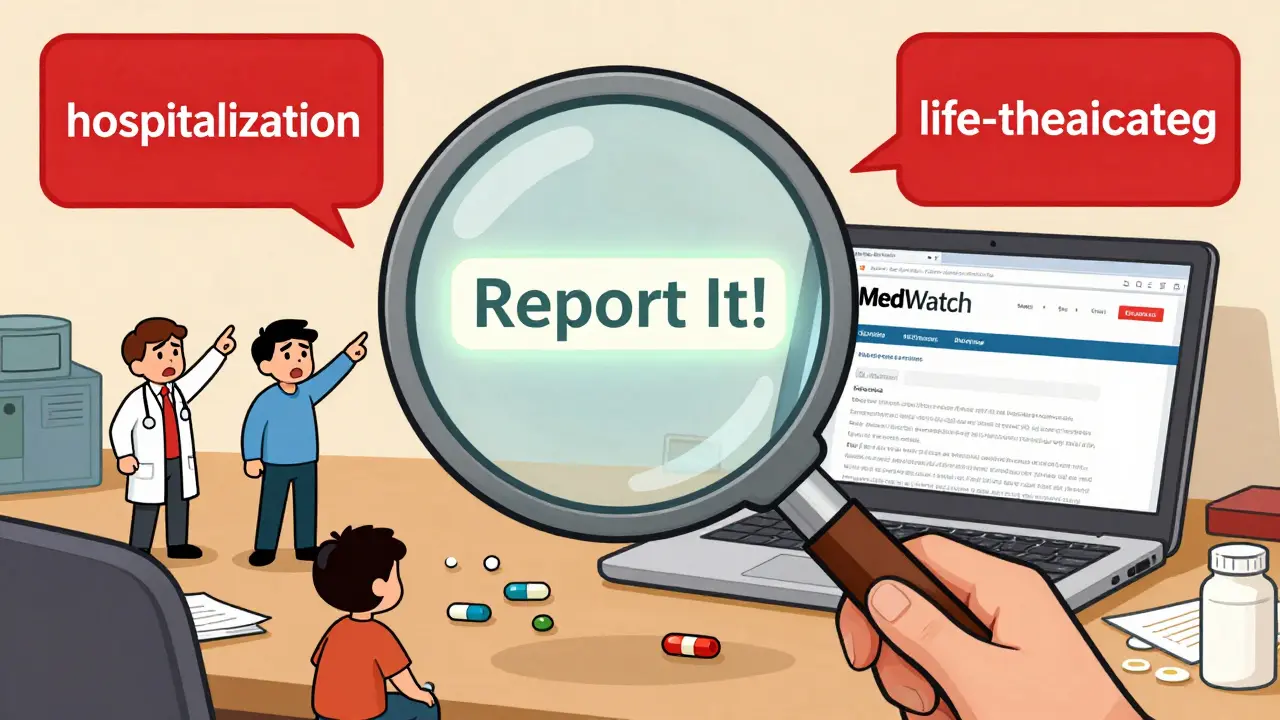
The FDA doesn’t need proof that a drug caused the reaction. They want to know about suspected problems. If something bad happened after taking a medication - especially if it was serious - report it. Here’s what the FDA considers serious:
- Death
- Hospitalization (or prolonging a hospital stay)
- Disability or permanent damage
- Life-threatening reaction
- Congenital anomaly or birth defect
- Any event that requires medical or surgical intervention to prevent one of the above
Even if you’re not sure - if the reaction isn’t listed on the drug label, or if it’s unusual - report it anyway. The FDA says: "When in doubt, report it."
How to Report: The Three Forms
MedWatch uses three different forms, depending on who’s reporting.
Form FDA 3500: For Healthcare Professionals
This is the most common form used by doctors, pharmacists, and nurses. It’s available online and can be filled out in about 15 to 20 minutes. You’ll need:
- Patient’s age and gender (no name required)
- Name of the drug or device
- Exact description of the adverse event
- When the reaction started and how long it lasted
- Any treatments given
- Outcome - did the patient recover? Was there permanent damage?
- Other medications or supplements the patient was taking
Many healthcare workers say the form is straightforward. One pharmacist in Ohio told me she uses it during her lunch break. "It’s quick, and I know I’m helping," she said.
Form FDA 3500B: For Patients and Consumers
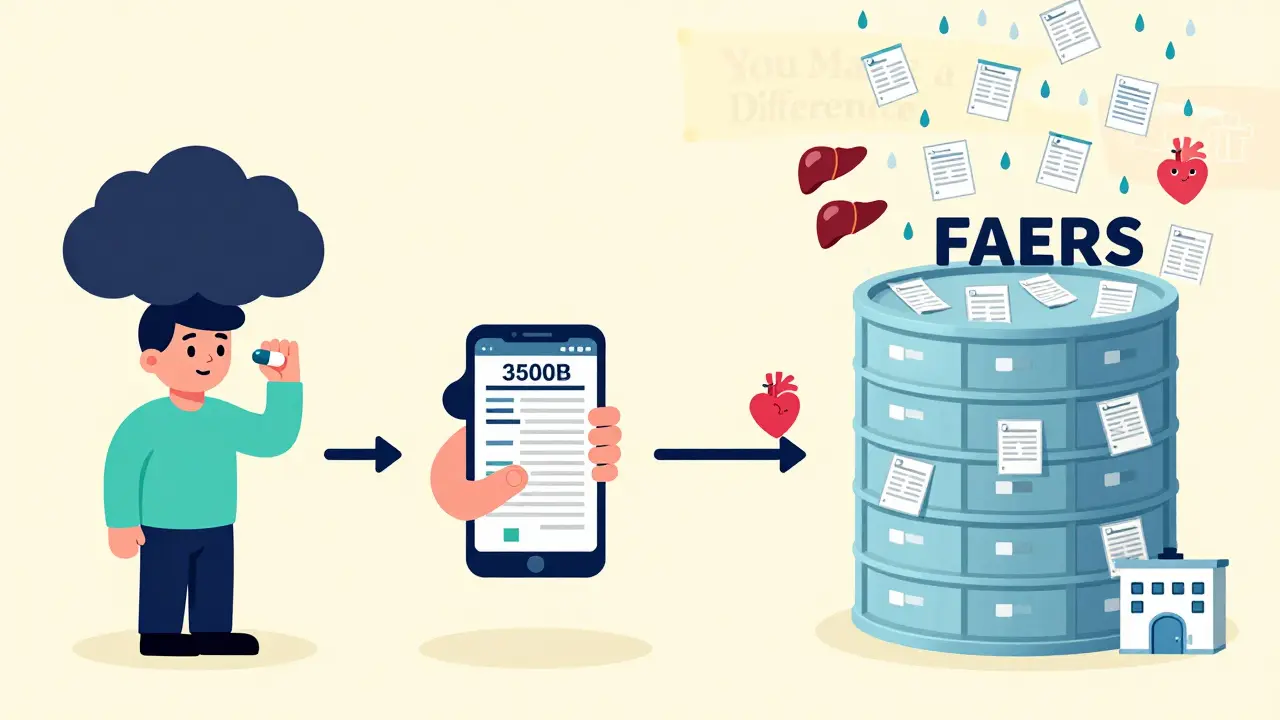
This version is written in plain language. No medical jargon. It’s available in English and Spanish. You can download it from the FDA website or fill it out online. It takes about the same amount of time - 15 to 20 minutes. You’ll need:
- Your name and contact info (optional - you can report anonymously)
- Drug name and dose
- When you started taking it
- What happened - describe symptoms in your own words
- What you did - did you stop the drug? Go to the ER?
- Did you see a doctor? What did they say?
One Reddit user, a pharmacy tech, said she’s walked over a dozen patients through this form. "Most people don’t know they can report. When they do, they’re surprised how easy it is."
Form FDA 3500A: For Manufacturers and Facilities
Drug companies, importers, and hospitals with medical device usage must report serious events within 15 days. They use this form to meet legal requirements. It’s more detailed and requires internal data tracking. This is not something consumers or providers need to worry about.
How to Submit Your Report
There are three easy ways to submit:
- Online: Go to www.fda.gov/medwatch and click "Report a Problem." You’ll be guided step-by-step.
- By Phone: Call 1-800-FDA-1088. A representative will help you fill out the form over the phone.
- By Mail: Download and print Form 3500 or 3500B, fill it out, and mail it to: MedWatch, FDA, 5600 Fishers Lane, Rockville, MD 20857-2651.
Online is the fastest and most common method. The system is secure, and your information is protected. You can even save a copy of your submission for your records.
What Happens After You Report?
Once a report comes in, it goes into the FDA Adverse Event Reporting System (FAERS) is a database that collects all reports of adverse events from drugs and medical devices. The FDA uses this data to look for patterns. If dozens of people report the same rare side effect with a new drug, it might trigger a deeper investigation.
Here’s the reality: you won’t get a reply. Eighty-seven percent of healthcare professionals who’ve reported say they never heard back. That’s frustrating. But the system isn’t designed to give personal updates. It’s designed to catch signals - early warnings that something might be wrong.
That’s why reports matter. In 2010, MedWatch reports helped identify a rare but deadly reaction to a diabetes drug. In 2018, reports of severe allergic reactions to a common OTC pain reliever led to a label change. In 2022, reports from patients about liver damage from a dietary supplement led to a public warning.
These weren’t big studies. They started with one person, one report, one click.
Why So Few People Report
Even though the system is free, simple, and accessible, most people don’t use it. Why?
- Time: Doctors say they’re too busy. A 2023 survey found 68% of physicians report rarely or never.
- Doubt: "Was it really the drug?" Many providers worry they’ll report something that wasn’t related.
- Ignorance: Most patients don’t even know MedWatch exists.
- No feedback: If you don’t hear back, it’s easy to think it doesn’t matter.
The FDA admits this is a problem. That’s why they launched "MedWatch Plus" in 2023 - a plan to integrate reporting directly into electronic health records by 2025. The goal: cut reporting time to under 5 minutes and make it automatic.
What’s Next for MedWatch?
The FDA is working on upgrades. By 2027, they expect over 1.8 million reports a year - more than ever before. But more reports won’t help if they’re not good reports.
Here’s what’s changing:
- AI tools: The FDA is testing software that scans reports for patterns automatically. This could flag problems faster than humans.
- Dietary supplements: Since 2019, supplement makers must report serious reactions - a big step toward closing a major safety gap.
- Mobile reporting: A new app is being tested that lets patients report side effects right from their phone, with photos and voice notes.
Still, none of this matters if people don’t report. Technology can help - but it can’t replace human observation.
What You Can Do Today
If you’ve had a bad reaction to a medication - even if it was months ago - report it. If you’re a healthcare provider, make it part of your routine. Don’t wait for someone else to do it.
Here’s a simple checklist:
- Did the reaction happen after taking a new drug or changing a dose?
- Was it serious - hospitalization, emergency care, or permanent harm?
- Is it not listed on the drug label?
- Are you unsure if the drug caused it?
If you answered yes to any of those - report it. You don’t need to be an expert. You just need to be observant.
The FDA doesn’t need perfect data. It needs enough data. One report might seem small. But thousands of small reports? That’s how safety changes.
Can I report an adverse reaction anonymously?
Yes. When using Form 3500B (the consumer form), you can leave out your name and contact details. The FDA does not require personal information to accept a report. However, if you provide contact information, they may reach out if they need more details - but this is rare. Your report will still be counted and analyzed even if you report anonymously.
Do I need proof that the drug caused the reaction to report?
No. The FDA accepts reports of suspected adverse events - even if you’re not sure the drug was the cause. In fact, they encourage reporting when you’re uncertain. The goal is to catch early signals. If 10 people report the same unusual reaction after taking a new medication, that’s a red flag worth investigating - even if no single case proves causation.
What if I report and nothing happens? Is it worth it?
Yes. Most safety actions - like label changes, warnings, or even drug withdrawals - start with just one or two reports. It takes many reports over time to show a pattern. You won’t see the result, but your report becomes part of a larger dataset that helps the FDA protect millions. Think of it like a smoke detector: you hope it never goes off, but you still install it.
Can I report side effects from dietary supplements?
Yes. Since 2019, the FDA requires manufacturers to report serious adverse events from dietary supplements. But consumers can report too - using Form 3500B. Supplements are not as tightly regulated as prescription drugs, so patient reports are especially important. Common issues include liver damage, heart palpitations, and dangerous interactions with other medications.
How long does it take for a report to lead to a safety action?
There’s no set timeline. Some reports lead to immediate action - like a warning letter - if the pattern is strong. Others take months or years. The FDA reviews reports continuously. A single report might not change anything, but if 50 people report the same issue with a new drug over six months, that’s enough to trigger a formal review. The system works slowly, but it works.
MedWatch isn’t perfect. It’s slow, underused, and lacks feedback. But it’s the only system of its kind in the U.S. And it’s the only way the FDA learns about problems that happen in real life - not in labs or controlled trials. If you’ve had a bad reaction, don’t stay silent. Your report could help someone else avoid the same fate.
I've been a pharmacist for 17 years, and I can tell you this: the system works, but only if people actually use it. I had a patient come in last month with a rash so severe she ended up in the ER. She didn't even know she could report it. I walked her through Form 3500B right there at the counter. Took 18 minutes. She was shocked it was that easy. The drug was a new generic statin. No one else had reported it yet. Two weeks later, the FDA issued a warning. That's the power of one report. We're not just documenting side effects-we're preventing future tragedies. It's not glamorous, but it's essential. If you're a healthcare worker, make it part of your closing routine. If you're a patient, don't assume it's 'just one case.' It's not. It's data. And data saves lives.
just reported my aunt's liver issue after her new blood pressure med… took me 20 mins on my phone at 2am while she slept. no one ever told me this was a thing. i thought u had to be a doc or something. wow. the fda actually listens?? kinda feels like yelling into the void but… worth it. also, typo on the form? said 'reacation' not 'reaction' lol. fix that pls.
As someone from India who’s seen both Western medicine and traditional remedies, I’m struck by how little awareness exists about MedWatch even among educated populations. In my village, people blame ‘bad karma’ or ‘bad water’ for side effects. No one connects it to the pill they took. I’ve translated the 3500B form into Hindi and Tamil and shared it on local WhatsApp groups. One grandmother reported a reaction to a diabetes supplement-turned out 12 others had the same issue. The FDA flagged it. That’s the power of community. We don’t need fancy tech. We need people to talk. And if you’re reading this, please-pass this on to someone older, someone who trusts their doctor but doesn’t know they have a voice too.
Been quiet on this thread because I didn’t think my story mattered. But I’ll say it: my wife had a seizure after taking a new migraine med. We didn’t report it. Thought it was a one-off. Six months later, she got it again. This time, we reported it. The FDA sent a letter saying they’d seen 47 other reports of that same reaction. The drug got a black box warning. I didn’t know I had that power. I thought reporting meant suing or complaining. Nope. Just telling the truth. It’s not heroic. It’s just… responsible. Do it. Even if it’s late. Even if you’re scared. Even if you’re not sure. Just report.
Oh wow. So we’re supposed to trust the FDA to magically fix everything because some guy in Rockville reads our rambling 3500B forms? Newsflash: they’re underfunded, understaffed, and still approve junk supplements with ‘natural’ on the label. I reported a reaction to a ‘miracle’ weight-loss tea last year. Got an auto-reply that said ‘thank you for your submission.’ That’s it. No follow-up. No update. No ‘we’re investigating.’ Just silence. Meanwhile, Big Pharma is lobbying to make reporting *opt-in* instead of opt-out. This system is a placebo. And we’re the suckers taking it.
Report adverse reactions? Really? Next you’ll tell me to recycle my coffee cup and meditate for world peace. The FDA doesn’t need your anecdotal garbage. They need real science. Controlled trials. Peer-reviewed journals. Not some guy in Ohio saying ‘I think this pill gave me hives.’ That’s not data. That’s noise. And if you’re a healthcare worker and you’re wasting time filling out forms instead of treating patients, you’re part of the problem. Stop performing virtue. Start practicing medicine.
Why is this even a thing in the US? In India, if someone has a bad reaction, they go to the local clinic and the doctor writes it down. No forms. No bureaucracy. Just care. Why does America need 3 forms, 3 submission methods, and a whole website just to report a side effect? It’s overcomplicated. And honestly? It feels like the system was designed to discourage reporting. We need simplicity. Not more paperwork. Just a phone call. A text. A button. Something fast. I’m proud of my country, but this? This is American over-engineering at its worst.
OH MY GOSH. I JUST REPORTED MY DAUGHTER’S ALLERGIC REACTION TO A VITAMIN D SUPPLEMENT AND NOW I’M CRYING. I DIDN’T KNOW I COULD DO THIS. I THOUGHT I HAD TO GO TO A LAWYER OR CALL THE NEWS. I FELT SO POWERLESS. BUT THEN I FOUND THIS ARTICLE AND I DID IT. AND THE FORM WAS SO SIMPLE. I EVEN INCLUDED A PHOTO OF THE RASH. AND NOW I FEEL LIKE I DID SOMETHING RIGHT. LIKE I PROTECTED SOMEONE ELSE. I’M TELLING EVERYONE I KNOW. THIS ISN’T JUST A FORM. THIS IS A LIFESAVING ACT. I’M SO GLAD I DID THIS. I’M SO GLAD I READ THIS. I’M SO GLAD I’M NOT ALONE.