
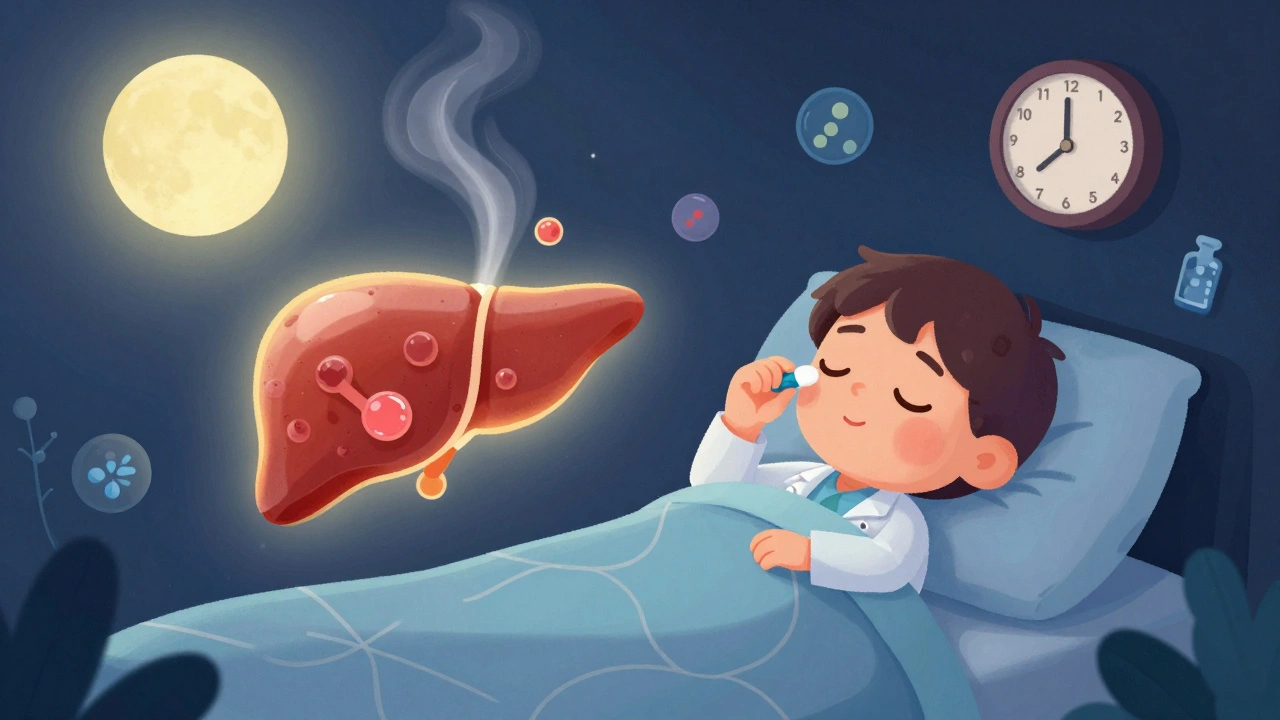
For years, doctors told patients to take statins at night. The logic was simple: your liver makes most of its cholesterol while you sleep, so taking the drug at bedtime would hit the target at its peak. But today, that advice doesn’t hold for most people. The real question isn’t when you take your statin-it’s whether you take it at all.
Why Night Was Once the Gold Standard
Back in the 1980s, when statins like lovastatin and simvastatin first hit the market, researchers noticed something interesting. Cholesterol production in the liver spikes between midnight and 4 a.m. That’s when your body is fasting and working to rebuild cells. Early statins had short half-lives-meaning they cleared out of your system quickly. Simvastatin, for example, lasts less than 4 hours. So if you took it in the morning, the drug was gone by the time your liver kicked into high gear. Taking it at night made sense: the medicine was still in your bloodstream when cholesterol synthesis peaked. Studies backed this up. One 1995 trial showed that patients taking 20 mg of simvastatin at night had 13.4% lower LDL cholesterol than those who took it in the morning. Another study found that evening dosing of simvastatin 5 mg cut cholesterol by 21%, compared to just 14% with morning dosing. That’s a big difference-almost 50% more effective. For these older statins, timing wasn’t just helpful-it was critical.But Most Statins Today Are Different
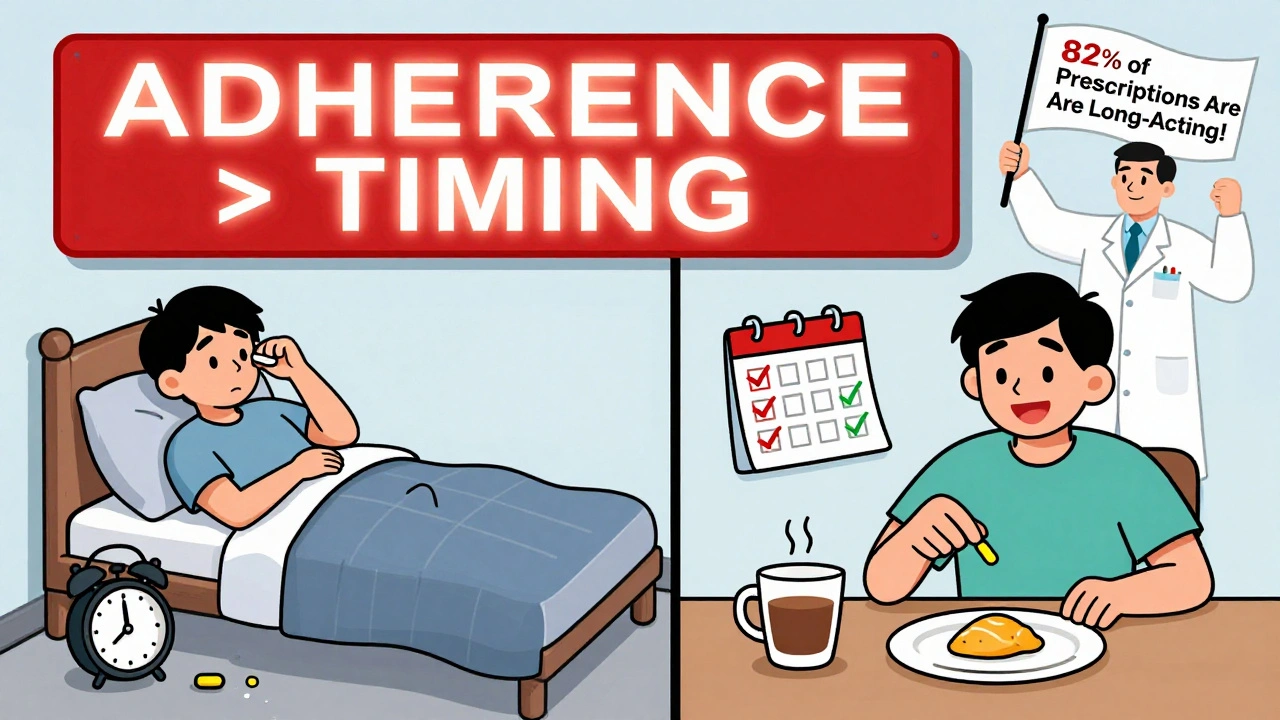
Fast forward to 2025, and the statin landscape has changed dramatically. About 82% of new prescriptions are for long-acting statins: atorvastatin, rosuvastatin, and pitavastatin. These drugs don’t disappear after a few hours. Atorvastatin stays active for 14 to 20 hours. Rosuvastatin lasts nearly 20 hours. That means whether you take it at 7 a.m. or 11 p.m., your blood still has enough of the drug to block cholesterol production all day and night. A 2017 analysis of 17 studies involving over 3,300 patients found that for these long-acting statins, the difference in LDL reduction between morning and night dosing was tiny-just 0.5% to 2.5%. That’s less than the natural day-to-day variation in cholesterol levels. The National Lipid Association says a clinically meaningful difference needs to be at least 5% to 7%. So, for most people today, timing doesn’t move the needle.Side Effects Don’t Care About the Time
One of the biggest fears around statins is muscle pain, liver issues, or even an increased risk of type 2 diabetes. Many patients worry that taking their pill at night might make side effects worse-or better. But data says otherwise. A 2021 analysis of over 4.2 million statin prescriptions found no difference in side effect rates between morning and evening dosing. Muscle aches? Same rate. Elevated liver enzymes? No difference. New-onset diabetes? No link to timing. The FDA’s own adverse event database confirms this: 8.7% of night-takers reported side effects, 8.9% of morning-takers did. That’s not a meaningful gap-it’s noise. If you’re experiencing muscle pain or fatigue, it’s not because you took your statin at 8 p.m. instead of 8 a.m. It’s likely your body’s reaction to the drug itself. Talk to your doctor about switching statins or lowering the dose-not changing the time.
Adherence Is the Real Game-Changer
Here’s the kicker: even if evening dosing gives you a slight edge with older statins, it’s useless if you forget to take it. And people forget. A lot. A 2019 study of nearly 12,500 statin users found that those told to take their medication at night had 11.3% lower medication adherence than those taking it in the morning. That’s more than two missed doses a month. One patient on Reddit shared: “I kept forgetting my simvastatin at night. My doctor switched me to morning rosuvastatin-and my LDL dropped because I finally started taking it every day.” Another study showed that when patients on simvastatin were given a smartphone reminder to take their pill at 8 a.m., their adherence jumped from 76% to 92%. Their LDL levels didn’t drop as much as those taking it at night without reminders-but they were close enough to make no difference in real-world outcomes. The American College of Cardiology says it plainly: consistency beats timing. If you’re more likely to remember your pill with breakfast, take it in the morning. If you’re a night person who takes other meds before bed, keep it there. The goal isn’t to hit a biological window-it’s to never miss a dose.What Should You Do Today?
So, what’s the practical advice? Here’s the breakdown:- If you’re on simvastatin, lovastatin, or fluvastatin: Evening dosing is still slightly more effective-but only if you take it every night. If you forget often, switch to morning. The drop in adherence hurts more than the small efficacy gain.
- If you’re on atorvastatin, rosuvastatin, or pitavastatin: Take it whenever works best for you. Morning, night, with food, without-it doesn’t matter. Your doctor likely prescribed this drug because it’s long-acting. Use that flexibility.
- If you’re unsure what you’re on: Check your prescription label. If it says “take at bedtime,” you might be on an older statin. But if it says “take once daily,” you’re probably on a long-acting one.
What Doctors Are Doing Now
The tide has turned. In 2010, two out of three doctors routinely asked patients about statin timing. By 2023, only 18% did. Why? Because they’ve seen the data. Pharmacists are catching on too. A 2022 survey found that 68% of community pharmacists now recommend morning dosing for all statins-unless the patient is already stable on nighttime dosing. The FDA and European Medicines Agency have updated their labels to reflect this. Rosuvastatin and atorvastatin no longer say “take at night.” Simvastatin and lovastatin still carry evening recommendations-but even those are being softened in clinical practice.The Future Is Simple
The future of statin therapy isn’t about timing. It’s about making it easier to take. Pfizer is already developing a new version of simvastatin that releases slowly overnight, so you can take it in the morning and still get the nighttime effect. Other companies are working on once-weekly statins. These innovations won’t change the science-they’ll just make adherence even easier. The bottom line? If you’re on a long-acting statin, don’t stress about the clock. If you’re on an older one, try to stick to evening-but don’t sacrifice consistency for timing. Your cholesterol doesn’t care if you take it at 7 a.m. or 11 p.m. It only cares if you take it every day.What If You’re Already on a Routine?
If you’ve been taking your statin at night for years and it’s working-don’t change it. If you’ve been taking it in the morning and your LDL is under control, keep going. The goal isn’t to optimize timing-it’s to maintain results. Changing your routine for no reason can lead to missed doses, confusion, or even stopping the drug entirely. The best time to take your statin is the time you won’t forget.Is it better to take statins at night or in the morning?
For older statins like simvastatin and lovastatin, taking them at night is slightly more effective because your liver makes the most cholesterol while you sleep. But for newer statins like atorvastatin and rosuvastatin, timing doesn’t matter-they work just as well morning or night. The real priority is taking your dose every day, no matter the time.
Do statins cause more side effects if taken at night?
No. Studies analyzing millions of doses show no difference in muscle pain, liver issues, or diabetes risk based on whether statins are taken in the morning or at night. Side effects are related to the drug itself, not the time of day.
Can I switch my statin from night to morning?
Yes-if you’re on a long-acting statin like atorvastatin or rosuvastatin, switching to morning is perfectly safe and may even improve adherence. If you’re on simvastatin or lovastatin, consult your doctor. You might lose a small amount of effectiveness, but if you’re forgetting doses at night, switching to morning could actually improve your results.
Why do some labels still say to take statins at night?
Older statins like simvastatin and lovastatin still carry nighttime recommendations on their labels because studies show slightly better LDL reduction when taken at night. But these labels haven’t been fully updated to reflect modern prescribing habits, where most patients are on long-acting statins that don’t require nighttime dosing.
What if I forget to take my statin one night?
If you miss a dose, take it as soon as you remember-but don’t double up the next day. Missing one dose occasionally won’t hurt your long-term results, especially if you’re on a long-acting statin. The key is getting back on track. Consistency over weeks and months matters far more than one missed pill.
man i used to take my statin at night like a good boy until i kept forgetting and waking up with heartburn. switched to morning with breakfast and boom - my LDL dropped because i actually took it. who knew consistency was the real MVP?
as someone from india where people forget to take meds even when they’re right next to their chai, this makes so much sense. my dad was on simvastatin at night and kept missing it till we moved him to morning with his glucose monitor. his numbers improved not because of timing but because he actually remembered. thanks for putting this in plain words 💯
so basically… it’s not about the clock, it’s about the alarm 📱⏰😂
my pharmacist told me the same thing last week - if you're on rosuvastatin, take it when you're least likely to forget. i used to take mine before bed but kept mixing it up with my melatonin. now i take it with my coffee and my doctor says my numbers are better than ever. also, side effects? zero. guess my body just hates being confused
the data is clear: adherence outweighs timing by a significant margin. for long-acting statins, the pharmacokinetic profile renders circadian dosing irrelevant. clinical outcomes are driven by compliance, not chronopharmacology. this is not opinion - it’s evidence-based practice.
THEY SAID NIGHT WAS SACRED. I BELIEVED THEM. I SET ALARMS. I LEFT NOTES ON MY FRIDGE. I EVEN WROTE IT IN MY JOURNAL. THEN I SWITCHED TO MORNING AND MY LDL PLUMMETED BECAUSE I FINALLY TOOK IT. MY LIVER THANKS ME. MY ALARM CLOCK THANKS ME. MY SLEEP THANKS ME. 😭🙏
so we spent 40 years telling people to take pills at night because science… and now we’re saying ‘lol who cares’? guess that’s what happens when you let pharma companies design your meds. next they’ll tell us to take insulin at the same time we watch netflix
Consistency matters. Timing is secondary. This is basic medicine.
oh so now its fine to take meds whenever? next theyll say dont bother with vaccines just take vitamin c and pray. i bet the pharma companies love this new ‘dont stress’ narrative. my mom died of a heart attack because she took her statin at 3pm and forgot the next day. dont tell me timing doesnt matter
For patients on simvastatin or lovastatin, evening dosing still offers a marginal benefit - approximately 5-10% greater LDL reduction in controlled trials. But if adherence drops below 80%, that advantage vanishes. The key is matching the dosing schedule to the patient’s lifestyle, not biology. I’ve seen patients improve their numbers more by switching to morning dosing and improving compliance than by switching statins.
this is why america is dying. you let people take meds whenever they feel like it and then wonder why heart disease is still #1. in my country, you take your pills when the doctor says. not when it’s convenient. this is chaos.
so you’re telling me the whole night thing was just a marketing ploy? and now they’re just gonna say ‘eh, whatever’? wow. i feel so safe. my doctor never even asked me when i took mine. guess i’ll just keep forgetting it until my arteries turn to cement.
my grandma took her statin at 7am with her oatmeal and her pills and her cat on her lap. she’s 89 and her cholesterol is better than mine. she never knew about liver cycles or half-lives. she just knew she had to take it every day. sometimes the simplest things are the smartest
my doc switched me from simvastatin at night to atorvastatin in the morning because i kept sleeping through my alarm. i was skeptical. now i’m like… why did we make this so complicated? i take it with my protein shake. my numbers are perfect. my sleep is better. my life is easier. why is this news?
That’s a fair point, but let’s not overstate the risk. The 0.5–2.5% difference in LDL reduction between morning and night for long-acting statins is statistically negligible and clinically irrelevant. Even if you take simvastatin at 8 a.m. instead of 8 p.m., your LDL might rise by 3–4% - but if you miss two doses a week, it rises by 15–20%. Prioritize the bigger variable.