
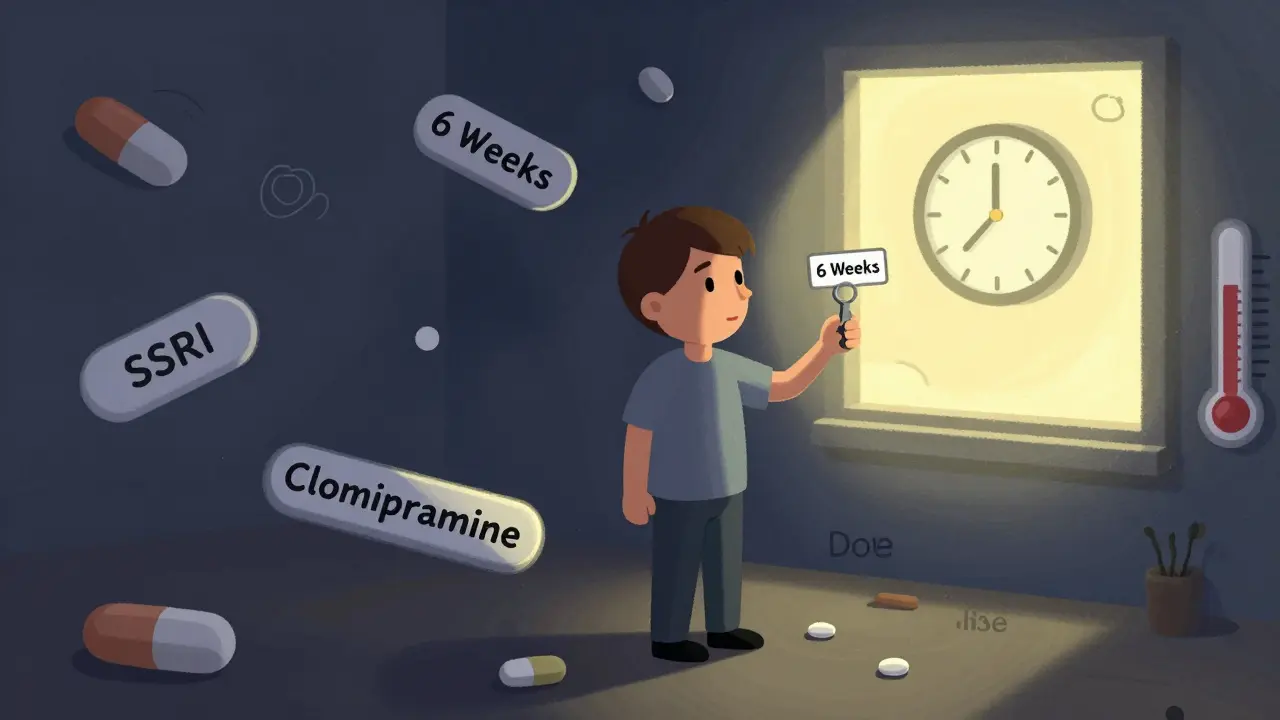
When someone is struggling with obsessive-compulsive disorder (OCD), finding the right medication can feel like searching for a key in a dark room. It’s not just about taking a pill-it’s about finding the right dose, the right drug, and the right balance between relief and side effects. For many, the journey starts with two main options: SSRIs and clomipramine. These aren’t just random choices. They’re the only two classes of medication with solid, research-backed evidence for treating OCD. Everything else? It’s usually added on, not used alone.
SSRIs: The First-Line Choice
SSRIs-selective serotonin reuptake inhibitors-are the go-to starting point for OCD treatment. Why? Because they work, and they’re generally easier to tolerate than older options. The FDA has approved several SSRIs for OCD: fluoxetine (Prozac), fluvoxamine (Luvox), paroxetine (Paxil), and sertraline (Zoloft). But here’s the catch: the doses needed for OCD are much higher than those used for depression.
For depression, you might start with 20 mg of sertraline. For OCD? You’ll likely need to get up to 200 mg, sometimes even 300 mg. That’s not a typo. A 2023 review from the International OCD Foundation says you need at least six weeks at a moderate to high dose before deciding if it’s working. Many people give up too soon, thinking the medication isn’t helping, when really, they just haven’t given it time.
Typical starting doses for SSRIs in OCD:
- Fluoxetine: 20 mg/day, increased to 40-60 mg/day
- Fluvoxamine: 25-50 mg/day, increased to 200-300 mg/day
- Paroxetine: 20 mg/day, increased to 40-60 mg/day
- Sertraline: 25 mg/day, increased to 200-300 mg/day
These aren’t suggestions-they’re clinical benchmarks. A 2023 study from Stanford’s OCD Center found that patients who didn’t reach at least 200 mg of sertraline were far less likely to see improvement. And it’s not just about the number. It’s about how slowly you get there. Doctors usually increase the dose by 25 mg every week or two. Rushing it can make anxiety worse before it gets better.
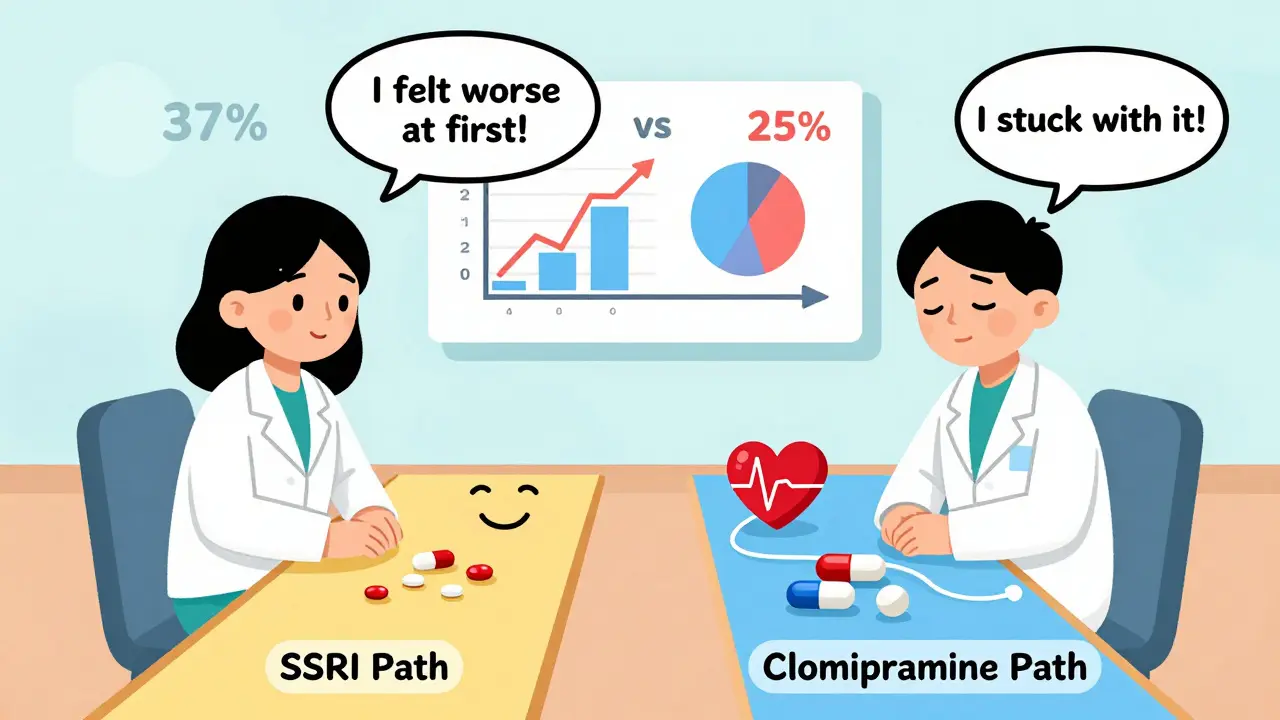
That’s another thing people don’t talk about enough: in the first 1-2 weeks, symptoms can get worse. A 2019 NIMH study found 37% of patients stopped taking their medication because they felt more anxious right after starting. But 89% of those who stuck it out saw improvement within 4-6 weeks. The key? Knowing this is normal. Talking to your doctor before you panic. And not quitting too soon.
Clomipramine: The Old Warrior
Clomipramine (Anafranil) was the first drug ever approved by the FDA specifically for OCD-in 1989. It’s a tricyclic antidepressant, not an SSRI. And while it’s not used as often anymore, it’s still one of the most powerful tools in the toolbox. In fact, some studies show it works better than SSRIs in kids and teens. One meta-analysis found clomipramine improved OCD symptoms by 37% in children, outperforming sertraline, fluoxetine, and fluvoxamine.
But here’s the trade-off: side effects. Clomipramine hits more receptors in the brain than SSRIs. That means it can cause dry mouth, constipation, weight gain, drowsiness, and even heart rhythm changes. The QTc interval-a measure of heart electrical activity-can get prolonged at doses over 150 mg. That’s why doctors monitor it with EKGs.
Dosing clomipramine is a careful dance:
- Adults: Start at 25 mg/day, increase by 25 mg every 4-7 days. Target: 100-250 mg/day. Max: 250 mg/day.
- Children (10+): 1-3 mg/kg/day, max 200-250 mg/day (Mayo Clinic recommends 200 mg max).
- Elderly: Start at 10 mg/day, rarely exceed 50 mg/day.
Most people need at least 100 mg to feel any benefit. Many don’t respond until they hit 150-200 mg. A Reddit survey of 856 users found 78% only saw improvement at 150 mg or higher. But 43% quit because of side effects. One user wrote: “Clomipramine at 175 mg stopped my checking rituals after 5 failed SSRIs. But I was so tired, I could barely work.”
It’s also usually taken at night because of its strong sedative effect. Some doctors split the dose-say, 75 mg in the morning and 125 mg at night-to manage drowsiness. And yes, blood levels matter. Researchers at Stanford found that people who responded to clomipramine had plasma levels of 220-350 ng/mL for clomipramine itself, and 379 ng/mL for its metabolite, desmethylclomipramine. That’s why some psychiatrists check blood levels, especially in tough cases.
SSRIs vs. Clomipramine: What’s the Real Difference?
Here’s the truth: for adults, SSRIs and clomipramine are about equally effective. Multiple head-to-head trials show no clear winner. But for kids? Clomipramine has a slight edge. And for adults with contamination fears? Clomipramine at 150-250 mg/day seems to work better than SSRIs.
But effectiveness isn’t everything. Tolerability is. A 2023 survey from OCD-UK found 62% of 1,247 users found SSRIs easier to handle. Common complaints about clomipramine? Dry mouth so bad you need five glasses of water an hour. Weight gain of 15-25 pounds in six months. Constant fatigue. Those aren’t rare-they’re routine.
SSRIs aren’t perfect, either. People report nausea, sexual side effects, and emotional numbness. But compared to clomipramine? The side effect burden is lighter. One study found 28% of people quit clomipramine due to side effects, versus 15-18% for SSRIs.
And cost? Generic SSRIs cost $350-$500 a year. Branded clomipramine? $800-$1,200. Insurance often covers SSRIs better. That’s not just a financial issue-it affects who gets treated.
When Clomipramine Makes Sense
The American Psychiatric Association says you should try two full SSRI trials before even thinking about clomipramine. Each trial needs 12 weeks, with at least 6 weeks at the highest tolerated dose. That’s a long time. But if you’ve tried two SSRIs and still can’t function? Clomipramine might be your next step.
It’s also used as an add-on. If you’re on an SSRI but only getting 40% improvement, adding a low dose of clomipramine (25-75 mg/day) can push you over the edge. Since 2020, this combination has grown by 15% a year. Why? Because it works. Research shows 35-40% of partial responders get significant relief from this combo.
Dr. Dan Stein, a leading OCD researcher, says clomipramine is underused. “It’s not that SSRIs fail,” he says. “It’s that we stop too early. Clomipramine can help 40-60% of treatment-resistant cases-if dosed right.”
What Comes Next?
The future of OCD treatment isn’t just about tweaking old drugs. In March 2023, the FDA gave Breakthrough Therapy status to a new serotonin modulator called SEP-363856. Early trials showed 45% response rates in people who hadn’t responded to anything else. Meanwhile, psilocybin-yes, the psychedelic compound in magic mushrooms-is being tested alongside SSRIs. A 2023 NIH trial found 60% of patients went into remission after psilocybin-assisted therapy, compared to 35% on SSRIs alone.
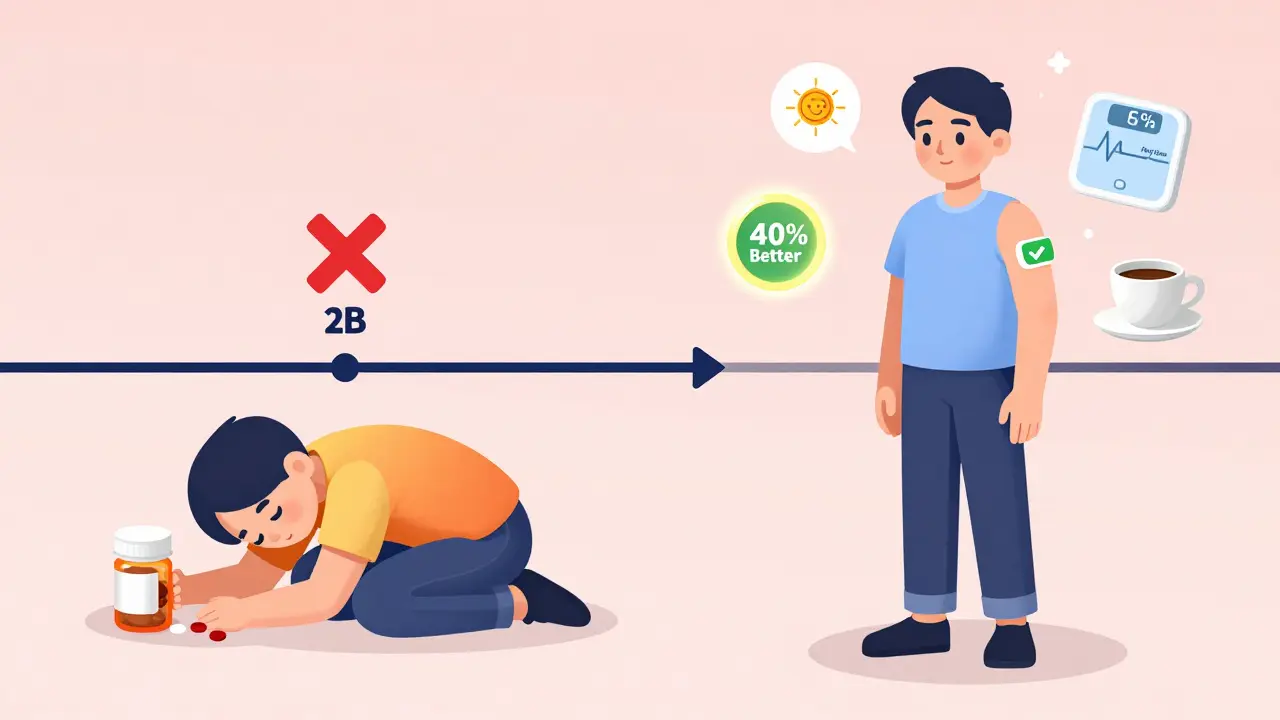
Even clomipramine is getting an upgrade. Researchers are testing a skin patch that delivers the drug slowly. Early results show it works just as well as the pill, but with 40% fewer side effects. That could change everything.
For now, though, the choice is still SSRIs first, clomipramine if needed. And dosing? It’s not a guess. It’s science. You need enough to work, but not so much that you can’t live with the side effects. Patience. Monitoring. And communication with your doctor. That’s what makes the difference.
Monitoring and What to Watch For
Starting any OCD medication isn’t a set-it-and-forget-it deal. You need regular check-ins. Every 2-4 weeks during the first few months, your doctor should be assessing your symptoms using the Yale-Brown Obsessive Compulsive Scale (CY-BOCS). A 25-35% drop in score is considered a good response.
For clomipramine, you’ll need:
- An EKG before starting and again if you go over 150 mg/day
- Liver function tests every 3-6 months
- Weight checks monthly
For SSRIs, watch for:
- Nausea (usually fades in 1-2 weeks)
- Sleep changes (insomnia or drowsiness)
- Sexual side effects (delayed orgasm, low libido)
- Increased anxiety in the first 10 days
If you feel worse after 2 weeks, don’t quit. Call your doctor. You might need a slower ramp-up. Or a different SSRI. Or a different approach altogether.
How long does it take for OCD medication to work?
Most people start seeing improvement after 4-6 weeks, but it can take up to 12 weeks to reach full effect. SSRIs need to be taken at a high enough dose for at least 6 weeks before deciding if they’re working. Clomipramine often takes 8-14 weeks to reach its peak benefit. Patience is key-quitting too early is one of the most common reasons treatment fails.
Can you take SSRIs and clomipramine together?
Yes, and it’s becoming more common. Combining a low dose of clomipramine (25-75 mg/day) with an SSRI can help people who only partially respond to SSRIs alone. Studies show this combo boosts response rates to 35-40% in treatment-resistant cases. But it requires careful monitoring because of increased side effects and potential drug interactions. This approach is usually reserved for people who’ve tried multiple medications without full success.
Is clomipramine better for kids than SSRIs?
Research suggests clomipramine may be slightly more effective than SSRIs in children and teens, with one meta-analysis showing a 37% improvement in symptoms compared to 25-30% for SSRIs. However, because of its side effect profile-weight gain, drowsiness, heart rhythm concerns-SSRIs are still typically tried first. Clomipramine is often reserved for kids who don’t respond to at least two SSRI trials. Dosing for children is weight-based: 1-3 mg/kg/day, with a max of 200-250 mg/day.
Why do SSRIs need higher doses for OCD than for depression?
OCD is more resistant to serotonin modulation than depression. Studies show that doses effective for depression (like 20 mg of sertraline) often don’t touch OCD symptoms. To get a response, you need to saturate serotonin receptors more fully-typically 200-300 mg of sertraline or 200-300 mg of fluvoxamine. This higher dose requirement is why many patients don’t respond until they’ve been on the medication at maximum tolerated levels for 6-12 weeks.
What happens if I stop my OCD medication suddenly?
Stopping abruptly can trigger withdrawal symptoms like dizziness, nausea, headaches, irritability, and a return of OCD symptoms-sometimes worse than before. This is especially true for SSRIs and clomipramine, both of which affect serotonin levels. Always taper down slowly under your doctor’s supervision. For clomipramine, a gradual reduction over 4-8 weeks is recommended. Never stop on your own, even if you feel better.
If you’re on OCD medication, you’re not alone. Thousands of people are walking this path right now-some on SSRIs, some on clomipramine, some on both. What matters isn’t which pill you’re taking. It’s whether you’re taking the right one, at the right dose, with the right support. And if one doesn’t work? There’s another. And another after that. The goal isn’t perfection. It’s progress. Slow, steady, and supported.
SSRIs at high doses are a grind but worth it. I went from 50mg to 250mg sertraline over 4 months. Felt like hell for 6 weeks. Now I can leave the house. Don't quit before 8 weeks.
I love how people act like clomipramine is some dark magic potion. It's not. It's just a heavier hammer. I took 200mg for 18 months. Lost 20 lbs of muscle because I couldn't get off the couch. SSRIs were rough but I kept working. Clomipramine? I stopped being a person.
lol so clomipramine works better for kids but nobody uses it because it turns you into a zombie with a dry mouth and a heart that might explode? yeah that's a tradeoff i'd totally make if i were a parent. also why is everyone so obsessed with dosing numbers like they're cooking a turkey?
I tried clomipramine 😅 it was like being hugged by a bear that also had a fever. But my checking stopped. So... worth it? 🤷♂️
The part about needing 6 weeks to see results is so critical. So many people think meds don't work because they feel worse at first. It's not failure. It's the process. Stay the course.
I got put on 25mg clomipramine and thought it was a joke. Then my doc upped it to 150 and I felt like a ghost. Couldn't talk. Couldn't move. But my rituals? Gone. I'd do it again. But man. The fatigue. It's not sleep. It's soul exhaustion.
Actually SSRIs don't work better for OCD. The studies are biased. Pharma funds most trials. Clomipramine is cheaper and more effective. They just don't want you to know that.
I'm from the Philippines and we don't even have clomipramine available here. SSRIs are the only option. It's frustrating. I've been on 250mg sertraline for 10 months. I'm 70% better. It's not perfect. But it's life-changing. So grateful for access to any of this.
I had a patient on 200mg sertraline for 14 weeks with zero improvement. We added 50mg clomipramine at night. Within 3 weeks, her contamination fears dropped 80%. The combo is real. Not magic. Just science. And it works when single agents fail. Never give up on the combo approach.
In clinical practice, we see 68% of patients achieve remission with optimized SSRI dosing. The key is adherence and titration. Many patients discontinue due to early side effects. The data is clear: persistence yields results. We must emphasize neuroplasticity timelines. Delayed response is not failure.
I was on clomipramine for 6 months. I lost my job. My wife left. I gained 30 pounds. I still had rituals. But I didn't quit. I switched back to sertraline. Now I'm at 225mg. I can breathe. I can work. I can hug my kid. It took 18 months. But I'm here. Don't listen to people who say 'it didn't work.' They just didn't wait long enough.