
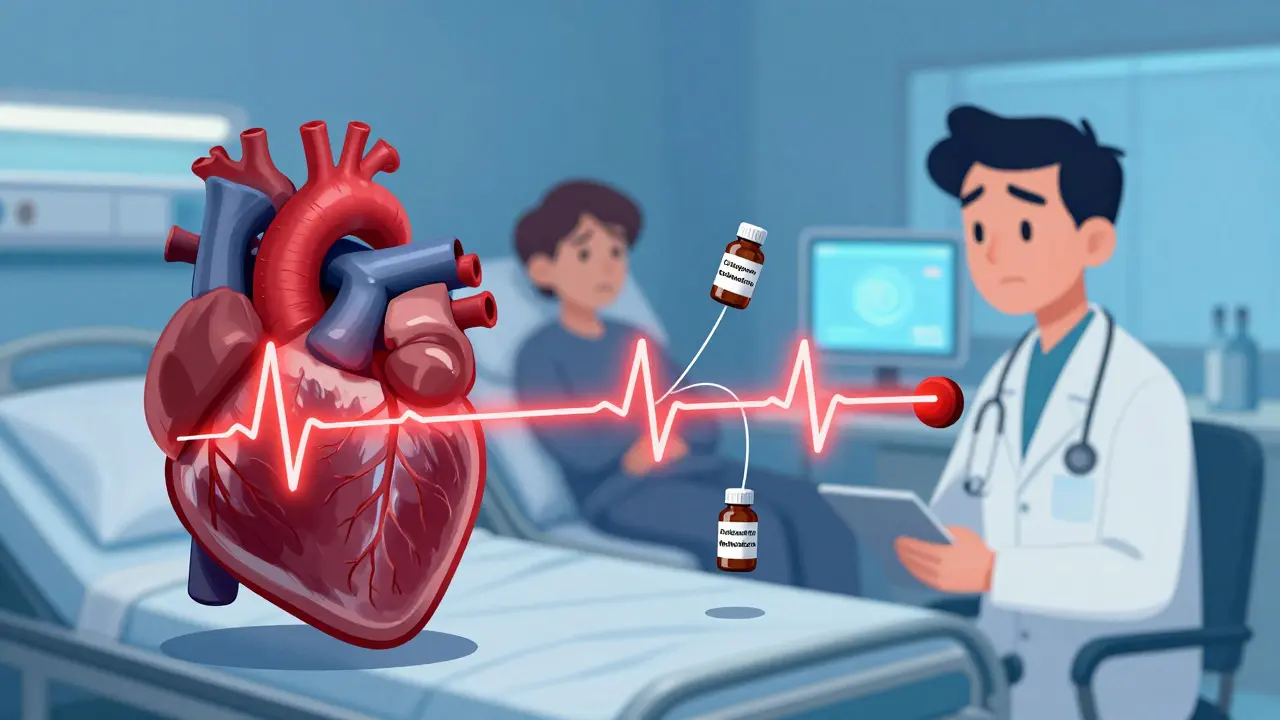
QT prolongation isn’t something most people hear about until it’s too late. It’s a silent electrical glitch in the heart that can turn a routine prescription into a life-threatening event. When the QT interval on an ECG stretches too long, it sets the stage for a dangerous rhythm called torsades de pointes - a type of ventricular tachycardia that can spiral into sudden cardiac death. And the scary part? Many of the drugs that cause this aren’t obscure experimental pills. They’re common medications you might already be taking.
What Exactly Is QT Prolongation?
The QT interval measures how long it takes your heart’s lower chambers (ventricles) to recharge after each beat. It’s shown as a spike and dip on an ECG tracing. When that interval gets too long, the heart muscle doesn’t reset properly. That delay creates an electrical imbalance, making the heart vulnerable to chaotic, rapid firing - torsades de pointes. This isn’t theoretical. It’s been documented in thousands of cases since the 1950s, starting with early antiarrhythmics like quinidine. The main culprit? Blockage of the hERG potassium channel. This channel, found in heart cells, helps pump potassium out to reset the electrical charge. When drugs bind to it - often unintentionally - they slow down repolarization. That’s what stretches the QT interval. The hERG channel is surprisingly easy to block. Even small changes in drug concentration can trigger it.Which Medications Are the Biggest Risks?
Not all QT-prolonging drugs are created equal. Some carry high risk even at normal doses. Others only become dangerous when combined with other drugs or in people with underlying conditions. High-risk cardiac drugs:- Sotalol: Used for atrial fibrillation, it prolongs QT by design - but that’s also why it causes torsades in 2-5% of patients.
- Dofetilide and ibutilide: These are used to reset heart rhythm in hospitals. They’re powerful, and the risk is real. Dofetilide requires hospital admission for the first 3 days of treatment - for monitoring.
- Quinidine and procainamide: Older antiarrhythmics. Quinidine causes torsades in up to 6% of users.
- Amiodarone: Yes, it prolongs QT - a lot. But its multi-channel effects make it less likely to cause torsades than sotalol. Still, it’s not safe to ignore.
- Methadone: Used for pain and opioid addiction. Risk spikes above 100 mg/day. TdP cases are well-documented, especially in patients on high doses without ECG monitoring.
- Citalopram and escitalopram: Common antidepressants. The FDA limited citalopram to 40 mg/day (20 mg for those over 60) because of clear QT prolongation at higher doses.
- Antibiotics: Erythromycin and clarithromycin (macrolides) can prolong QT by 15-25 ms. Azithromycin is lower risk, but still flagged. Fluconazole (an antifungal) is another silent player.
- Antipsychotics: Haloperidol, ziprasidone, and thioridazine carry black box warnings. Ziprasidone’s label explicitly mentions ventricular arrhythmia risk.
- Antiemetics: Ondansetron (Zofran) is given to cancer patients and those with nausea. It’s one of the top drugs linked to TdP in FDA reports - especially when paired with other QT-prolonging meds.
Why Some People Are at Higher Risk
It’s not just about the drug. The person matters - a lot. Women are at 70% higher risk. Hormonal differences make their hearts more sensitive to QT prolongation. The risk is highest in the postpartum period. Age over 65. Kidneys and liver slow down. Drugs stick around longer. Blood levels rise. QT prolongation becomes more likely. Electrolyte imbalances. Low potassium, low magnesium, low calcium - these make the heart even more electrically unstable. A simple case of vomiting or diuretic use can tip the scale. Genetics. About 30% of drug-induced TdP cases involve subtle hERG gene variants. People with these variants don’t know they’re at risk until they take a medication that triggers it. Drug combinations. This is where things get dangerous. Taking two QT-prolonging drugs together doesn’t just add risk - it multiplies it. A 2020 FDA analysis found 68% of TdP cases involved two or more such drugs. Common dangerous pairs: ondansetron + azithromycin, haloperidol + citalopram, erythromycin + fluconazole.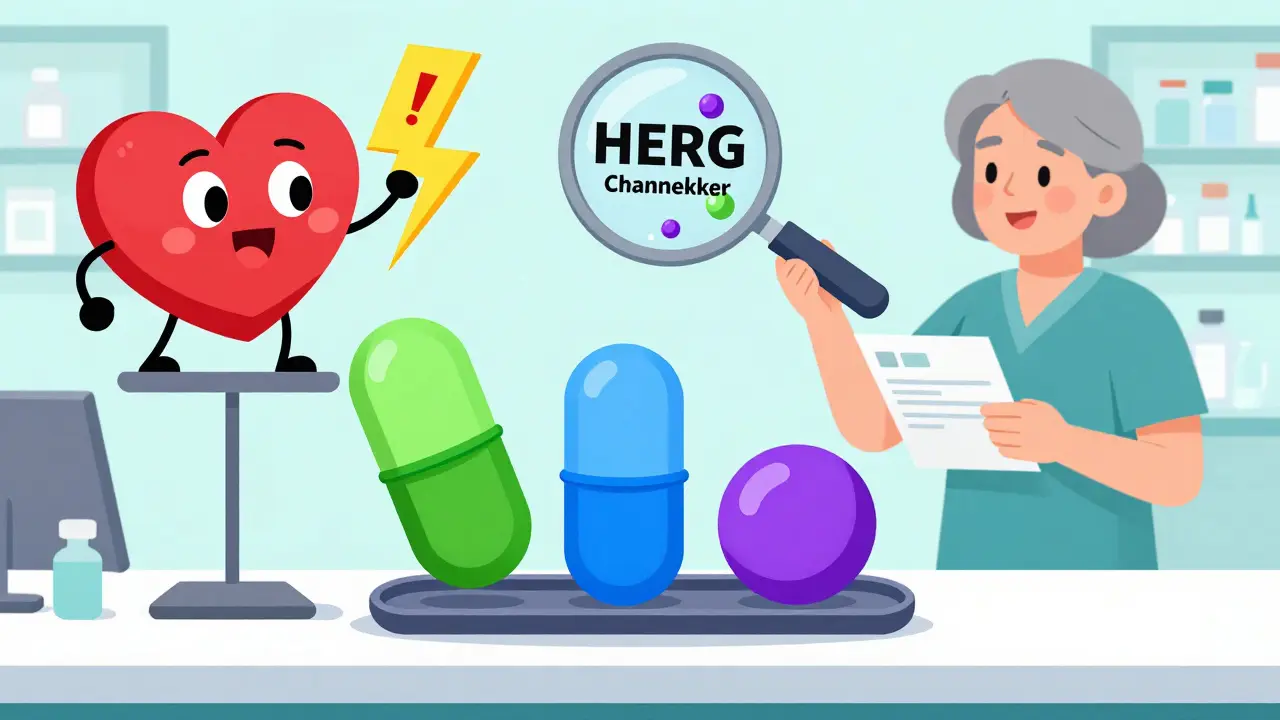
When Does QT Prolongation Become Dangerous?
Not every longer QT interval means danger. But there are clear red flags:- QTc over 500 milliseconds - risk of torsades triples to fivefold.
- An increase of more than 60 ms from baseline - even if still under 500 ms, this is a warning sign.
- Flat or notched T-waves on ECG - subtle signs that often precede torsades.
What Doctors Should Do - And Often Don’t
The European Society of Cardiology and the American Heart Association both recommend baseline ECGs before starting high-risk drugs. Repeat ECGs within 3-7 days after starting or increasing the dose. But in practice? Many doctors skip it. Why? Because they think the risk is too low. And for most people, it is. The absolute risk of TdP from a single non-cardiac drug is less than 1 in 10,000 per year. But when you have a 72-year-old woman on citalopram, with low potassium, taking ondansetron for nausea - that’s not a low-risk patient. That’s a ticking time bomb. A 2022 survey of 327 hospital pharmacists found 63% struggled to determine safe combinations of QT-prolonging drugs. Even experienced providers get overwhelmed. That’s why tools like crediblemeds.org - updated quarterly - are essential. It categorizes drugs as “Known Risk,” “Possible Risk,” or “Conditional Risk.” It’s the gold standard.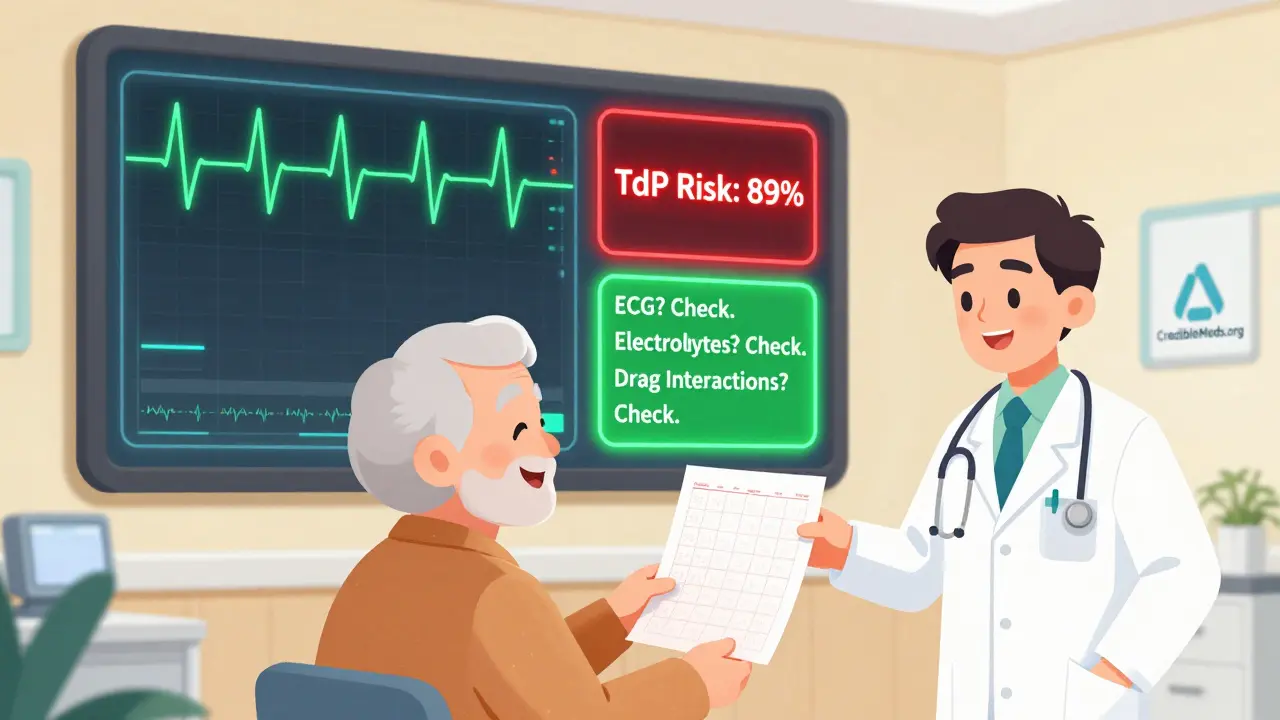
What You Can Do
If you’re on any of these medications, here’s what matters:- Ask your doctor: “Could this drug affect my heart rhythm?”
- Know your ECG history. If you’ve had a baseline ECG, keep a copy. Bring it to appointments.
- Watch for symptoms. Dizziness, fainting, palpitations, or sudden fatigue - especially after starting a new drug - need immediate attention.
- Don’t combine meds without checking. If you’re prescribed something new, ask your pharmacist if it interacts with your other drugs.
- Check electrolytes. If you’re on diuretics or have had vomiting/diarrhea, get your potassium and magnesium levels checked.
So let me get this straight - you’re telling me my grandma’s Zofran and my neighbor’s methadone could literally kill them if they don’t get an ECG first? And doctors just shrug? That’s not healthcare, that’s Russian roulette with a prescription pad. I’ve seen this happen. My uncle died at 68 from a ‘routine’ antibiotic combo. No one warned him. No one checked his QT. Now his wife has to live with that. Stop pretending this is rare. It’s not. It’s negligence dressed up as standard care.
This is one of those posts that makes you pause. I’m not a doctor, but I’ve worked in pharmacy for 18 years - and I’ve seen the quiet panic when someone’s QT spikes after a new script. What’s heartbreaking isn’t the drugs themselves - it’s how often we forget to ask: ‘Who is this person?’ Not just their diagnosis, but their age, their electrolytes, their other meds, their history. We treat symptoms, not systems. And that’s where the cracks open. I’ve flagged 37 risky combos in the last year alone. Most got overridden. We need better tools - and more humility.
Just had to comment because I’m a nurse and this is SO real. I had a patient last month - 74yo woman on citalopram, furosemide, and ondansetron for chemo nausea. Baseline QT was 440. Three days later? 518. She got dizzy walking to the bathroom. We caught it because we checked. She’s fine now. But if we hadn’t? She wouldn’t be. Please if you’re on any of these meds - especially if you’re older or on diuretics - ask for an ECG. It takes 5 minutes. Could save your life. And if your doctor says ‘it’s unlikely’ - ask them to show you the data. CredibleMeds.org is your friend.
It’s astounding how many clinicians still rely on Bazett’s formula in 2024. The correction is mathematically invalid at heart rates outside 60–80 bpm, yet it’s still the default in most ECG machines. Fridericia’s is superior for slow rates, and the Framingham correction is better for fast ones. And don’t get me started on how ‘QTc < 500’ is treated as a magic number when TdP has occurred at 480 in women with hypomagnesemia. This isn’t just ignorance - it’s systemic incompetence masked as protocol. The FDA’s CiPA initiative is a step forward, but until labs stop using outdated algorithms, we’re just rearranging deck chairs on the Titanic.
My mom’s on amiodarone and I didn’t know any of this until she almost passed out last year. I started reading everything I could. CredibleMeds.org changed my life. Now I print the risk levels for every new med she gets. I’ve become the family pharmacist. I don’t care if people think I’m obsessive - I’d rather be annoying than bury my mom. If you’re caring for someone on meds, do this. Print the chart. Bring it to appointments. Ask the pharmacist. Don’t wait for a crisis. You won’t get a second chance.
So basically… my antidepressant and my nausea pill are trying to kill me? Cool. Thanks for the heads up. I guess I’ll just stop taking everything and hope my heart doesn’t notice. 😅
OMG this is why I hate American medicine so much like literally everyone is just on 10 drugs and no one checks anything like my cousin in Texas got hospitalized because she took azithromycin and sertraline and her QT went to 560 and they didn’t even know what it meant until her sister Google it like how is this even legal like why do doctors even exist if they don’t know this like I swear if I had a dollar for every time someone died from a combo like this I could buy a whole hospital and fire all the staff and replace them with AI bots that actually read the labels
Let’s be brutally honest: this isn’t about ‘risk.’ It’s about liability avoidance. Hospitals don’t want to pay for ECGs. Pharmacies don’t want to flag every interaction. Pharma companies don’t want to delay approvals. So they downplay it. The data is there. The guidelines exist. But enforcement? Nonexistent. The fact that you need to Google ‘crediblemeds.org’ to stay alive should be a national scandal. This isn’t patient care - it’s profit-driven triage. And the people who pay? The elderly. The women. The poor. Again.
There’s a quiet tragedy here - we’ve outsourced our bodily awareness to algorithms and prescriptions. We trust the pill more than the pulse. We assume the doctor knows, the machine measures, the system protects. But the heart doesn’t care about protocols. It only responds to chemistry, to imbalance, to silence. QT prolongation is a whisper before a scream. And we’ve trained ourselves not to listen. Maybe the real danger isn’t the drugs - it’s our collective surrender to the illusion of safety. What if the cure isn’t more testing… but more attention? More presence? More humility before the body’s quiet, ancient rhythm?