
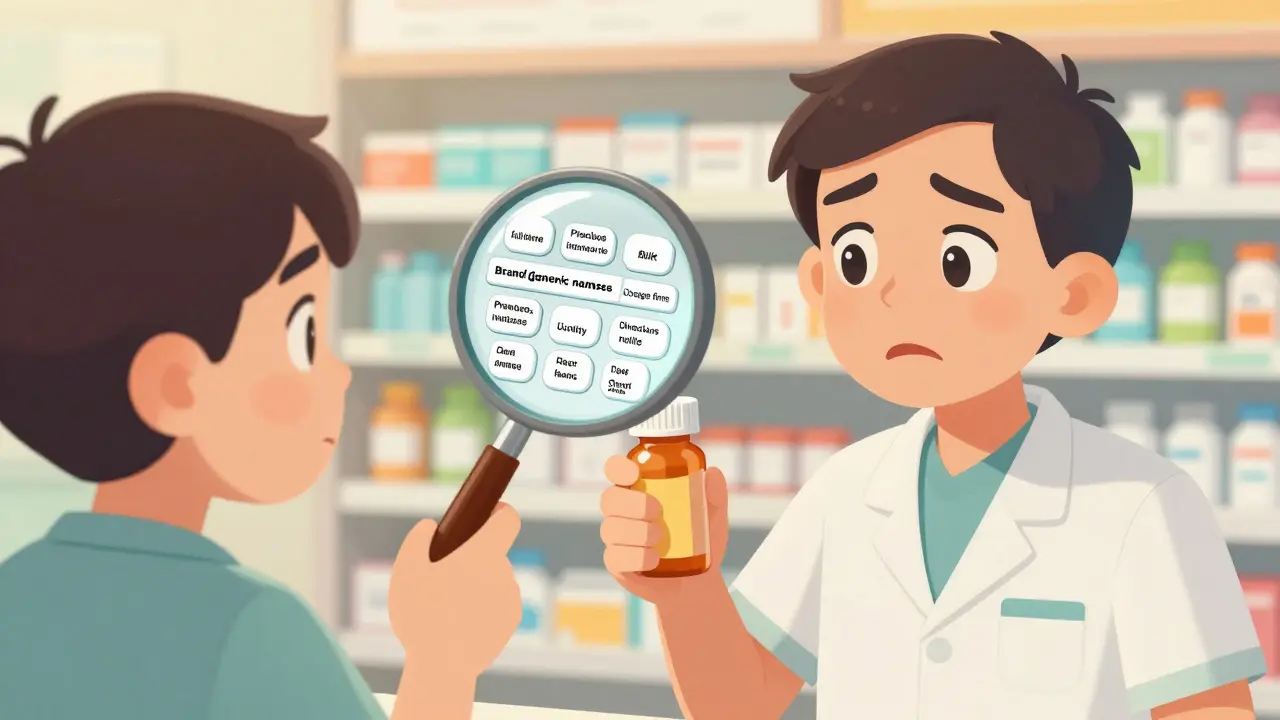
Every year, over 4.9 billion prescriptions are filled in the U.S. That’s more than 15 million a day. But here’s the problem: prescription labels aren’t always clear. You might think you know what’s written on that little slip of paper, but you could be missing something critical. A 2023 FDA report found that 22% of medication errors happen because patients misunderstood their labels. That’s not a small number - it’s 1.3 million preventable mistakes annually. And many of those mistakes happen because no one asked the right questions at the pharmacy.
What’s Actually on Your Prescription Label?
Your prescription label isn’t just a name and a number. It’s a legal document with nine mandatory elements required by the National Association of Boards of Pharmacy. If any of these are missing, the label doesn’t meet federal standards. Here’s what you should see:- Your full name (not just "J. Smith")
- The prescriber’s name and contact info
- The drug’s brand name AND generic name (e.g., "Lipitor" and "atorvastatin")
- The strength (e.g., 10 mg, not just "10")
- The dosage form (tablet, capsule, liquid, etc.)
- The quantity (how many pills or mL you got)
- Directions for use (e.g., "Take one by mouth at bedtime")
- Number of refills allowed
- The pharmacy’s phone number and address
That’s the baseline. But labels often include more - like expiration dates, storage instructions, and barcodes. If you’re handed a bottle and can’t find one of these nine items, ask for a corrected label. It’s your right.
Ask About the "5 Rights" - Your Personal Safety Checklist
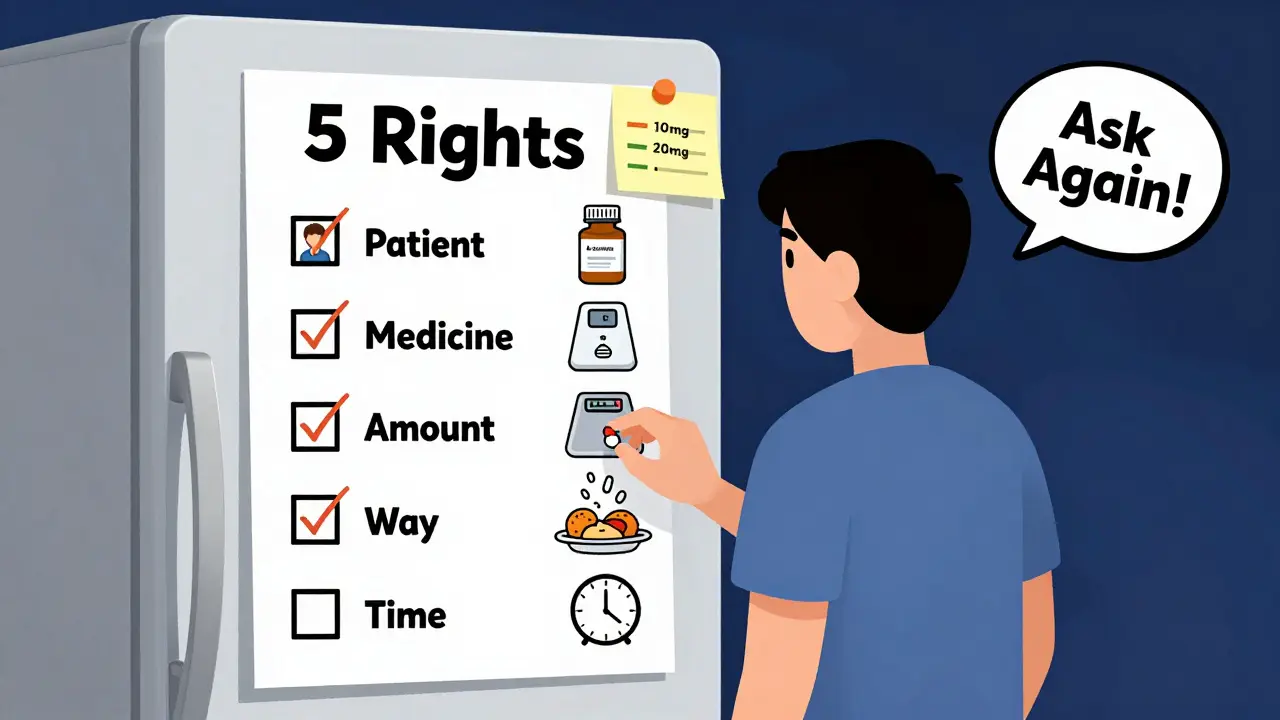
The Institute for Safe Medication Practices created the "5 Rights" system to stop medication errors before they happen. Use it every time you pick up a prescription. Don’t just nod along - verify each one out loud.- Right Patient: "Is this prescription for Anna Smith?" - Match it to your ID.
- Right Medicine: "Is this the same drug my doctor told me about?" - Compare the name on the label to what your doctor said. Brand names can be confusing. If you’re used to generic atorvastatin, but the label says Lipitor, ask if they’re the same thing.
- Right Amount: "Is this 10 mg or 20 mg?" - A simple mix-up here can be dangerous. One patient in a 2022 CDC report took 20 mg of lisinopril thinking it was 5 mg. She ended up in the ER.
- Right Way: "Should I take this with food? Can I crush it?" - Some pills lose effectiveness if crushed. Others cause stomach damage if taken on an empty stomach.
- Right Time: "Should I take this in the morning or at night?" - Some meds work better at certain times. Blood pressure pills, for example, are often more effective when taken at bedtime.
Pharmacists say the biggest safety boost comes from patients repeating instructions back. If you say, "So I take one tablet at night, with food, and I can refill this twice?" - they’ll correct you if you’re wrong. That simple step cuts errors by nearly 60%.
Storage Matters - More Than You Think
You might assume all pills are fine in your bathroom cabinet. They’re not. According to a 2022 American Pharmacists Association survey, 78% of prescriptions need room temperature (68-77°F). But 15% need refrigeration. That includes insulin, certain antibiotics like azithromycin, and some biologics.One patient in Boston left her insulin in her car for two hours after picking it up. The temperature hit 90°F. The insulin degraded. She didn’t realize until her blood sugar spiked. Her pharmacist later told her: "We put a sticker on the bottle. You just didn’t see it."
Ask: "Does this medicine need to be refrigerated?" Then check the label for the exact temperature range. If it says "store between 36-46°F," keep it in the fridge - not the door. The door fluctuates too much. If you’re unsure, ask for a printed storage guide. Many pharmacies now offer this as a small card you can stick on your fridge.
Expiration Dates Aren’t Just for Show
The FDA requires expiration dates based on stability testing. That means the drug is guaranteed to work as intended until that date - if stored properly. But many people think expiration = useless. That’s not true. Most medications stay effective for years after the date. However, some - like nitroglycerin, insulin, and epinephrine - degrade quickly and can become dangerous.Ask: "What happens if I use this after the expiration date?" For critical meds like EpiPens or asthma inhalers, the answer is simple: Don’t use it. For others, like antibiotics or pain relievers, your pharmacist can tell you if it’s still safe. Never assume.
Refills and Restrictions - What You Might Be Missing
The label says "3 refills." But does that mean you can get it three more times, or three times total? It means three more times after the first fill. So if you picked it up last week, you have three more refills left.But here’s the catch: Some drugs have legal limits. Opioids, for example, can’t be refilled after 6 months without a new prescription. Others, like Adderall, require a new script every 30 days. If your refill is denied, don’t assume it’s a pharmacy error. Ask: "Why can’t I refill this? Is there a legal limit?"
Also, check for "Do Not Substitute" or "Dispense as Written" notes. These mean your doctor specifically wants the brand name, not a generic. If you’re handed a generic without being told, ask why. It’s not a mistake - it’s a choice your doctor made.
What About Those Tiny Print and Foreign Languages?
You’re not alone if you can’t read the label. Nearly 80 million U.S. adults struggle with health literacy. The FDA estimates 42% of Americans misinterpret standard prescription labels. The text is often too small, the font too thin, the contrast too low.Ask for a large-print label. It’s not a special request - it’s a right. 92% of U.S. pharmacies offer this free. You can also ask for a translated version. Under the Affordable Care Act, pharmacies receiving federal funds must provide language assistance. If you speak Spanish, Mandarin, Vietnamese, or any of the 350 languages spoken in U.S. homes, you’re entitled to a label in your language.
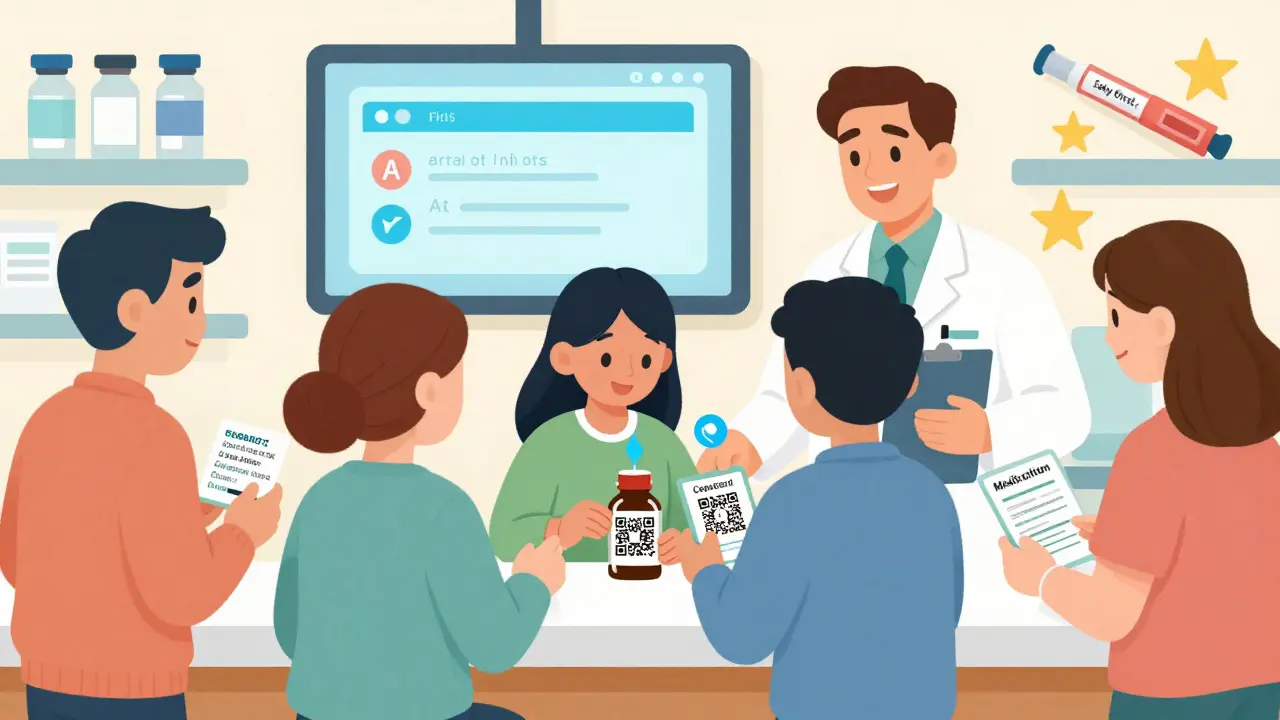
And if you’re visually impaired, ask if they have audio labels or QR codes. Many pharmacies now link to video instructions. Scan the code with your phone, and a pharmacist will walk you through the instructions in plain language.
High-Risk Medications Need Extra Attention
The FDA requires a separate Medication Guide for 107 high-risk drugs. These include opioids, blood thinners, diabetes meds, and antidepressants. If you’re given one of these, you should get a printed guide - usually 2-3 pages - that explains risks, side effects, and what to avoid.Ask: "Do I get a Medication Guide with this?" If they say no, ask why. If it’s one of the 107, they’re legally required to give it to you. Don’t take it home without reading it. One study found patients who read their Medication Guides were 47% less likely to have an adverse reaction.
Why Your Pharmacy Matters
Not all pharmacies are the same. Independent pharmacies score higher in patient satisfaction than big chains. A 2023 Consumer Reports survey found independent pharmacies averaged 4.3/5 stars for labeling clarity, while CVS and Walgreens scored 3.2 and 3.1 respectively.Why? Independent pharmacists often spend more time with patients. They’re more likely to sit down, explain the label, and answer questions without rushing. If you’re confused, try going to a smaller pharmacy. You might get better service - and fewer errors.
What to Do If Something Feels Off
You don’t need to be an expert to spot a problem. If the pill looks different from last time. If the directions don’t match what your doctor said. If the label says "take twice daily" but your doctor said "once daily" - trust your gut.Call the pharmacy. Ask: "Can you double-check this label? I’m confused because..." Then explain why. Pharmacists expect this. In fact, they prefer it. The FDA says the most effective safety tool isn’t technology - it’s patient engagement. When you ask questions, you’re not being difficult. You’re saving your life.
Future Improvements Are Coming
By 2026, all high-risk medications in the U.S. will need scannable QR codes linking to updated safety info. Some pharmacies already use augmented reality labels - point your phone at the bottle, and digital instructions appear over the pill. AI-powered systems are being tested to flag mismatches between prescriptions and labels before you leave the counter.But none of that replaces you asking questions. Technology helps. But only you can catch the small things: "Wait - this isn’t the color I remember," or "My doctor said to take it with water, not milk." Those are the moments that prevent hospital visits.
What if I don’t understand the instructions on my prescription label?
Ask the pharmacist to explain it in plain language. You can also request a large-print version, a translated version, or a video instruction link via QR code. Pharmacists are trained to help patients with low health literacy - it’s part of their job. Don’t pretend you understand just to avoid embarrassment. Misunderstanding a label can lead to serious harm.
Can I get a printed copy of my prescription label to take home?
Yes. Most pharmacies will print a simplified version of your label with key details: drug name, dose, frequency, and storage instructions. Some even offer a one-page summary card. Ask for it when you pick up your prescription. Keep it on your fridge or in your wallet.
Why does my label say a different name than what my doctor prescribed?
Your doctor may have prescribed the brand name (like "Lipitor"), but the pharmacy dispensed the generic ("atorvastatin"). This is legal and common - generics are cheaper and just as effective. But if your doctor wrote "Do Not Substitute," the pharmacy should have given you the brand. If you’re unsure, ask: "Is this the same as what my doctor ordered?"
How do I know if my medication needs to be refrigerated?
Check the label for storage instructions. Look for phrases like "refrigerate," "store between 36-46°F," or "keep cold." If it’s not clear, ask the pharmacist. Some medications, like insulin or certain antibiotics, lose effectiveness if left at room temperature. Never guess - ask.
What should I do if I think there’s a mistake on my label?
Don’t take the medication. Call the pharmacy immediately. Say: "I think there’s an error on my label - can you verify the drug name, dose, and instructions?" Bring the bottle back if needed. Pharmacists are required to double-check prescriptions before dispensing. If they made a mistake, they’ll fix it. Your safety comes first.
Are there free resources to help me understand my prescription label?
Yes. The FDA’s "Medication Check-Up" program offers free label comprehension assessments at over 8,400 pharmacies nationwide. You can also visit the FDA’s website for plain-language guides on common medications. Many community health centers offer free one-on-one counseling with pharmacists. Ask your pharmacy if they partner with one.
Label clarity is everything. I’ve seen folks skip the generic/brand name check and end up with a 2x dose because they didn’t realize Lipitor and atorvastatin are the same. Pharmacists don’t always explain it - you gotta ask. No shame in saying, "Wait, is this the same as last time?"
YOOOOO THIS IS LIFE OR DEATH STUFF. I almost died because I didn’t ask about refrigeration. My insulin sat in my car for 3 hours in 95°F heat. I thought it was fine. I was WRONG. Pharmacies need to slap neon stickers on bottles. Like, literally. A glowing red sign that says "KEEP COLD OR DIE."
😭 I cried when my pharmacist gave me a printed card with my med schedule. I have ADHD and I forget everything. She didn’t have to do it. She just… did. I’ve kept it on my fridge for 2 years now. Thank you, unsung heroes.
The premise of this article is fundamentally flawed. The FDA’s 22% error rate is based on self-reported data, which is statistically unreliable. Moreover, the 5 Rights framework is a theoretical construct with minimal empirical validation in real-world pharmacy settings. You’re attributing causality where correlation is more likely.
As a clinical pharmacist for 18 years, I can confirm: the most critical intervention is patient verbal confirmation. When a patient repeats the instructions back, error rates drop by 58–62%. This is not anecdotal - it’s documented in JAMA and the American Journal of Health-System Pharmacy. The label is a legal document, but the conversation is the safeguard.
Oh honey, you mean you didn’t know that your 3 refills mean 3 refills AFTER the first fill? And you thought it was 3 total? Sweetie, welcome to the club of people who read labels like they’re cereal boxes. 😘
India has been doing this right for decades. We don’t need QR codes or AI. Our pharmacists sit with you. They ask if you ate. They check if your kid is allergic. They speak your language. Why are Americans so lazy? You pay $150 for a pill and then don’t even ask if it’s the right color? Pathetic.
It’s worth noting that the National Association of Boards of Pharmacy mandates nine elements, but enforcement varies by state. Some states require only six. This inconsistency undermines the entire system. Standardization at the federal level is not optional - it’s a public health imperative.
Ask. Always ask. It’s not annoying. It’s your right. And if they act like you’re bothering them, find a new pharmacy.
Pharmacists are trained to recognize health literacy barriers. The provision of translated labels, large print, and audio instructions is not a courtesy - it is a requirement under Title VI of the Civil Rights Act. If you are denied these accommodations, file a complaint with the Office for Civil Rights. Your safety is non-negotiable.
💖 I started asking questions after my grandma almost took the wrong pill. Now I do it for everyone. I even made a little checklist on my phone: Patient? Medicine? Dose? Way? Time? 📋✨ And I hand it to the pharmacist. They always smile. It’s weirdly empowering.
So let me get this straight - you’re saying we should trust a pharmacist more than our own doctor? Because that’s what this article is really saying. And also, why is everyone so scared to read tiny print? Grow a pair.
Independent pharmacies in the UK routinely provide personalized medication reviews. The NHS has been doing this for over a decade. The issue is not lack of knowledge - it’s systemic underfunding of community pharmacy services. In the U.S., the profit model disincentivizes time-intensive counseling. This is a policy failure, not a patient failure.
As a first-gen immigrant, I didn’t know I could ask for a Spanish label. I thought I had to "figure it out." Took me three wrong refills to learn. Now I tell everyone: your language is your right. Don’t let them make you feel small for needing clarity.
If the label says "take at bedtime," and your doctor said "take in the morning," ask. Always ask. It’s not a trick question. It’s how people die.