
SGLT2 Inhibitor Side Effects Risk Calculator
This calculator helps you understand your risk of dehydration, dizziness, and blood pressure changes when taking SGLT2 inhibitors. Based on your age, blood pressure, medications, and hydration habits.
Your Risk Level
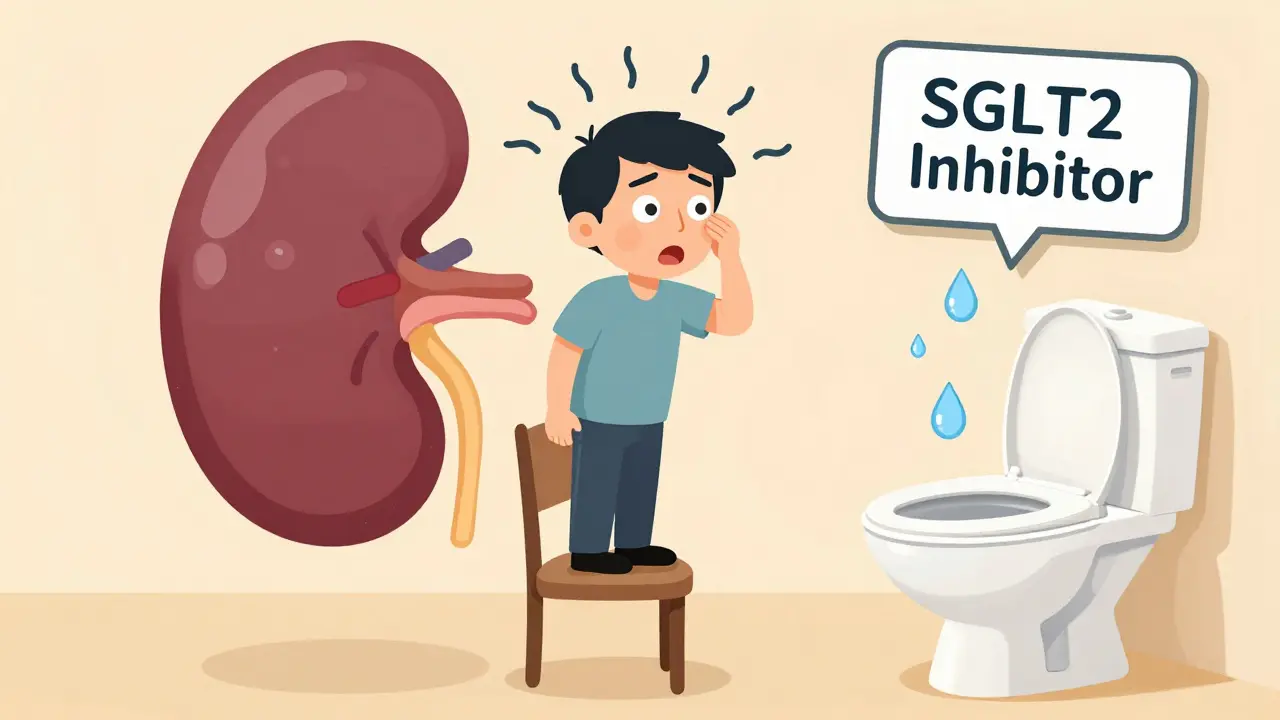
When you start taking an SGLT2 inhibitor like Jardiance, Farxiga, or Invokana, you might not expect to feel dizzy or unusually thirsty. But these side effects aren’t rare-they’re built into how the drug works. SGLT2 inhibitors were originally designed to lower blood sugar by making your kidneys dump glucose into your urine. But that same mechanism also pulls water and sodium out with it, turning these diabetes pills into mild, steady diuretics. And that’s where the real-world effects-dehydration, dizziness, and blood pressure drops-come from.
How SGLT2 Inhibitors Work as Diuretics
These drugs block a protein in your kidneys called SGLT2, which normally reabsorbs glucose back into your bloodstream. When it’s blocked, about 70 to 100 grams of glucose spill into your urine every day. That might sound like a lot, but here’s the catch: glucose pulls water along with it. For every gram of glucose excreted, your body loses about 3 to 4 mL of water. That adds up to 1 to 1.5 liters of fluid lost in the first week. That’s the same as taking a low-dose water pill every day.
It’s not just sugar leaving your body-sodium goes too. By blocking sodium reabsorption, these drugs reduce the amount of fluid in your blood vessels. That’s why they lower blood pressure, even in people without diabetes. In clinical trials, empagliflozin dropped systolic blood pressure by 4 to 6 mmHg within weeks. Dapagliflozin did the same. That’s not a small change. It’s enough to reduce stroke risk and ease strain on your heart.
But here’s the trade-off: your body doesn’t know the difference between losing glucose for a good reason and losing fluid by accident. If you’re not drinking enough, or if you’re on other blood pressure meds, that fluid loss can tip you into trouble.
Why Dehydration Happens-and Who’s at Risk
Dehydration from SGLT2 inhibitors isn’t just about feeling dry. It can lead to dizziness, fainting, kidney stress, and even hospitalization. Studies show that 1.3% to 2.8% of people taking these drugs experience volume depletion, compared to less than 1% on placebo. That might sound low, but when you’re talking about millions of prescriptions, that’s thousands of people.
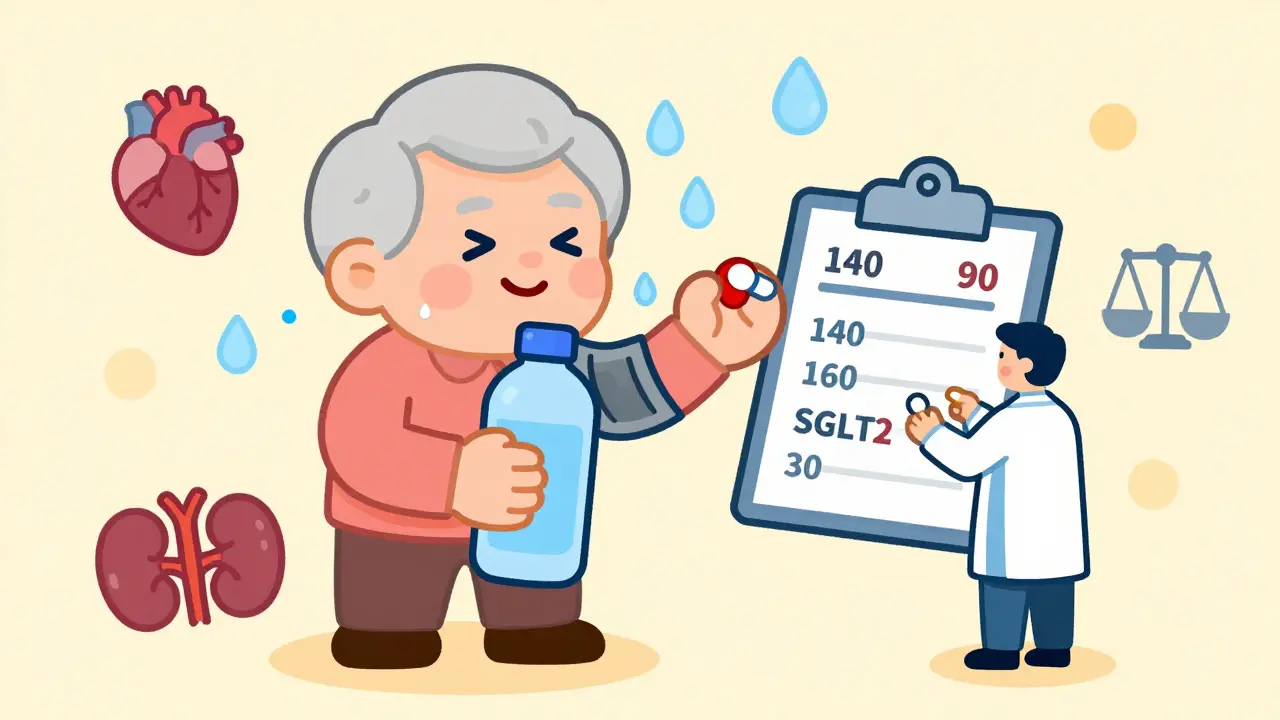
Some groups are far more vulnerable. People over 65 are 2.1 times more likely to have dehydration-related issues. That’s partly because older adults often don’t feel thirsty until they’re already dehydrated. If you’re taking a diuretic like furosemide, or an ACE inhibitor like lisinopril, your risk doubles. Same if your blood pressure is already low-below 120 mmHg systolic.
Real-world reports back this up. On patient forums, people describe dry mouth, dark urine, and feeling lightheaded when standing up. One Reddit user wrote: “Canagliflozin made me so dehydrated I had to stop after 3 weeks-constant thirst but dry mouth.” That’s not an isolated story. In clinical trials, 0.8% of people on empagliflozin quit because of volume depletion. That’s more than twice the placebo rate.
Dizziness: The Most Common Symptom
Dizziness is the #1 complaint tied to SGLT2 inhibitors. Clinical trials show 3.5% to 5.8% of users report it, compared to 2.5% to 3.2% on placebo. But here’s what most people don’t realize: dizziness isn’t random. It’s almost always linked to orthostatic hypotension-your blood pressure dropping when you stand up.
Studies found that 63% of patients who felt dizzy had a systolic BP drop of 20 mmHg or more when standing. That’s the kind of drop that makes your vision go gray and your knees buckle. It’s most common in the first 4 weeks, right when your body is adjusting to the fluid loss.
Age plays a big role. People over 75 have more than double the risk. So do those with baseline blood pressure under 130 mmHg. And if you’re on a diuretic already? Your odds jump by 3 times. Canagliflozin has the highest reported dizziness rate-6.3 cases per 1,000 patient-years-likely because it’s the strongest diuretic in the class.
But here’s the twist: most cases are mild and fade. In one study, 62% of people who felt dizzy said it was temporary. Still, 28% were so bothered they considered quitting. That’s why doctors now check orthostatic blood pressure at the 1-week follow-up. If your systolic drops below 90, or you’re dizzy when standing, they may lower your dose or pause the drug.
Blood Pressure: A Benefit That Comes with a Catch
The blood pressure drop from SGLT2 inhibitors isn’t a bug-it’s a feature. In heart failure patients, lowering blood pressure by even 5 mmHg reduces hospitalizations and death. The EMPEROR-Reduced and DAPA-HF trials proved this. Dapagliflozin cut cardiovascular death by 17% in heart failure patients, even those without diabetes.
But that benefit only works if you’re not too low. If your blood pressure is already borderline-say, 110/70-then losing another 5 to 10 mmHg can make you feel weak, tired, or faint. That’s why guidelines now say: check your blood pressure before starting. If it’s under 110 mmHg systolic, you’re at high risk for problems.
What’s surprising is that these drugs lower blood pressure even in people with normal or low glucose. That means their effect isn’t just about sugar-it’s about fluid balance, arterial stiffness, and kidney function. In fact, SGLT2 inhibitors reduce arterial stiffness by 8-12% over 24 weeks. That’s a direct benefit to your heart and arteries, independent of weight loss or sugar control.
Still, the same mechanism that helps your heart can hurt your balance. That’s why the American Heart Association recommends checking orthostatic vital signs before and after starting these drugs. It’s not just about safety-it’s about making sure you get the benefit without the crash.

How to Stay Safe While Taking These Drugs
You don’t have to avoid SGLT2 inhibitors if you’re worried about side effects. You just need to be smart about it.
- Start low. If you’re over 65, have kidney issues, or take other blood pressure meds, ask for the lowest dose-10 mg of empagliflozin instead of 25 mg.
- Hydrate. Drink an extra 500 to 1,000 mL of water a day, especially in hot weather or after exercise. Don’t wait until you’re thirsty.
- Watch for warning signs. Dark urine, dry mouth, lightheadedness when standing, or sudden weight loss (more than 2 kg in a week) are red flags.
- Check your blood pressure. Take it lying down and then standing up. If your systolic drops 20 mmHg or more, tell your doctor.
- Hold the drug if you’re sick. If you have vomiting, diarrhea, or can’t eat or drink for a day, pause the medication. Fluid loss from illness + SGLT2 = high risk.
- Don’t panic about dizziness. Most cases fade in 2 to 4 weeks. But if it’s severe or lasts longer, ask about lowering your diuretic dose instead of stopping the SGLT2 inhibitor.
Many patients worry that dizziness means the drug isn’t right for them. But in heart failure patients, the benefits far outweigh the risks. One expert put it this way: “The 17% drop in death with dapagliflozin means 6 lives saved per 100 patients over 18 months. The dizziness? Usually temporary.”
When to Talk to Your Doctor
Call your doctor right away if:
- You feel faint or pass out
- Your urine is dark, or you haven’t urinated in 12 hours
- You’ve lost more than 2 kg (4.5 lbs) in a week without trying
- Your dizziness is getting worse, not better
- You’re confused, weak, or have a rapid heartbeat
These aren’t normal side effects-they’re signs of volume depletion. Your doctor might adjust your dose, hold the drug temporarily, or check your kidney function and electrolytes.
But don’t stop the medication on your own. For many people, especially those with heart failure or chronic kidney disease, the long-term benefits-fewer hospital stays, slower kidney decline, lower risk of heart attack-are life-changing. The side effects? Often manageable.
The key is awareness. Know how the drug works. Know your risks. Know the signs. And don’t be afraid to speak up if something feels off. You’re not overreacting-you’re being smart.
Bro, I started Jardiance and thought I was dying. Went from hydrated to "why is my tongue stuck to the roof of my mouth" in 48 hours. 😵💫💧 Then I realized - it's not a bug, it's a FEATURE. Drink water like it's your job. Now I chug 3L a day and feel like a superhero. 🦸♂️
I love how this post breaks it down without scaring people. I was terrified at first, but my doc told me to sip water all day and check my BP standing up. Now I’ve been on it for 8 months and my HbA1c is at 5.8. My dizziness faded after two weeks. You’re not broken-you’re adjusting. 💛
I’m 68 and on this med. Honestly? I thought I’d hate it. But my BP dropped from 145 to 125 and I’m sleeping better. I just carry a water bottle everywhere now. It’s weird, but kinda empowering? Like I’m in charge of my body again. 🤷♀️
The key is listening to your body not the internet. I got dizzy at first too. Didn't panic. Dr told me to stand up slower. Now I'm fine. Simple stuff works
Let’s be real. This isn’t medicine-it’s a slow-motion water torture protocol disguised as a diabetes solution. You’re forcing your kidneys to act like a broken faucet while pretending it’s a ‘benefit.’ And don’t get me started on the placebo-controlled trials where they cherry-pick ‘mild dizziness’ as if it’s a minor inconvenience. This is pharmacological manipulation disguised as science. The real benefit? Pharma profits. The real cost? Your electrolytes, your dignity, and your ability to stand up without seeing stars. You think you’re managing diabetes? You’re managing a side effect cascade. And for what? A 17% reduction in cardiovascular death? That’s not a cure-it’s a statistical consolation prize for people who are already on the edge. If your body’s screaming for water and you’re still popping pills because some guideline says it’s ‘manageable,’ you’re not being smart-you’re being programmed.
Interesting analysis. But I must point out that the dehydration risk is significantly higher in patients with CKD stage 3 or above, which is often overlooked. Also, sodium loss is underestimated-serum sodium can drop below 135 mmol/L in 12% of elderly patients within 2 weeks. This isn't just about thirst. It's about hyponatremia risk. I've seen patients admitted for confusion due to this. The guidelines need to emphasize electrolyte monitoring, not just hydration.
Oh wow, so now we’re calling diuretics ‘smart’? Next they’ll tell us that losing 1.5L of fluid daily is ‘a feature, not a bug’ and we should all just buy fancy water bottles with motivational quotes. 🙄 My grandma took this and started hallucinating. Guess she just didn’t drink enough water, right? 🤦♀️
I CAN’T BELIEVE PEOPLE ARE STILL TAKING THIS WITHOUT A SECOND THOUGHT. I was on this for 3 weeks and woke up one morning with my heart pounding like a jackhammer and my vision going black when I stood up. I went to the ER. They said I was dehydrated, potassium was 3.1, and my BP was 88/54. I thought I was having a heart attack. Turns out? It was the drug. I’m never touching one again. This isn’t ‘manageable’-it’s a gamble with your life. And no, drinking water doesn’t fix everything when your body is in shock.
I just want to say-this is one of the clearest, most balanced explanations I’ve ever read. Seriously. Thank you. I’m a nurse, and I’ve seen so many patients panic because they don’t understand the mechanism. The key is education. Teach them: glucose out → water out → BP down → dizziness possible. But also: heart failure? Better outcomes. Kidney protection? Real. It’s not magic. It’s physiology. And if you’re smart, you can ride the wave without crashing. Hydrate. Monitor. Communicate. That’s the trifecta. You’ve got this.
everyone thinks they're special and can 'handle it' until they're lying on the bathroom floor wondering why their legs won't work. i took this because my doctor said it was 'good for your heart' and now i'm on iv fluids in the hospital. they said it was 'expected' and 'manageable'. so what? i'm not a statistic. i'm a person who just wanted to live without feeling like a ghost. thanks for nothing, big pharma.
Hey, I get it. This stuff can feel scary. But here’s what I tell my patients: if you’re not dizzy after 3 weeks, you’re probably doing it right. If you are dizzy, don’t quit-talk to your doc. Maybe drop the diuretic, not the SGLT2i. I had a 72-year-old patient with heart failure who went from 3 hospitalizations a year to zero after starting dapagliflozin. She had dizziness for 10 days. Now she hikes every weekend. This isn’t about fear. It’s about smart adaptation.
So let me get this straight-you’re telling me the solution to diabetes is to make your kidneys pee out sugar like a broken toilet, then call it ‘weight loss’ and ‘heart protection’? Meanwhile, people are collapsing in Walmart because they didn’t chug enough Gatorade. This isn’t medicine. This is a corporate-funded science fair project that got too popular. Next they’ll sell us pills that make us sweat out cholesterol. At least back in the day, we just ate less sugar. Now? We’re just paying to leak our way to wellness. 🤡