
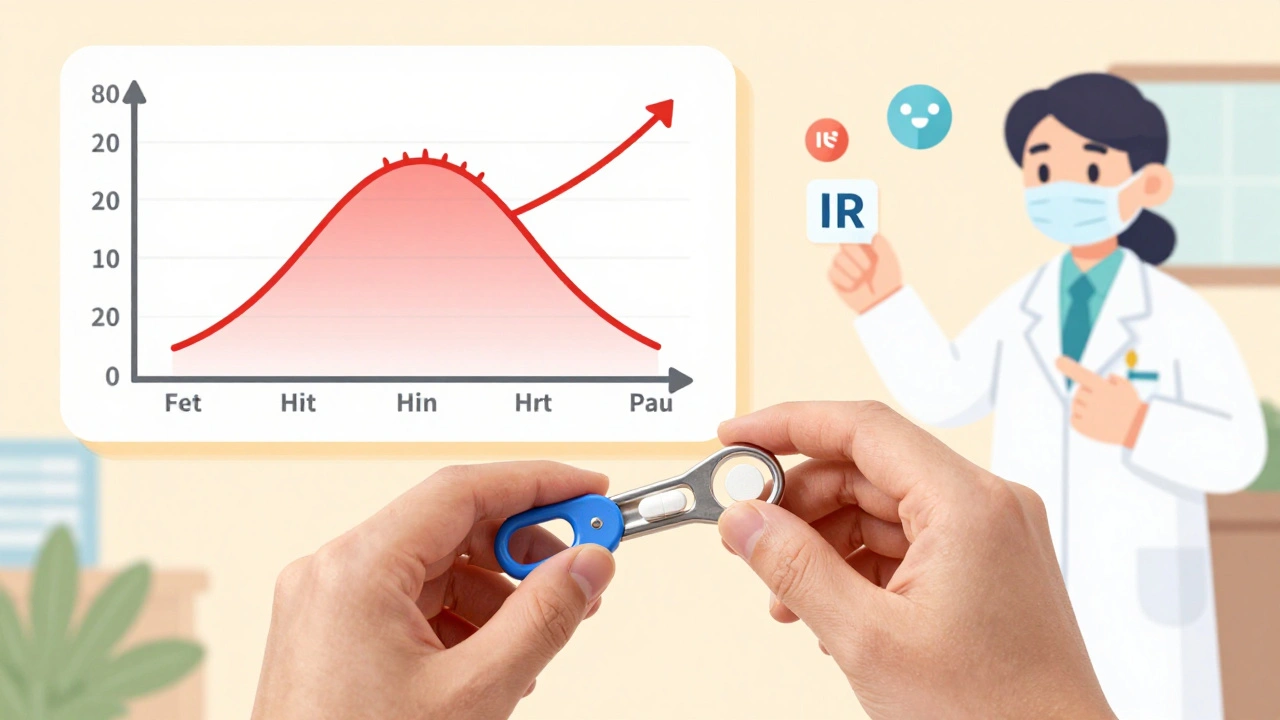
Many people split their pills to save money or ease side effects-like nausea, dizziness, or headaches-but not all splitting is safe. The key isn’t just cutting a pill in half. It’s understanding dose splitting: taking the same total daily dose in smaller, more frequent amounts to smooth out blood levels and avoid dangerous spikes. This isn’t the same as physically splitting a tablet, which can backfire badly if done on the wrong drug.
Why Peak Concentrations Matter
When you take a pill, your body absorbs it over time. The highest level of drug in your bloodstream is called the peak concentration. For some medications, that peak is what causes side effects-not the total amount you take. For example, immediate-release metformin can cause stomach upset when blood levels jump too high all at once. Splitting the daily dose into smaller portions taken four times instead of two can cut those peaks by nearly half, reducing diarrhea and nausea without losing effectiveness.Drugs with short half-lives (under 6 hours) are the best candidates. These meds leave your system quickly, so if you take them once a day, levels crash by evening and spike again the next morning. Splitting the dose keeps levels steadier. Think of it like filling a bathtub with a bucket-you’re less likely to overflow if you pour slowly in small amounts instead of dumping the whole bucket at once.
When Tablet Splitting Is Dangerous
Don’t confuse dose splitting with cutting pills. Many people assume if a pill is scored, it’s safe to split. That’s not true. Extended-release, enteric-coated, or controlled-release pills are designed to release medication slowly over hours. Cutting them destroys that design. A 40mg extended-release lisinopril tablet cut in half doesn’t give you two 20mg doses-it gives you two doses that release all at once, causing a dangerous spike in blood pressure control and increasing the risk of fainting or kidney stress.The FDA has logged over 1,200 adverse events from improper tablet splitting between 2015 and 2020. Nearly 40% involved blood thinners like warfarin. Even a 10% variation in dose can push INR levels out of the safe range, leading to bleeding or clots. Digoxin, used for heart rhythm, has a therapeutic index of just 1.8-meaning the difference between a helpful dose and a toxic one is tiny. Splitting those tablets is asking for trouble.
Which Medications Can Be Safely Split
There are exceptions. Some drugs are built to handle splitting without losing their release profile. Isosorbide mononitrate and extended-release bupropion are two examples where halving the tablet still works as intended. But these are rare.For most people, the safest candidates for dose splitting are:
- Immediate-release metformin (for GI side effects)
- Immediate-release lisinopril or other ACE inhibitors (to reduce cough)
- Immediate-release stimulants like methylphenidate (to reduce jitteriness)
- Immediate-release opioids like oxycodone (to reduce nausea)
- Immediate-release antidepressants like sertraline (for mild side effects)
These drugs have wide therapeutic indices-meaning there’s a big safety margin between effective and toxic doses. Sertraline, for instance, has a therapeutic index above 10. Even if you accidentally split a tablet unevenly, your body can handle the small variation. That’s not true for warfarin, lithium, or cyclosporine. Don’t touch those.
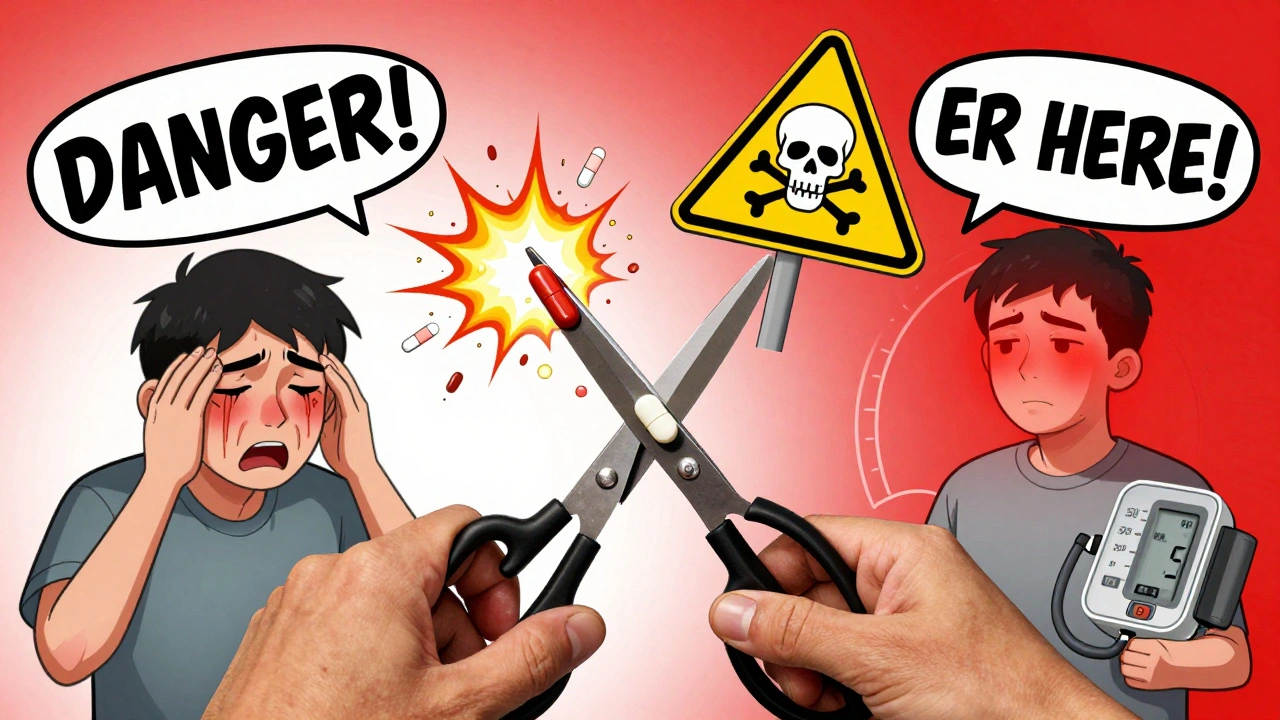
What Makes a Tablet Safe to Split
If your doctor says it’s okay, not all tablets are created equal. Scored tablets-those with a line down the middle-are more likely to split evenly. But even then, studies show that without a proper pill splitter, up to 65% of people end up with doses that vary by more than 15%. That’s enough to cause problems with sensitive meds.Use a dedicated pill splitter, not a knife or scissors. Store split tablets in their original blister pack or bottle, and use them within a week. Moisture and light can degrade the medication. Some pills, like levothyroxine, are stable after splitting, which is why many patients report no issues. Others, like enteric-coated aspirin, lose their protective coating and can irritate your stomach if split.
The Cost Trap
A lot of people split pills because they’re expensive. A 80mg atorvastatin tablet might cost $20, while two 40mg tablets cost $40. Splitting saves money-but only if it’s safe. GoodRx data shows 42% of patients split pills to cut costs. But the savings can vanish fast if you end up in the ER because you split a controlled-release oxycodone tablet. The FDA estimates inappropriate splitting adds $12.3 billion a year in avoidable hospital costs.Pharmaceutical companies are catching on. Pfizer now offers 5mg and 10mg versions of rivaroxaban instead of just 20mg. That cut inappropriate splitting by 78%. It’s cheaper for them to make smaller pills than to deal with lawsuits and bad press.
What to Do Before You Split
Don’t guess. Don’t rely on Reddit advice or a friend’s experience. Talk to your pharmacist or doctor. Ask:- Is this an immediate-release formulation?
- What’s the half-life of this drug?
- What’s the therapeutic index?
- Is there a lower-dose version available?
- Will splitting affect how the drug works?
For high-risk drugs-like anticoagulants, anti-seizure meds, or chemotherapy-splitting is never recommended. For others, your provider might suggest a different dosing schedule instead. Instead of splitting a 20mg tablet, they might switch you to two 10mg tablets taken 12 hours apart. That’s safer, more consistent, and often just as affordable.
What’s Changing in 2025
The FDA is pushing new rules for all scored tablets. By 2026, manufacturers will need to prove their scored pills maintain uniform drug content after splitting. Right now, about 22% of scored tablets fail this test. That means more labels will say “Do Not Split” in the coming years.Meanwhile, the NIH is running a major trial called SPLIT-PEAK, testing whether splitting venlafaxine doses reduces nausea from 32% to under 20%. Early results are promising. If it works, this could become a standard recommendation for antidepressants.
Smart pills are also in development-tablets with built-in split points that preserve extended-release mechanisms. Seven pharmaceutical companies have patents pending on this tech. But until then, stick to what’s proven: if you need to split, do it only with drugs your provider approves, use a proper splitter, and monitor for side effects.
Real Results: A Success Story
One patient, a 52-year-old man with type 2 diabetes, had been taking 1000mg of metformin twice daily. He suffered diarrhea after every dose. His pharmacist suggested splitting the total daily dose into four 500mg doses: morning, midday, afternoon, and bedtime. Within two weeks, his diarrhea dropped from 60% of doses to just 15%. His blood sugar stayed stable. No new prescriptions. No extra cost. Just smarter timing.That’s the goal-not cutting pills, but controlling peaks. It’s not magic. It’s pharmacology.
Can I split any pill with a score line?
No. A score line doesn’t mean it’s safe to split. Extended-release, enteric-coated, or capsule-based medications can become dangerous if split, even if they’re scored. Always check with your pharmacist or doctor before splitting any pill.
Does splitting pills save money?
Sometimes, but not always. Splitting an 80mg atorvastatin tablet can save up to $300 a year compared to buying two 40mg tablets. But if splitting causes side effects that lead to ER visits or hospital stays, those savings vanish. For high-risk drugs like warfarin, the financial risk outweighs any cost benefit.
What’s the difference between dose splitting and tablet splitting?
Tablet splitting is physically cutting a pill in half. Dose splitting is taking the same total daily amount in smaller, more frequent doses-like 500mg four times a day instead of 1000mg twice a day. You can do dose splitting without ever cutting a pill, by using pre-made lower-dose tablets.
Which drugs are most dangerous to split?
Warfarin, digoxin, lithium, cyclosporine, and any extended-release or enteric-coated drug. These have narrow therapeutic windows or complex release mechanisms. Splitting them can cause overdose, toxicity, or loss of effectiveness. Avoid splitting these unless explicitly told to by your doctor.
How do I know if my pill is immediate-release?
Check the label. Immediate-release drugs are often labeled as “IR,” “immediate release,” or have no mention of “ER,” “SR,” “XL,” “CR,” or “XR.” If you’re unsure, ask your pharmacist. They can look up the formulation in the drug database.
Can I split my pills if I have trouble swallowing them?
If you have trouble swallowing pills, talk to your doctor before splitting. There are often liquid forms, chewable tablets, or smaller pills available. Splitting a pill without knowing its release mechanism can be risky. Your provider can find a safer alternative.
What if I accidentally split a pill I shouldn’t have?
Stop taking the split pill. Contact your pharmacist or doctor immediately. If you took it once, monitor for unusual symptoms like dizziness, nausea, irregular heartbeat, or bleeding. Don’t wait for side effects to appear-act fast. Keep the original packaging so your provider can identify the drug and its formulation.
Next Steps
If you’re thinking about splitting your meds:- Don’t do it without talking to your pharmacist first.
- Ask if a lower-dose version is available-it’s safer and often just as cheap.
- If splitting is approved, use a pill splitter, not a knife.
- Track your side effects for the first week after changing your dosing schedule.
- For high-risk drugs, schedule a follow-up blood test (like INR for warfarin) within 7 days.
Medication safety isn’t about cutting corners. It’s about working smarter-with science, not guesswork.
Yo, this post is a godsend. I’ve been splitting my metformin for months because the GI stuff was killing me, and honestly? No one told me it was actually a legit pharmacology trick. I thought I was just being cheap. Turns out I was accidentally doing science. My diarrhea’s down 80%. I’m not a doctor, but I’m now the guy in my WhatsApp group who sends this link to everyone asking how to stop feeling like they’re being gut-punched after breakfast. 🙌
This is exactly the kind of info people need before they start cutting pills with kitchen knives. Thank you for making it so clear. You saved someone’s liver today. 💪
I split my sertraline because my anxiety got worse every time I took it all at once. I thought I was being reckless. Turns out I was being smart? I’m still scared to tell my doctor though… what if they think I’m a rebel? 😅
Dose splitting only works for IR drugs. ER is a trap. Warfarin dont touch. Period. No debate. You wanna live? Read the label.
While the empirical basis for dose splitting in immediate-release formulations is statistically sound, the epistemological flaw lies in the conflation of pharmacokinetic optimization with patient self-regulation. The absence of standardized dosing protocols, coupled with the high variance in GI absorption profiles across populations, renders this practice a form of therapeutic nihilism disguised as frugality. Moreover, the FDA’s 1,200 adverse event dataset reveals a troubling correlation between socioeconomic deprivation and pill-splitting behavior - suggesting this is less a clinical innovation and more a symptom of pharmaceutical austerity. One must ask: are we optimizing pharmacology, or merely rationalizing systemic neglect?
I’ve been thinking about this for years - how we treat medicine like a one-size-fits-all tool, when our bodies are more like symphonies than machines. Peak concentrations aren’t just a pharmacology footnote; they’re the crescendo that breaks the listener. If you pour a whole bottle of wine into your system at once, you’re not just drunk - you’re drowning in your own chemistry. But spread it out? That’s rhythm. That’s harmony. That’s why my grandfather, who took lisinopril for 30 years, never had a cough - he took half in the morning, half at night. No one taught him. He just figured it out. Maybe the real innovation isn’t in the pill, but in the patience to wait. We rush everything - meals, sleep, healing. Maybe we need to slow down the medicine too.
Let’s be clear: pill splitting is a biohazardous act of medical illiteracy. The therapeutic index is not a suggestion - it’s a razor’s edge. You think you’re saving $300 a year? You’re gambling with your renal function, your coagulation cascade, your cardiac stability. The FDA’s data isn’t anecdotal - it’s forensic. Every ER visit from a split warfarin tablet is a taxpayer-funded consequence of ignorance. If you can’t read a drug label, don’t touch the pill. Get the generic 5mg. It exists. Stop being a human lab rat. This isn’t Reddit - it’s your life.
OMG I just split my atorvastatin yesterday 😳 I thought the score line meant it was fine… I’m gonna call my pharmacist rn. Also I spelled ‘pharmacist’ wrong in my search. I’m so dumb. But like… thanks for saving me?? 🥲
I hate how people act like this is some genius hack. Like, wow, you figured out that if you take less at once you feel better? Newsflash: your body doesn’t like being hit with a drug sledgehammer. But also… why are we even still doing this? Why don’t drug companies just make smaller pills? Because they’re greedy. And I’m tired of having to be a DIY pharmacist just to afford to stay alive. This isn’t innovation - it’s capitalism forcing us to hack our own medicine. I’m done being grateful for survival. I deserve better than this.
Wait - so if I take my 20mg oxycodone as two 10mg doses 6 hours apart instead of one big one… I’ll still get the pain relief but less nausea? 🤯 I’ve been taking it once a day and feeling like I’m gonna puke every time. I’m calling my doc tomorrow. Also - can you recommend a good pill splitter? I don’t want to use scissors again… 🙏