

To solve this, manufacturers use Stability Testing is a systematic process where drug manufacturers collect data on a product over specific timeframes and environmental conditions to track changes in the Active Pharmaceutical Ingredient (API) or the final product. It's the only way to scientifically prove how long a drug lasts and how it should be stored. Without it, expiration dates would be mere guesses.
Why Stability Testing is More Than a Regulatory Hurdle
You might see stability testing as a bureaucratic box to check for the FDA, but it's actually a critical safety net. If a drug degrades, it doesn't just stop working; sometimes, it turns into something toxic. For instance, a 2022 FDA report revealed that about 17.3% of drug recalls in 2021 were tied directly to stability issues, like potency loss or degradation products crossing dangerous limits.
The goal here is threefold: determining the accurate shelf life, defining the storage conditions (like "keep refrigerated"), and setting the labeling requirements. This process is governed by the International Council for Harmonisation (ICH), which provides the global gold standard for these tests. When you see an expiration date on a bottle of medicine, you're looking at the result of years of data gathered under strict cGMP (current Good Manufacturing Practice) controls.
The Technical Blueprint: How it Actually Works
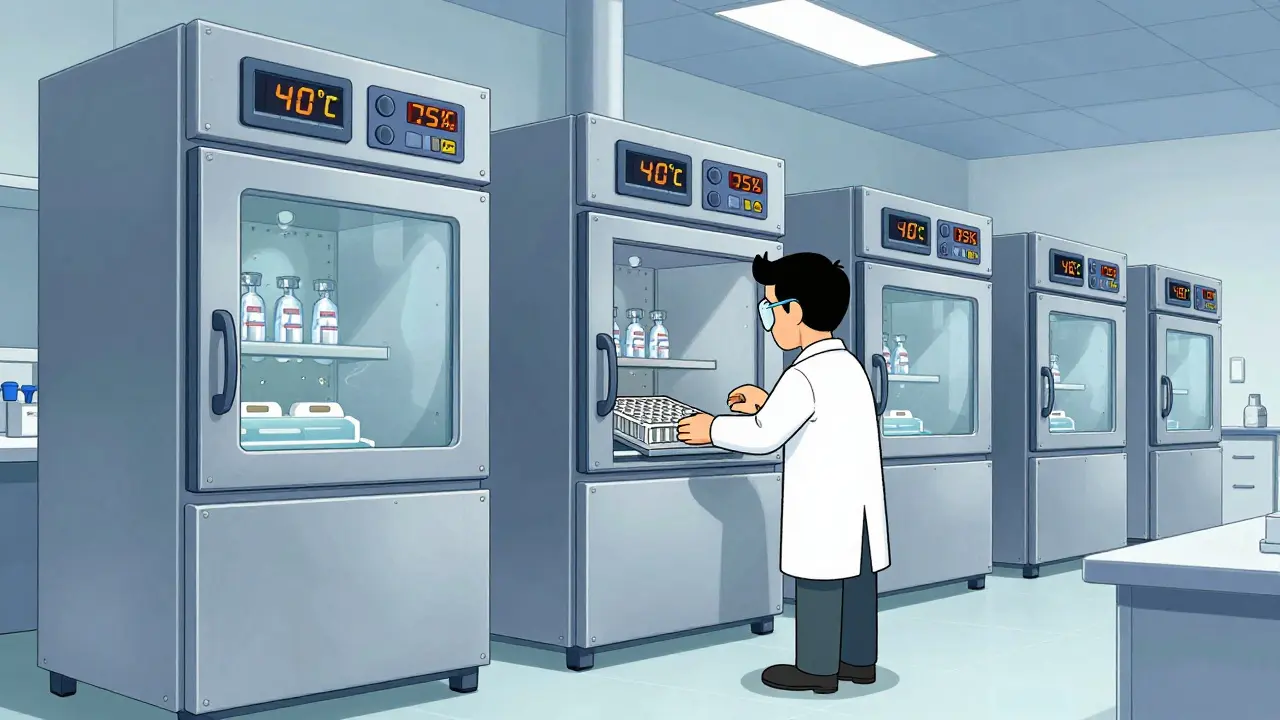
Stability testing isn't as simple as putting a bottle on a shelf and waiting. It involves placing packaged products into specialized stability chambers that mimic different global climates. These chambers control temperature and humidity with pinpoint accuracy.
Depending on the drug's destination, manufacturers use different settings. For temperate climates, they typically maintain 25°C (± 2°C) and 60% relative humidity. If the drug is headed for hot and humid regions, they bump it up to 30°C and 65% humidity. For new molecular entities, testing happens at a grueling schedule: 0, 3, 6, 9, 12, 18, 24, and 36 months.
To speed things up, labs use "Accelerated Testing." By cranking the heat to 40°C and humidity to 75% for six months, they can spot potential failures quickly. However, this is a shortcut; real-time data is still the only way to get a definitive shelf-life determination. They also perform photostability testing, exposing drugs to intense visible and UV light to see if the packaging actually protects the medicine from sun damage.
| Test Type | Temperature | Relative Humidity (RH) | Duration/Purpose |
|---|---|---|---|
| Long-term (Temperate) | 25°C ± 2°C | 60% ± 5% | Up to 36 months; defines shelf life |
| Long-term (Hot/Humid) | 30°C ± 2°C | 65% ± 5% | Up to 36 months; global market viability |
| Accelerated | 40°C ± 2°C | 75% ± 5% | 6 months; predicts early degradation |
What Exactly Are Quality Managers Looking For?
Testing isn't just about "does it still work?" It's a deep dive into four specific areas of quality. First, they check physical attributes-does the tablet change color? Does the pH of a liquid shift? Second, they analyze chemical properties using HPLC (High-Performance Liquid Chromatography) to measure the exact assay and identify degradation products.
Third, they monitor microbiological characteristics, ensuring that sterility is maintained and no bioburden has crept in. Finally, they check therapeutic efficacy, often through dissolution profiles, to make sure the drug still releases into the body at the correct rate. If any of these fall outside the pre-set limits, it triggers an "Out-of-Specification" (OOS) investigation, which is a high-stakes process overseen by the Quality Assurance department.
The Cost of Getting it Wrong
Setting up a compliant stability program is an expensive venture. Major firms spend between $500,000 and $2 million annually on infrastructure. An individual study for a single product formulation can easily cost between $50,000 and $150,000. But the cost of failure is far higher.
Consider a technician who describes a humidity excursion in a stability chamber. A simple equipment glitch that causes a three-month data gap can delay a New Drug Application (NDA) by months. In one real-world instance, such a gap delayed a market entry by eight months, costing an estimated $2.3 million in lost revenue. Even more critical is the impact on patients; the International Pharmaceutical Aerosol Consortium noted that stability testing prevented 47 dangerous products from hitting the market between 2020 and 2022.

Modernizing the Process: AI and Risk-Based Approaches
The industry is moving away from the "one size fits all" approach. Many companies are adopting Quality by Design (QbD), which integrates stability knowledge into the development phase. This can reduce the amount of required testing by up to 35% for well-characterized products.
We are also seeing a shift toward ICH Q12 principles, which allow for more flexible post-approval lifecycle management. Some companies have reported reducing their stability sample sizes by 40% using these principles, saving over $100,000 per product annually. Looking ahead, artificial intelligence and machine learning are expected to cut testing timelines by another 30-40% by 2027 by predicting how molecules will degrade before the test even begins.
Implementation Checklist for Quality Teams
If you're building or refining a stability program, you can't wing it. Success requires a mix of analytical chemistry expertise and rigorous data management. Here is a practical checklist for operational readiness:
- Equipment Qualification: Ensure stability chambers have ISO 17025 accredited calibration and undergo quarterly temperature mapping per USP Chapter 1079.
- Method Validation: Confirm that all analytical methods are "stability-indicating," meaning they can distinguish the active drug from its degradation products.
- Data Integrity: Implement an electronic data management system. Transitioning from paper to digital can reduce review time by 55%.
- Protocol Detail: Ensure protocols include the 15 mandatory elements required by the FDA, including sampling plans and clear acceptance criteria.
- Outsourcing Strategy: Determine if in-house capacity is sufficient. About 72% of firms use Contract Research Organizations (CROs) like SGS or Eurofins for specialized testing.
What is the difference between real-time and accelerated stability testing?
Accelerated testing uses high temperature and humidity (typically 40°C/75% RH) to force degradation, providing a prediction of shelf life within 6 months. Real-time testing follows actual storage conditions over 24-36 months. While accelerated testing is great for early warnings, real-time data is the only version regulators accept for final expiration dating because it is far more precise.
What happens if a stability test result is "Out-of-Specification" (OOS)?
An OOS result triggers a formal investigation mandated by 21 CFR 211.192. The Quality Assurance department must determine if the result was due to a laboratory error or an actual product failure. If the product is failing, the manufacturer may need to shorten the shelf life, change the packaging, or recall existing batches from the market.
How does photostability testing differ from standard stability tests?
Standard tests focus on heat and moisture. Photostability testing, governed by ICH Q1B, specifically tests how a drug reacts to light. It involves exposing the drug to a set amount of visible light (1.2 million lux hours) and UV light to ensure the primary packaging is sufficient to prevent light-induced degradation.
Are there specific requirements for biologics stability testing?
Yes, biologics are much more complex than small molecules. Their degradation pathways are multifactorial, often involving protein unfolding or aggregation. Stability testing for biologics focuses heavily on maintaining the 3D structure of the protein and often requires much stricter temperature controls (cold chain) and specialized analytical tools.
Which regulatory guidelines are the most important for stability testing?
The most critical are the ICH guidelines: Q1A(R2) for stability data, Q1B for photostability, Q1E for shelf-life estimation, and Q2(R1) for analytical validation. In the US, 21 CFR 211 is the primary legal framework for cGMP, and FDA's specific guidance documents for NDAs and ANDAs provide the necessary submission details.