
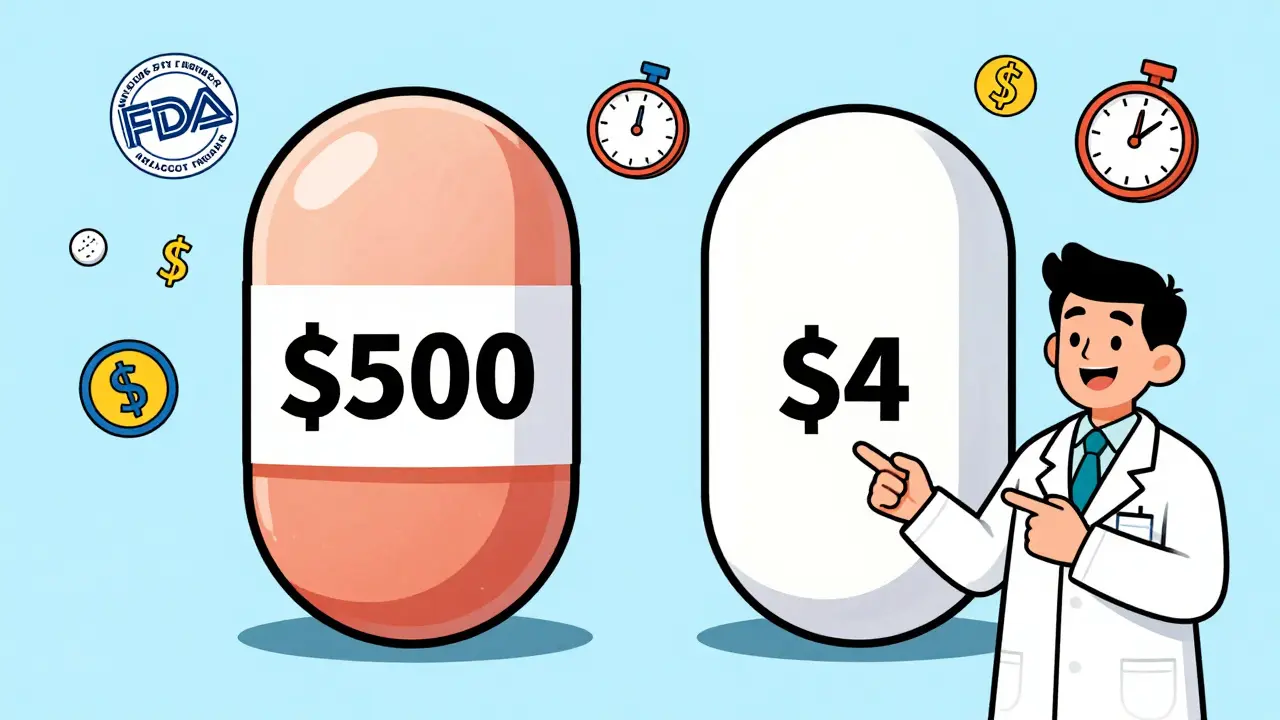
Have you ever looked at your prescription receipt and wondered why the generic version costs a fraction of the brand-name drug? It’s not a trick. It’s not a scam. It’s simple economics - and the system is working exactly as designed.
Same Medicine, Different Price Tag
A generic drug isn’t a weaker version. It’s not a knockoff. It’s the exact same medicine, with the same active ingredient, in the same dose, taken the same way. If you take generic atorvastatin, you’re getting the same chemical as Lipitor. Generic omeprazole? It’s identical to Prilosec. The FDA requires this. No exceptions.
The only differences? Color, shape, flavor, or the inactive ingredients - things like fillers or coatings. These don’t affect how the drug works. They’re just there to make the pill look different. Why? Because trademark laws prevent generics from copying the brand’s appearance. But the medicine inside? Identical.
The Real Cost Difference: R&D
Here’s where the money goes. Brand-name drugs cost an average of $2.6 billion to develop. That’s not a guess. That’s from the Tufts Center for the Study of Drug Development. That money pays for:
- 10 to 15 years of research
- Animal testing
- Multiple rounds of clinical trials on thousands of people
- Legal fees, patent applications, marketing campaigns
Once the drug is approved, the company gets 20 years of patent protection. That’s their chance to make back that money - and then some. During those two decades, no one else can make it. They have the market all to themselves. That’s how they set high prices.
Generic manufacturers? They don’t do any of that. They don’t repeat the animal trials. They don’t run new clinical studies. Instead, they file an Abbreviated New Drug Application (ANDA). All they need to prove is bioequivalence: that their version delivers the same amount of medicine into your bloodstream at the same speed as the brand. That’s it.
That cuts development time from over a decade down to 1 to 3 years. And it cuts costs from billions to just $1 million to $5 million per drug.
Regulation Isn’t Looser - It’s Smarter
Some people think generics are less regulated. They’re not. In fact, they’re held to the same strict standards. The FDA inspects every manufacturing facility - whether it’s making brand-name or generic drugs. In 2022 alone, they did over 12,000 inspections worldwide.
Generics must meet the same quality rules: purity, strength, stability. They must stay within 90% to 110% of their labeled potency for the entire shelf life. The same as brand-name drugs.
The bioequivalence test? It’s not a shortcut. It’s science. The generic must deliver the active ingredient within 80% to 125% of the brand’s blood concentration levels. That’s a tight window. If it doesn’t hit that mark, the FDA rejects it. No exceptions.
Competition Drives Prices Down
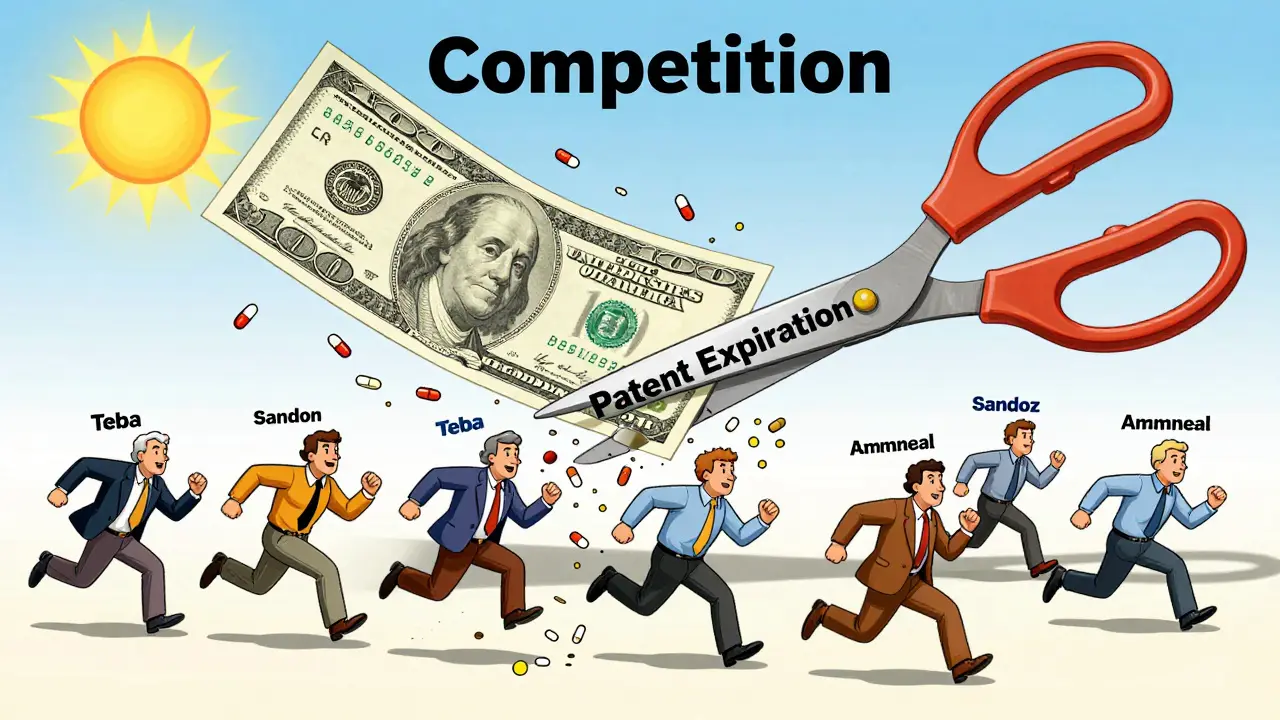
Once a patent expires, the floodgates open. On average, 14 different companies start making the same generic drug. That’s not competition - that’s a price war.
Take atorvastatin. When Lipitor’s patent expired, more than 10 companies started making generic versions. Within a year, the price dropped from $500 a month to $4. Omeprazole went from $300 to $6. That’s not a coincidence. It’s market forces.
The Congressional Budget Office found that generic competition typically cuts prices by 80% to 90% in the first year. And as more companies join, prices keep falling. That’s why 90% of all prescriptions filled in the U.S. are for generics - but they only make up 18% of total drug spending.
Why Do People Still Hesitate?
Despite the data, 62% of Americans still trust brand-name drugs more. Why? Because of appearance. A pill looks different. A capsule is a different color. A pill has a weird logo instead of a familiar brand name.
One Reddit user wrote: “I switched from Synthroid to generic levothyroxine and saved $400 a month. No side effects. No change.” Another said: “My ADHD got worse after switching from Concerta to generic methylphenidate.”
That’s the real issue - perception. Studies show most people who report problems after switching aren’t actually having a medical reaction. They’re reacting to anxiety. But there are rare exceptions.
For drugs with a narrow therapeutic index - like warfarin, levothyroxine, or phenytoin - even tiny changes in blood levels can matter. Some doctors prefer to keep patients on one brand or one generic manufacturer. But that’s not because generics are unsafe. It’s because switching between different generic brands might cause slight variations. The FDA says all approved generics are equivalent. But doctors, understandably, want consistency.
How Insurance Makes It Even Cheaper
Most insurance plans have a three-tier system:
- Tier 1: Generics - $0 to $15 copay
- Tier 2: Brand-name drugs - $25 to $50
- Tier 3: Specialty drugs - 25% to 33% of the cost
Many plans won’t cover the brand-name version unless your doctor jumps through hoops to get prior authorization. Some pharmacies automatically substitute a generic unless you specifically ask for the brand. And if you do ask? You might pay more out of pocket.
Pharmacists are trained to explain this. They’re supposed to spend 3 to 5 minutes talking to you when you get a new generic prescription. They’ll tell you: “This is the same medicine. The only difference is the price.”
The Bigger Picture: Billions in Savings
From 2007 to 2016, generic drugs saved the U.S. healthcare system $1.67 trillion. In 2022 alone, they saved $293 billion. That’s not a small number. That’s enough to cover healthcare for millions of people.
The top five generic manufacturers - Teva, Viatris, Sandoz, Amneal, and Aurobindo - control nearly half the market. And they’re not making huge profits per pill. They’re making money by volume. They sell billions of pills a year at pennies each.
The FDA approved over 1,000 generics in 2022. And more are coming. By 2028, over 150 brand-name drugs will lose patent protection, with combined annual sales of $157 billion. That means even bigger savings ahead.
What You Can Do
- Always ask if a generic is available - even if your doctor didn’t suggest it.
- Don’t assume a brand-name drug is better. It’s not.
- If you’re switching and feel different, talk to your pharmacist. It’s probably not the drug. It’s your brain.
- Use tools like GoodRx or SingleCare. They often show prices lower than your insurance copay.
- If you’re on a narrow therapeutic index drug, stick with the same generic manufacturer unless your doctor advises otherwise.
Generic drugs aren’t a compromise. They’re the smart choice. The science is clear. The data is solid. And the savings? Real.
I swear, I switched to generic omeprazole and my stomach felt like it was being hugged by a cloud. Then I saw the pill was a different color and I started having anxiety attacks. Like, why does it look like a reject from a 90s cartoon? I’m not even kidding. I went back to brand-name just because I needed to feel like I was doing something right. #EmotionalSupportPill
The claim that generics cost $1–5 million to develop is misleading. The FDA's own data shows that ANDA submissions often require extensive post-approval studies, especially when bioequivalence is contested. Moreover, many generic manufacturers outsource production to facilities in India and China that have poor inspection records. The 'same standards' narrative is a regulatory fiction.
Big Pharma owns the FDA. They let generics in so they can control the market. One company makes the generic, then sells it to another, then the price goes up. They just change the color of the pill and call it new. You think you're saving money? You're being played.
This is one of the most important things you'll ever read about your health. You don't need to pay $500 for a pill that costs 4 cents to make. The system is rigged, but you have power. Ask for generics. Use GoodRx. Talk to your pharmacist. Knowledge is your best medicine. Don't let fear or marketing tricks cost you your peace of mind. You deserve better.
It is of considerable interest to observe that the economic mechanisms underpinning pharmaceutical pricing in the United States reflect a structural imbalance that is both legally sanctioned and socially normalized. The profound savings realized through generic substitution represent not merely fiscal prudence, but a moral imperative in the context of healthcare equity.
I've been on generic lisinopril for five years. Never had a problem. But I read somewhere that some people's bodies react differently to fillers. Maybe that's why I feel better now. Or maybe I'm just imagining it. Either way, I'm not paying $300 a month for a pill that looks like a M&M.
I used to be scared of generics too. Then I switched from brand-name Synthroid to generic levothyroxine and saved $500/month. My TSH? Perfect. My bank account? Thank you. If you're scared, start with a low-cost trial. Talk to your pharmacist. You’re not weak for being cautious - but you’re brilliant for being curious.
The FDA's 80-125% bioequivalence window is not 'tight'-it's a gaping loophole. A 45% variance in absorption? That's not science. That's gambling. And people wonder why some feel worse after switching. It's not placebo. It's pharmacokinetic roulette.
They say generics are safe. But what about the factories? The ones in India with no running water? The ones that got shut down for falsifying data? The ones the FDA visits once every 7 years? You think your $4 pill isn’t made by someone who doesn’t know what a sterile environment is? Wake up. This isn't healthcare. It's a global supply chain nightmare.
I used to buy brand-name Advil. Then I tried the generic. Same pill. Same relief. Same headache gone. Now I buy them in bulk. Saved over $1,200 last year. Honestly? I feel like a genius. Why pay more for the same thing? That’s not smart. That’s just paying extra to feel safe. And guess what? You’re not safer.
Let me be clear: the FDA is a corporate puppet. The 12,000 inspections? Most are scheduled. The 'same standards'? They inspect the front room. The back room? That’s where the real manufacturing happens. And if your generic comes from a facility with a history of violations? You’re not taking medicine. You’re taking a gamble. And someone’s making billions off your ignorance.
I dont care what the science says. I was born in Indiana and I know what I know. Brand name drugs are made in America. Generics? Made in China. By people who dont even speak english. You think that's okay? You think your life is worth a pill made in a factory with no air conditioning? I think not. America First. Always.
I use generic metformin. My sugar is stable. I don't care about the color. I care about my health. Also, I'm from India. We make most of the world's generics. We know what we're doing. No conspiracy. Just science.
I’m a pharmacist, and I can tell you this: 99% of patients who say they ‘feel worse’ on generics are experiencing anxiety, not pharmacological change. I’ve had patients cry because their pill is smaller. We spend five minutes explaining that the active ingredient hasn’t changed. Sometimes, that’s all it takes. Trust the science. And trust your pharmacist.