
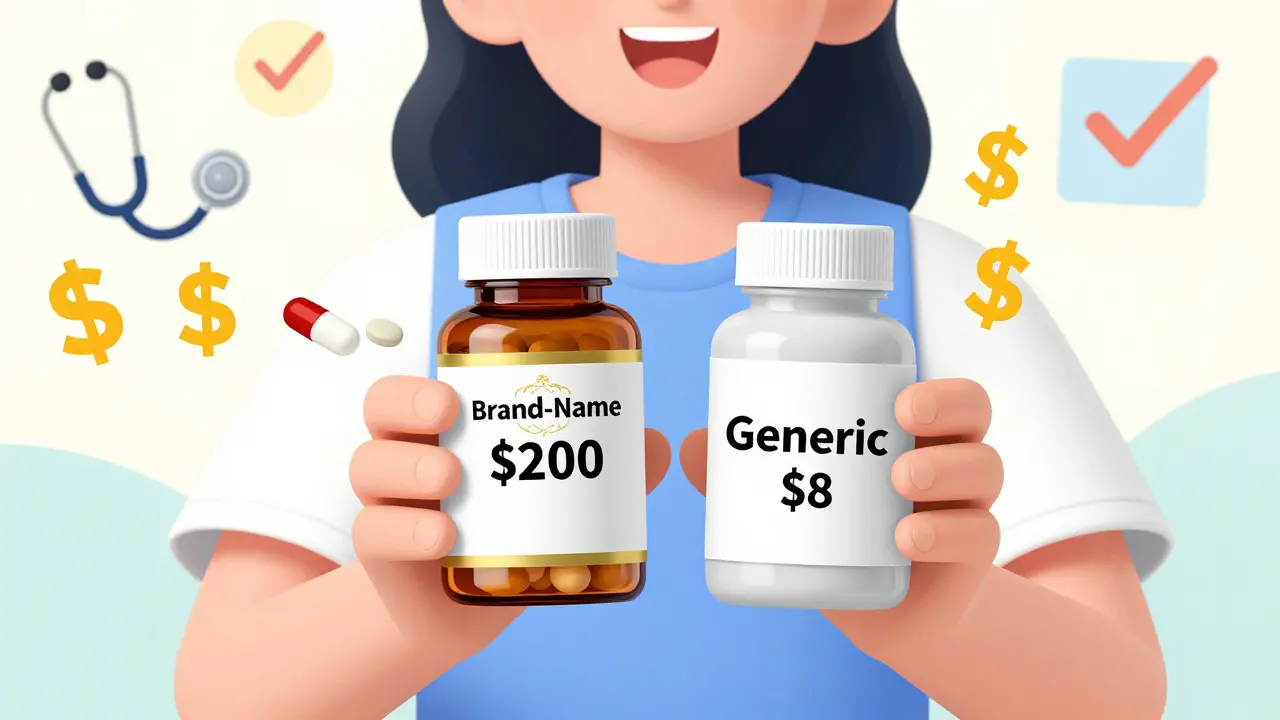
Most people don’t realize that the little white pill they pick up at the pharmacy might be identical to the expensive brand-name version they’ve been prescribed-except it costs a fraction of the price. That’s the reality of generic medications. In the U.S., nearly 9 out of 10 prescriptions filled are for generics. Yet many patients still pay more than they need to because they assume brand-name equals better. It doesn’t. And the savings aren’t just for you-they ripple through the entire healthcare system.
How Generic Drugs Are the Same, But Cheaper
The FDA requires generic drugs to have the same active ingredients, strength, dosage form, and route of administration as their brand-name counterparts. That means if you’re taking lisinopril for high blood pressure, the generic version works exactly like Zestril. The FDA also demands that generics meet the same standards for purity, stability, and performance. No shortcuts. No compromises. The only difference? The name on the bottle and the price tag. So why are generics so much cheaper? Because they don’t carry the same financial baggage. Brand-name drug companies spend years and hundreds of millions of dollars developing a new drug-running clinical trials, proving safety, navigating regulatory hurdles. Once they get approval, they get a patent that lets them be the only seller for 10-15 years. That’s how they recoup their investment. Generic manufacturers don’t have to do any of that. They just need to prove their version is bioequivalent-meaning it delivers the same amount of active ingredient into your bloodstream at the same rate as the brand. That’s it. No expensive trials. No marketing campaigns. No patent fees. That’s why a 30-day supply of generic atorvastatin (the cholesterol drug formerly known as Lipitor) can cost under $10, while the brand version might run over $200.Price Drops When Competition Kicks In
The real magic happens when more than one company starts making the same generic. The moment a patent expires and a second manufacturer enters the market, prices begin to tumble. By the time three or four companies are competing, the price often falls to just 15-20% of the original brand price. Take lurasidone, a drug for schizophrenia. When the brand Latuda was the only option, a 30-day supply cost around $1,400. Once generics arrived, the price dropped to under $60. That’s a 96% reduction. Another example: pemetrexed, used for lung cancer. The brand Alimta cost nearly $3,800 per month. Generics brought it down to about $500. That’s $68 million in savings for patients and insurers in just one case. The FDA found that in markets with strong generic competition, prices keep falling over time. More competitors mean lower prices. It’s basic economics. And it’s why the average copay for a generic drug is $6.16, while brand-name drugs average $56.12-nearly nine times more. Over 93% of generic prescriptions cost less than $20. For brand-name drugs? Only 59% do.Not All Generics Are Created Equal
Here’s the catch: not every generic is cheap. Some generics are priced almost as high as the brand. Why? Because of how pharmacy benefit managers (PBMs) work. PBMs are middlemen between insurers, pharmacies, and drug manufacturers. They negotiate prices and decide which drugs go on insurance formularies. But here’s the problem: some PBMs use a practice called “spread pricing.” They negotiate a low price with the manufacturer, then charge the insurer a higher price. The difference? That’s their profit. And sometimes, they push higher-priced generics onto formularies-not because they’re better, but because they make more money. A 2022 study in JAMA Network Open looked at 45 high-cost generics and found they were 15.6 times more expensive than other, equally effective alternatives. In Colorado, replacing just those high-cost generics saved over $6.6 million in a single year. That’s not just a savings-it’s a system glitch.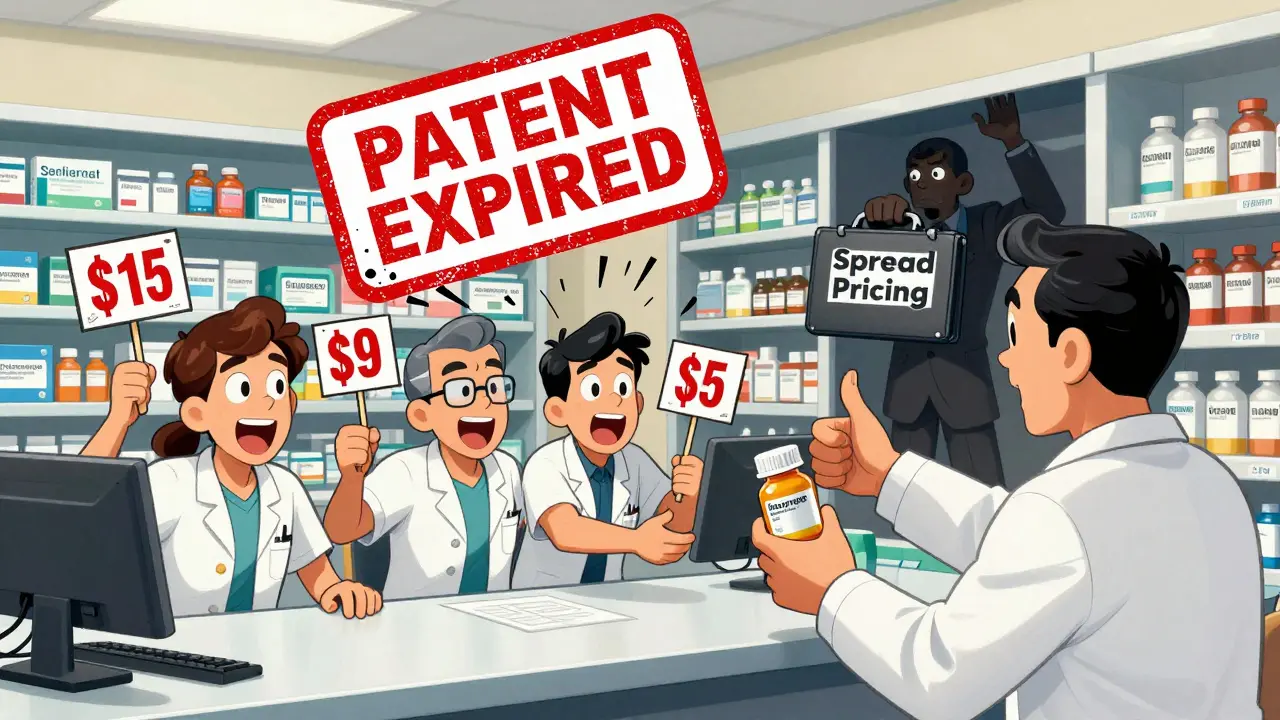
How Much Do Patients Really Save?
The numbers speak for themselves. In 2022 alone, generic and biosimilar drugs saved the U.S. healthcare system $408 billion. That’s up from $373 billion the year before. Over the last decade, those savings have totaled $2.9 trillion. That’s more than the entire annual budget of the Department of Defense. For individual patients, the impact is personal. A 2023 study found that 11.8% of generic prescriptions could have been cheaper if bought directly from the Mark Cuban Cost Plus Drug Company instead of through insurance. Uninsured patients saved the most-over $6 per prescription on average. Even with insurance, many people with high-deductible plans pay less out-of-pocket by skipping insurance entirely and using cash-price tools like GoodRx. GoodRx data shows average discounts: 67% for depression meds, 58% for blood pressure drugs, and 57% for weight loss medications. Some erectile dysfunction pills are available for as little as $18 a month. That’s not a rumor-it’s real. And it’s available to anyone who knows to look.How to Make Sure You’re Getting the Best Deal
You don’t need a degree in pharmacy to save money on your prescriptions. Here’s what actually works:- Ask your doctor to write “dispense as written” on your prescription. That gives your pharmacist legal permission to substitute a generic if one is available.
- Use free price-comparison tools like GoodRx, SingleCare, or Blink Health. Enter your drug name and zip code. You’ll often see cash prices lower than your insurance copay.
- For maintenance meds (like blood pressure or diabetes drugs), consider mail-order pharmacies. Many offer 90-day supplies at lower rates.
- If you’re on Medicare, check if your plan has a preferred generic list. Some plans reward you with lower copays for choosing certain generics.
- Don’t assume your insurance is always the cheapest option. A 2023 Reddit thread with over 1,400 responses found that 78% of people saved more by paying cash than using insurance for generics.
A study in JAMA Internal Medicine showed that patients with chronic conditions who compared prices saved an average of $287 per year-just by spending five to seven minutes per prescription checking prices. That’s free money.
The Bigger Picture: Generics Are the Backbone of Affordable Care
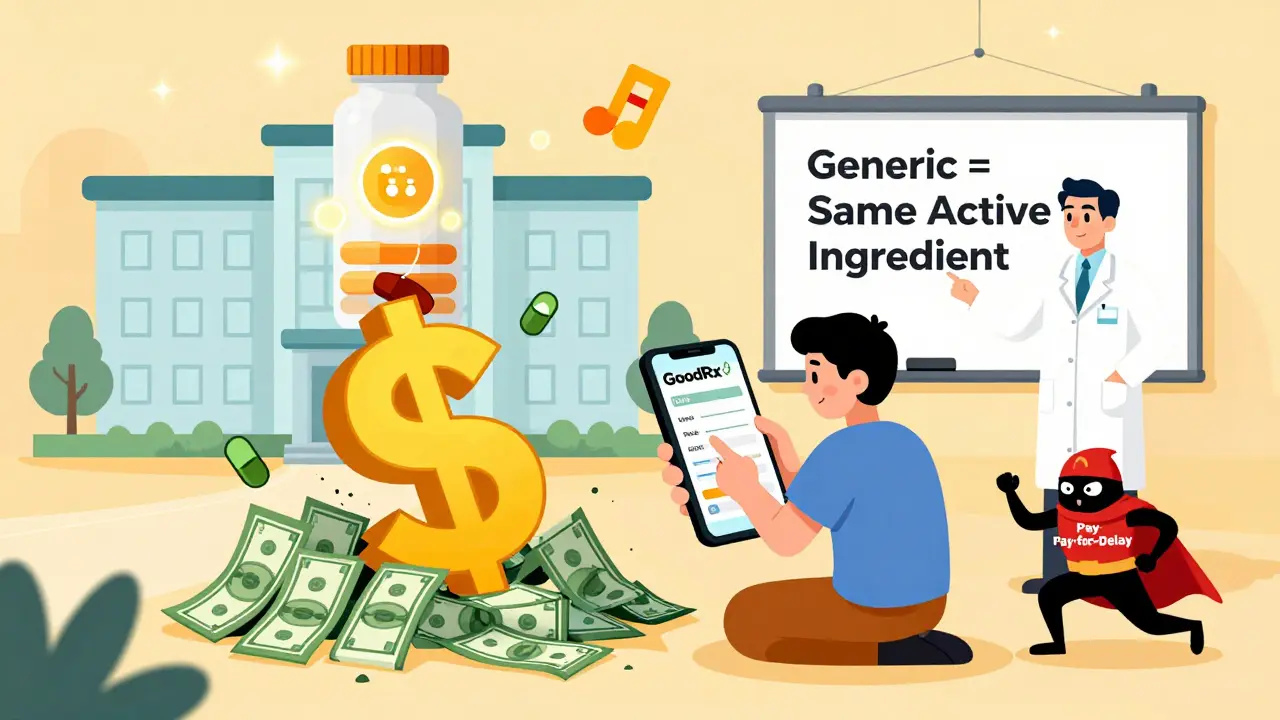
Despite their savings, generic drugs face real threats. Some brand-name companies use tactics called “evergreening”-making small changes to their drug to extend patent life and delay generic entry. Others pay generic makers to delay launching their cheaper versions. These “pay-for-delay” deals are under investigation by the Department of Justice. The FDA has approved over 700 generic drugs each year recently, but 202 of them are currently listed as “at-risk” for shortages. When supply drops, prices spike. That’s why competition matters. More manufacturers mean more stability. The Inflation Reduction Act of 2022 is helping too. It caps insulin at $35 a month for Medicare patients and will save $105 billion on prescriptions by 2031-mostly through increased generic and biosimilar use. And as more biologic drugs (like those for rheumatoid arthritis or cancer) lose patent protection over the next few years, biosimilar generics could save another $150 billion by 2027.Bottom Line: Generics Work. They Save Money. You Just Need to Ask.
Generic drugs aren’t a compromise. They’re the standard. They’re proven, safe, and effective. And they’re the single biggest reason prescription drug costs haven’t exploded even further in the last 20 years. If you’re paying more than $20 for a generic, you’re probably overpaying. If you’re taking a brand-name drug without checking if a generic exists, you’re leaving money on the table. And if your insurer or pharmacy is pushing a high-cost generic without explaining why, it’s time to ask questions. Your health doesn’t depend on the brand name. It depends on the active ingredient. And that’s the same whether it’s labeled as a generic or a brand.Are generic drugs as safe and effective as brand-name drugs?
Yes. The FDA requires generic drugs to meet the same strict standards as brand-name drugs for quality, strength, purity, and performance. They must deliver the same amount of active ingredient into your bloodstream at the same rate. Over 90% of prescriptions filled in the U.S. are generics, and millions of patients use them safely every day.
Why do some generic drugs cost more than others?
Not all generics are priced equally. Some are cheap because multiple manufacturers compete. Others are expensive because only one company makes them, or because pharmacy benefit managers (PBMs) profit from the price difference between what they pay the manufacturer and what they charge insurers-a practice called “spread pricing.” Always compare prices using tools like GoodRx to find the lowest cost.
Can I save money by paying cash instead of using insurance for generics?
Yes, often. Many people with high-deductible plans, Medicare Part D, or no insurance pay less out-of-pocket by using cash-price apps like GoodRx or SingleCare than they do by using their insurance. Insurance doesn’t always mean lower cost-it just means you’re paying through premiums and copays. For generics, cash can be cheaper.
What should I ask my doctor or pharmacist about generics?
Ask: “Is there a generic version of this drug?” and “Which generic is the most affordable?” Also ask your pharmacist to check if a different generic manufacturer offers a lower price. Don’t be afraid to request the lowest-cost option-your health won’t change, but your wallet will.
Why do some pharmacies not have the cheapest generic in stock?
Pharmacies stock based on contracts with PBMs and wholesalers, not always on price. The cheapest generic might come from a different distributor. If your pharmacy doesn’t have the lowest-priced version, ask them to order it or use a mail-order service. Many online tools let you find nearby pharmacies that carry the lowest-cost generic.
Are biosimilars the same as generic drugs?
Biosimilars are similar to generics but for complex biologic drugs-like those used for cancer, arthritis, or autoimmune diseases. They’re not exact copies because biologics are made from living cells, not chemicals. But they’re proven to work the same way and cost 15-35% less than the brand. They’re the next wave of savings in prescription drugs.
If you’re taking a medication long-term, a few minutes spent comparing prices could save you hundreds a year. That’s not a trick. It’s just how the system works. And now you know how to use it.
🚨 GENERIC DRUGS AREN'T JUST CHEAP-THEY'RE A NATIONAL SECURITY ISSUE! 🇺🇸 We're letting Big Pharma rob us blind while China makes our pills. I got my lisinopril for $4 at Walmart-Zestril was $210. This isn't healthcare, it's corporate slavery. 🤬 Someone needs to burn down the PBMs. 🔥 #GenericRevolution #AmericaFirst
I am from India, where generics are the only option for most people. We make 20% of the world's generics. You Americans act like this is some new discovery. In my village, we've been taking generics for decades. Your system is broken, not the medicine.
Look, I used to be one of those people who thought brand-name = better. Then my dad got diabetes and we were paying $400/month for metformin. We switched to generic-same pill, same results, $5. That’s not savings. That’s justice. If your doctor doesn’t bring up generics, ask. If your pharmacist doesn’t offer alternatives, find a new one. This isn’t complicated. Your health isn’t a marketing campaign.
I used GoodRx for my anxiety med and saved $120/month. I didn’t even know this was a thing until my friend showed me. Mind blown. 🤯 Also, my pharmacy didn’t have the cheapest generic in stock… so I ordered it online and picked it up next door. Took 10 minutes. Now I’m saving $1,440 a year. Why didn’t anyone tell me this sooner?
The entire pharmaceutical industrial complex is a Foucauldian apparatus of biopower-pharmacological normalization through commodified health. PBMs function as neoliberal necropolitical intermediaries, extracting surplus value from the biopolitical body. The generic drug is not merely an economic alternative-it’s a deconstructive rupture in the pharmacovigilant regime. Yet, the hegemony of patent logic persists through epistemic violence disguised as ‘formulary management.’ We must radicalize the pharmacy counter.
I just want to say thank you for writing this. I’ve been on blood pressure meds for 12 years and never knew I could save hundreds a year just by asking. I’m not tech-savvy, but I used GoodRx last week and paid $7 instead of $58. My wife cried. Not because she was sad-because she finally felt like the system wasn’t designed to screw us over. You’re not just talking about pills. You’re talking about dignity.
Let me tell you something: if you’re still paying full price for a generic because ‘my insurance covers it,’ you’re not being smart-you’re being exploited. I used to think insurance was my friend. Then I checked GoodRx and realized I was paying $87 for a drug that costs $11 cash. I switched. My deductible didn’t matter. My copay vanished. Stop letting the system tell you what’s best. You’re smarter than that. And your wallet deserves better.
You all are missing the real issue. The FDA’s bioequivalence standards are garbage. They allow 80-125% variability in absorption. That’s a 45% window. For some people, that’s the difference between therapeutic effect and toxicity. I’ve had patients on generic sertraline who had panic attacks because the batch was off. The brand? Consistent. Always. Don’t romanticize generics. They’re not magic. They’re just cheaper. And sometimes, cheaper isn’t safer.
I work in a community pharmacy. People are shocked when I tell them the same pill costs $4 cash vs $52 with insurance. I’ve started printing out GoodRx coupons and handing them out. One lady came back two weeks later with a thank-you card and $20 she saved. It’s not complicated. Just help people see it.
Oh honey, you think you’re so clever using GoodRx? I’ve been doing this since 2015. I even know which pharmacies have the same generic from different manufacturers-some are 30% cheaper just because of the distributor. But you know what? Most people are too lazy to look. And that’s why they keep paying $60 for a $7 pill. It’s not the system’s fault. It’s yours.
I’m an engineer. I don’t trust things I don’t understand. So I dug into the FDA’s bioequivalence guidelines. Turns out, generics must be within 80-125% of the brand’s absorption rate. That’s a wide range-but statistically, for 99% of people, it’s irrelevant. I’ve switched 14 prescriptions to generics. Zero side effects. $1,800 saved last year. The data doesn’t lie. If you’re healthy on brand, you’ll be healthy on generic. The math is simple.