
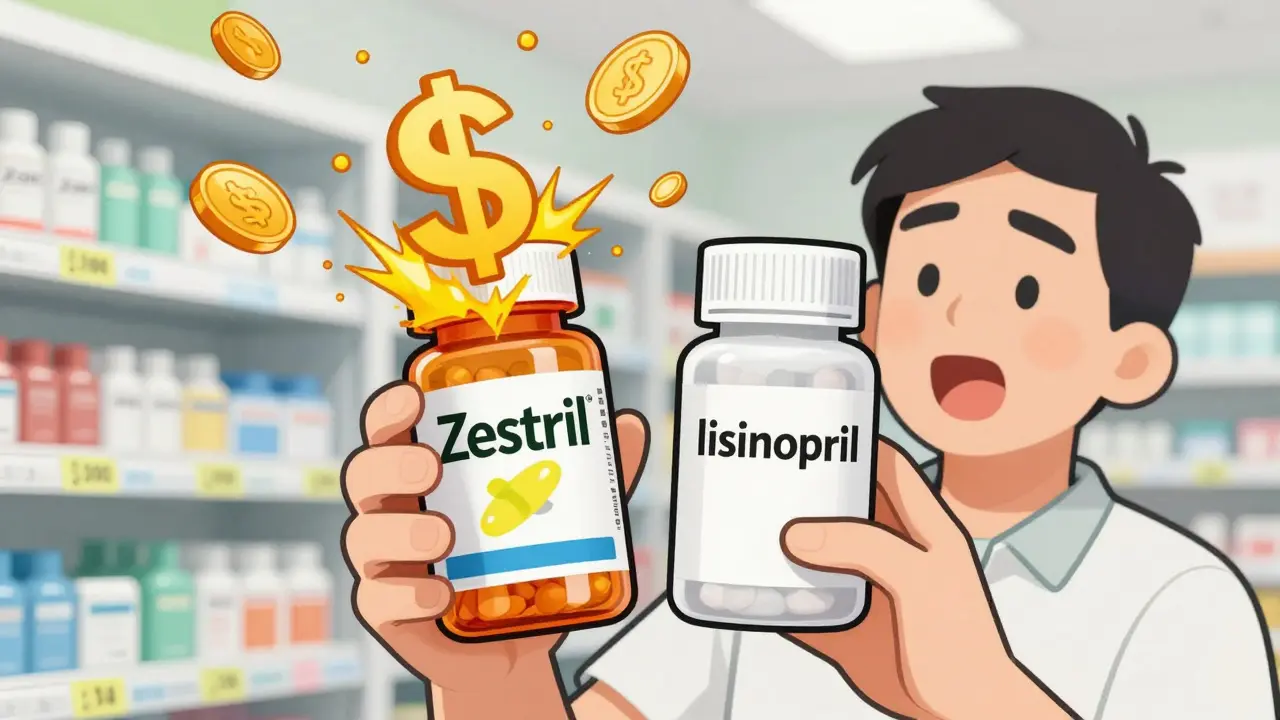
When you pick up a prescription, you might see two names on the label: one you recognize from TV ads, and another that looks unfamiliar. The second one? That’s the generic. And if you’re still paying more for the brand-name version, you’re leaving money on the table-sometimes hundreds of dollars a month.
Generics Are Just as Effective as Brand-Name Drugs
The biggest myth about generic medications is that they’re weaker or less reliable. That’s not true. The FDA requires every generic drug to have the same active ingredient, strength, dosage form, and route of administration as the brand-name version. That means if you’re taking lisinopril for high blood pressure, the generic version works exactly the same way as Zestril or Prinivil.
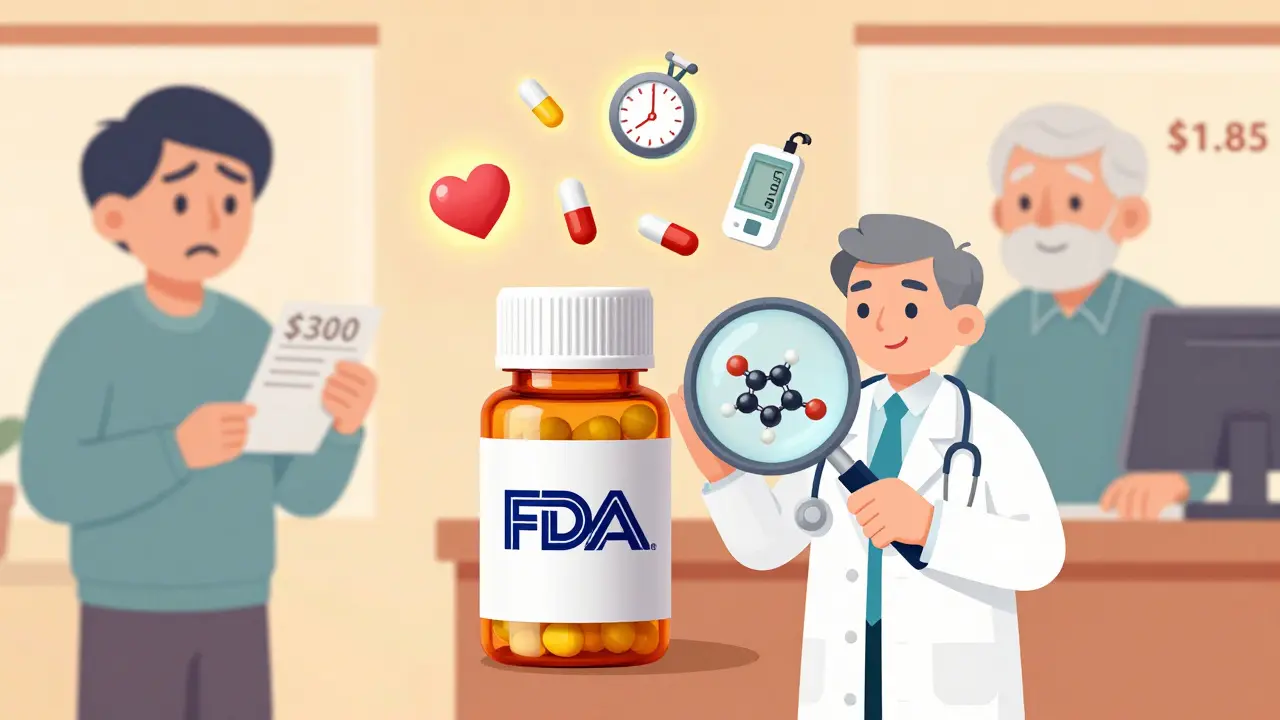
Before a generic hits the shelf, it must pass a strict test called bioequivalence. This means the drug must get into your bloodstream at the same rate and in the same amount as the brand-name drug. The FDA sets a range: the generic’s absorption must fall between 80% and 125% of the brand’s. That’s not a wide gap-it’s a tight, scientifically proven match.
Studies back this up. A 2022 analysis of over 186,000 patients taking heart medications found no difference in outcomes between generic and brand-name versions. Another study in the Journal of Managed Care & Specialty Pharmacy looked at blood pressure, cholesterol, and diabetes drugs and confirmed: no drop in effectiveness. For most people, switching to generic doesn’t mean sacrificing results-it means keeping your health on track without the price tag.
Generics Save You Hundreds-Sometimes Thousands-Each Year
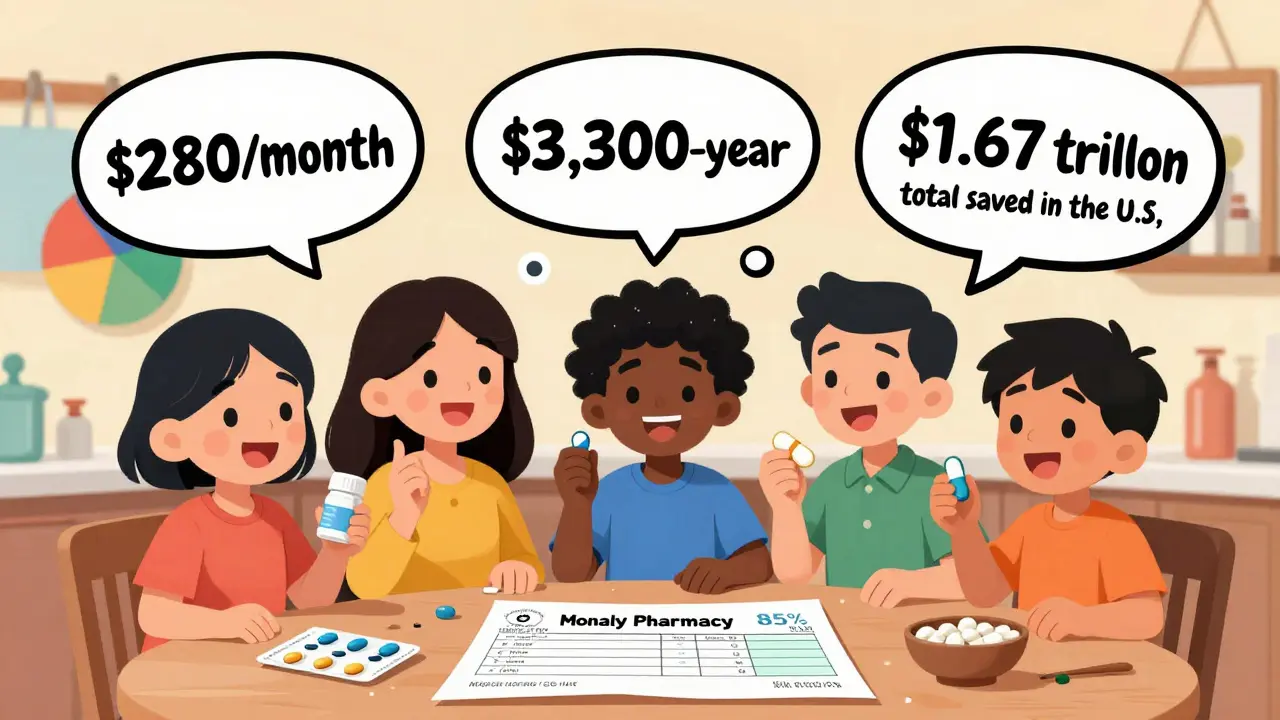
Here’s the hard number: generics cost, on average, 80% to 85% less than brand-name drugs. That’s not a small discount. That’s life-changing savings.
Take Lipitor, the cholesterol drug. When the brand went generic in 2011, the price dropped from around $130 a month to as low as $4. Warfarin, a blood thinner, costs about $4 for a 30-day supply as a generic. The brand name, Coumadin? Over $300. Fexofenadine (generic Allegra) runs about $10. Brand-name Allegra? Around $30. Metformin, the most common diabetes medication, costs $4 a month as a generic. Glucophage, the brand? Up to $300.
These aren’t outliers. They’re the norm. The FDA reports that generics saved the U.S. healthcare system $1.67 trillion between 2012 and 2022. That’s not just a statistic-it’s real money in people’s pockets. One Reddit user, PharmTech87, shared they saved $280 a month just by switching their blood pressure meds to generic. That’s over $3,300 a year. For someone on a fixed income, that could mean paying rent, buying groceries, or skipping a co-pay on another essential medication.
Insurance plans know this. Most have tiered copays: $1 to $10 for generics, $25 to $75 for brand-name drugs. Some plans don’t cover brand-name drugs at all unless you’ve tried the generic first. That’s not a trick-it’s a smart policy that keeps costs down for everyone.
Generics Are Just as Safe
Some people worry that generics are made in lower-quality factories. That’s another myth. The FDA inspects all manufacturing sites-brand and generic alike-using the same standards. In fact, many brand-name companies make their own generics after the patent expires. The FDA conducted over 1,200 inspections of generic drug facilities in 2023 alone. These aren’t fly-by-night operations. They’re regulated, monitored, and held to the same quality controls as any pharmaceutical company in the U.S.
Adverse events? The FDA’s reporting system shows that the number of side effects reported for generics is proportional to how often they’re used. Since generics make up 90% of all prescriptions, they naturally show up more in reports. But the rate of serious side effects? No higher than brand-name drugs.
Even for drugs with narrow therapeutic windows-like seizure medications or blood thinners-the FDA requires the same bioequivalence standards. While some doctors may monitor patients more closely during the switch (especially with antiepileptic drugs), the data shows most people transition without issue. The key is communication with your doctor or pharmacist, not fear of the generic label.
Why Do Generics Look Different?
If you’ve ever opened a pill bottle and seen a different color, shape, or marking, it’s normal. Generic manufacturers aren’t allowed to copy the exact appearance of the brand-name drug. That’s a trademark law thing. So your blue oval pill might become a white oval, or your tablet might switch from scored to unscored. But the active ingredient? Identical.
Some patients get anxious about the change. One Drugs.com review from early 2024 said, “The pill color changed and I thought it wasn’t the same.” But the doctor reassured them: it was. This isn’t a flaw-it’s a quirk of the system. If you’re ever unsure, ask your pharmacist. They can tell you exactly what’s in the pill and confirm it’s the same medication.
Who Benefits the Most From Switching?
Everyone benefits, but some groups see the biggest impact:
- Seniors on Medicare Part D: In 2023, the average copay for a generic was $1.85. For brand-name drugs? $33.67. That’s a 94% savings.
- People with chronic conditions: If you’re taking daily meds for diabetes, high blood pressure, or thyroid disease, the savings add up fast. One diabetes patient on PatientsLikeMe wrote: “Metformin generics cost me $4/month versus $300 for Glucophage-this keeps me adherent to my treatment.”
- People without insurance: Without coverage, the difference between $4 and $300 isn’t just financial-it’s life-or-death. Generics make treatment possible.
- Families: When multiple family members take meds, switching to generics can cut the monthly pharmacy bill in half.
How to Switch-And What to Watch For
Switching is usually simple. When your prescription renews, your pharmacist may automatically substitute the generic unless your doctor says “dispense as written.” You can also ask:
- Ask your doctor: “Is there a generic version of this?”
- Ask your pharmacist: “Can you switch me to the generic?”
- Check the FDA’s Orange Book online-it lists all approved generics and their therapeutic equivalence ratings.
- Don’t panic if the pill looks different. Call your pharmacist if you’re unsure.
Most medications don’t require a transition period. Your body doesn’t need to “adjust” to a generic. It’s the same molecule. The only time you might need extra monitoring is if you’re on a narrow therapeutic index drug-but even then, the FDA-approved generics are safe.
What About Biosimilars?
As newer biologic drugs (like those for rheumatoid arthritis or cancer) start losing patent protection, biosimilars-generic versions of complex biologics-are entering the market. As of December 2023, the FDA had approved 37 biosimilars. These aren’t exact copies like traditional generics, but they’re proven to work just as well. Experts predict biosimilars could save Medicare $50 billion a year by 2030. The same logic applies: better access, lower cost, same results.
Final Thought: It’s Not a Compromise. It’s a Smart Choice.
Switching to generic medications isn’t about settling. It’s about choosing smart, science-backed care. You’re not getting a second-rate drug. You’re getting the same drug, made to the same standards, for a fraction of the cost. The FDA, the American Medical Association, and leading research institutions all agree: generics are safe, effective, and essential.
Every time you choose a generic, you’re not just saving money. You’re helping make healthcare more affordable for everyone. And if your doctor says it’s right for you? There’s no reason not to switch.
Are generic medications as safe as brand-name drugs?
Yes. The FDA requires generic drugs to meet the same strict standards for safety, strength, quality, and performance as brand-name drugs. They undergo the same manufacturing inspections and must prove bioequivalence before approval. Adverse event reports for generics are proportional to their usage rate, showing no increased risk.
Why are generic drugs so much cheaper?
Generic manufacturers don’t have to repeat expensive clinical trials or pay for marketing campaigns. They only need to prove their drug is bioequivalent to the brand-name version. Once multiple companies start making the same generic, competition drives prices down-even 85% lower than the brand.
Can I switch from a brand-name drug to a generic anytime?
In most cases, yes. Your pharmacist can substitute a generic unless your doctor writes “dispense as written.” When your prescription is refilled, ask if a generic is available. For most medications, switching is immediate and safe. For a few narrow therapeutic index drugs, your doctor may monitor you briefly after the switch.
Do generic drugs have different side effects?
The active ingredient is identical, so side effects are the same. Some people report differences due to inactive ingredients (like fillers or dyes), which can rarely cause minor reactions like stomach upset or skin irritation. These aren’t common and aren’t related to effectiveness. If you notice a change, talk to your pharmacist or doctor.
How do I know if a generic is approved by the FDA?
All FDA-approved generics are listed in the Orange Book, published monthly by the FDA. You can search it online by drug name. If your pharmacy dispenses a generic, it’s already been reviewed and approved. Look for the same active ingredient listed on the label-this confirms it’s the right version.
Generics aren't just cheaper-they're the same molecule, same science, same outcome. I used to be skeptical until my doctor switched me from brand-name lisinopril to generic. Same blood pressure control, $120 less a month. No drama, no side effects. Just smart medicine.
People act like generics are some kind of compromise, but it's the brand names that are the luxury tax.
Let’s be real-big pharma doesn’t want you to know this because they’re raking in billions. The FDA? Controlled by the same lobbyists. I’ve seen people have seizures after switching to generic Keppra. They bury those reports. The ‘bioequivalence’ range? 80-125%? That’s not a match-that’s a gamble. And don’t get me started on Indian factories. You think your pills are clean? Think again.
Thank you for this well-researched and thoughtful post. 🙏
As someone from India, I can confirm that generic medications are not only widely available but often produced in the same facilities that supply global brands. The quality control is stringent, and the cost difference is life-changing for millions.
It’s a beautiful example of how science, when freed from profit-driven marketing, can serve humanity. Let’s normalize choosing generics-not as a fallback, but as a principled, intelligent choice.
Technically speaking, the bioequivalence threshold of 80–125% AUC and Cmax is statistically sound per FDA guidance, but it's critical to recognize that this range allows for inter-individual variability in absorption kinetics.
For drugs with narrow therapeutic indices-like warfarin, levothyroxine, or phenytoin-this variability can manifest clinically. That’s why therapeutic drug monitoring is still recommended during transition, even with FDA-approved generics.
So while the vast majority of patients experience no issue, the blanket assertion that ‘it’s identical’ is pharmacologically imprecise. Precision matters.
OMG YES. I switched my mom to generic metformin last year-she was paying $280/month for Glucophage. Now? $4. She cried. Not from sadness-from relief. She’s been on it for 12 years and never missed a dose since. That’s the power of affordability.
And the pills? Different color? Big whoop. I told her: ‘If it’s got the same active ingredient and the same FDA stamp, it’s the same pill in a tuxedo.’ 😎
Stop letting Big Pharma guilt-trip you into overpaying. Your wallet and your health will thank you.
I switched to generic and had a panic attack because the pill looked different. I thought I was being poisoned. My pharmacist had to sit with me for 20 minutes. I’m not exaggerating. This isn’t just about money-it’s about fear. People need to be walked through this. Not just told ‘it’s the same.’
And why do they make generics look so ugly? Like, why can’t they make them pretty? The brand ones have sleek designs. Generics look like something a hospital lost in the 90s. It’s psychological warfare.
My uncle in Delhi takes six different generics every day. He’s 72, diabetic, hypertensive, and still hikes on weekends. No brand-name drugs in his cabinet. He says, ‘If it works, why pay more?’ Simple. Smart. Real.
For anyone nervous about switching, I always say: talk to your pharmacist. They’re the real heroes here. They know every generic on the shelf, what it’s made of, and which ones have the best reputation for consistency.
And if your doctor says ‘dispense as written,’ ask why. Sometimes it’s habit. Sometimes it’s a valid reason. But don’t assume it’s the latter without asking.
Knowledge is power-and savings.
My dad was on brand-name Lipitor for years. When it went generic, I showed him the price difference: $130 → $4. He stared at the receipt for five minutes. Then he said, ‘I’ve been robbed.’ He’s been on generic since. No side effects. No issues. Just a man who finally got to eat fish without worrying about his bills.
Generics aren’t a compromise. They’re justice.