
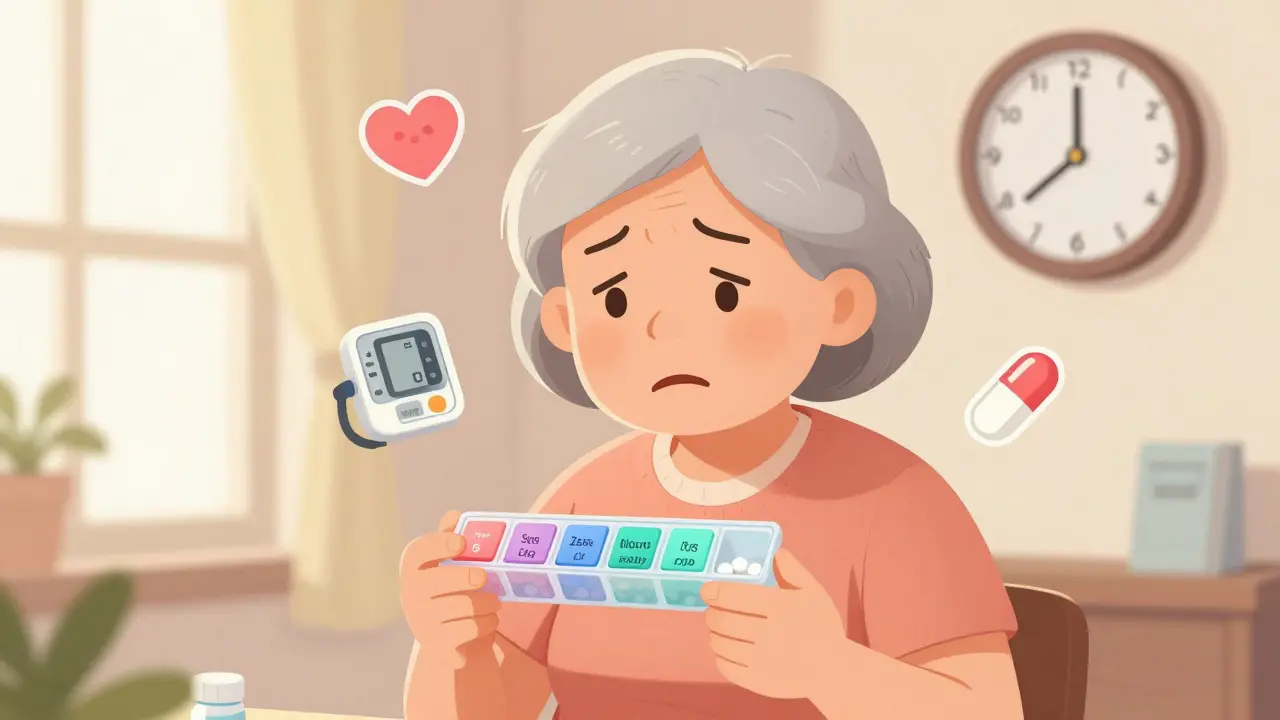
Skipping a pill because you’re running late, feeling fine, or just forgetting-it happens. But when it comes to prescription medication, that one missed dose isn’t just a minor slip. It can undo weeks of progress, trigger dangerous side effects, or even send you back to the hospital. Medication timing isn’t a suggestion. It’s a medical requirement built into your treatment plan for a reason.
Why Timing Matters More Than You Think
Your body doesn’t work on a schedule of "when I feel like it." It works on chemistry. Every time you take a pill, your bloodstream absorbs the drug, and your body slowly breaks it down. The goal? Keep the drug level steady-high enough to work, low enough to be safe. Skip a dose, and that level drops. Take it late, and the next dose might hit too hard. Either way, you’re throwing off the balance. For antibiotics, skipping doses doesn’t just mean your cold lingers. It lets the toughest bacteria survive, multiply, and become resistant. That’s how superbugs form. The CDC says you must finish every antibiotic course-even if you feel better after three days. Stopping early is like stopping a fire with just half the water. For blood pressure meds, skipping doses is even more dangerous. High blood pressure doesn’t cause symptoms until it’s already damaging your heart, kidneys, or brain. If you take your pill only when you feel "stressed" or "headachy," you’re leaving your body unprotected for hours-or days-at a time. That’s why the American Heart Association calls adherence to hypertension meds one of the most critical factors in preventing heart attacks and strokes. The same goes for blood thinners like warfarin. Too little? Risk of clots. Too much? Risk of bleeding. Both can kill. These drugs need to stay in your system at a precise level, which means taking them at the same time every day, no exceptions.What Happens When You Skip
It’s not just about your condition getting worse. Skipping doses triggers a chain reaction:- Rebound effects: Blood pressure spikes, seizures return, or blood sugar crashes-sometimes harder than before.
- Drug resistance: Antibiotics and antivirals lose effectiveness, making future infections harder to treat.
- Emergency visits: The Annals of Pharmacotherapy estimates 125,000 U.S. deaths each year are tied to people not taking their meds correctly.
- Costly hospital stays: Non-adherence causes 10-25% of all hospital admissions for chronic conditions. That’s not just a health problem-it’s a financial one, too.

Why People Skip-And How to Fix It
Most people don’t skip because they’re careless. They skip because it’s hard.- Too many pills: Each extra daily dose cuts adherence by about 16%. Someone on seven meds? Their odds of remembering everything are slim.
- Confusing instructions: "Take with food"-but which meal? "Take at bedtime"-but what if you wake up at 3 a.m.?
- Side effects: If a pill makes you dizzy or nauseous, it’s tempting to stop. But that’s when you need to call your doctor-not quit.
- Cost: One in four Americans skip doses because they can’t afford the prescription.
- Forgetfulness: Especially for older adults, memory lapses are common. It’s not laziness-it’s biology.
- Use a pill organizer. Weekly boxes with morning/afternoon/evening slots make it visual. Many pharmacies give them out for free.
- Set phone alarms. Label them: "Warfarin - 8 AM" or "Insulin - Before Breakfast." Don’t just say "Meds."
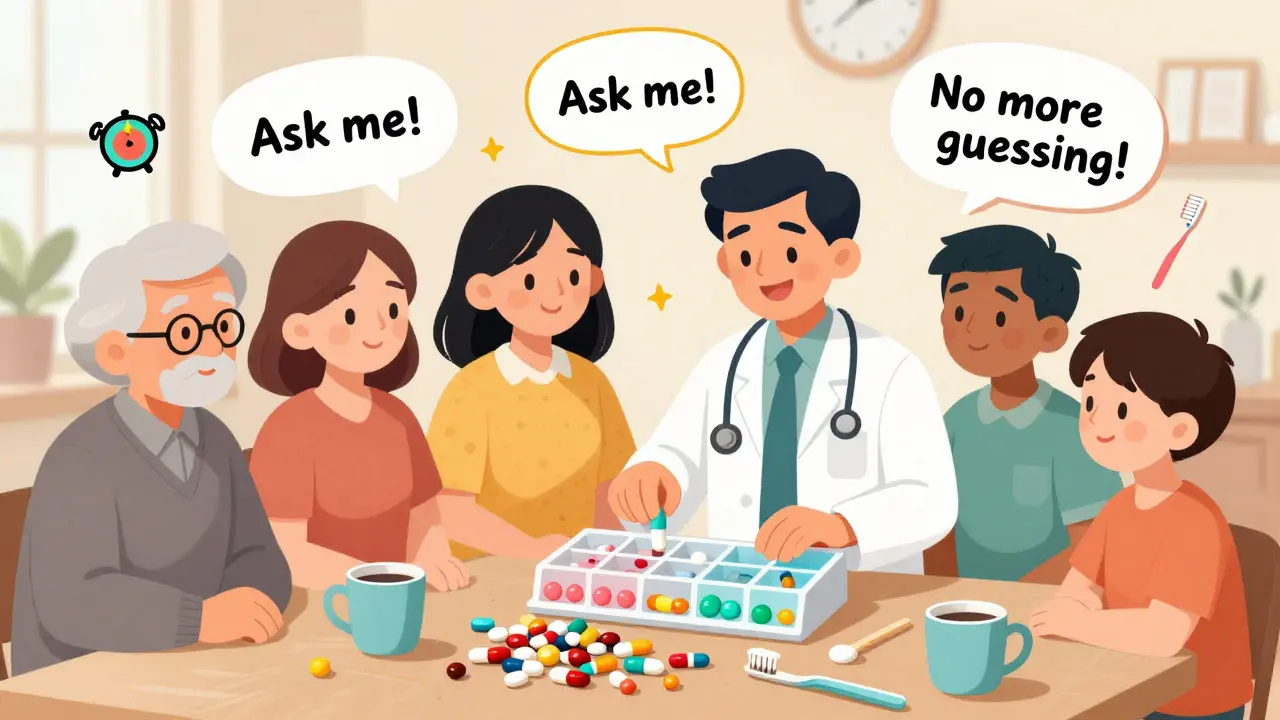
- Pair meds with habits. Take your pill right after brushing your teeth, pouring your coffee, or sitting down for dinner. The habit sticks better than a reminder.
- Ask your pharmacist. They’re trained to simplify regimens. Can two pills be combined? Can you switch to a once-daily version? Always ask.
- Use the teach-back method. Before leaving your doctor’s office, say: "So, just to make sure I got this-I take this pill every morning with breakfast, and I don’t skip it even if I feel fine. Is that right?"
When You Can’t Take It on Time
Life happens. You’re stuck in traffic. You’re traveling. You overslept. What now? There’s no one-size-fits-all answer-but here’s a general rule:- For most meds: If you’re less than 2 hours late, take it right away. If you’re more than 2 hours late, skip it and go back to your regular schedule. Don’t double up.
- For antibiotics: If you miss a dose by a few hours, take it as soon as you remember. If it’s almost time for the next dose, skip it. Never double up.
- For insulin or heart meds: Call your doctor. These are high-risk. Don’t guess.
- For blood thinners: Never take two doses to make up for one. Call your provider immediately.
Who’s at Highest Risk?
Older adults. People with multiple chronic conditions. Those on five or more medications. People with depression or memory issues. Low-income patients. These groups are hit hardest-not because they’re less responsible, but because the system isn’t built for them. One study found that 78% of seniors on complex regimens didn’t understand their own medication schedule. That’s not their fault. It’s a failure of communication. That’s why pharmacist-led medication reviews are so important. Medicare Part D plans are required to offer them. Ask for one. Bring all your pills-even the OTC ones and supplements-to your pharmacist. They’ll sort out the timing, spot duplicates, and simplify your routine.It’s Not Just About Taking Pills
Medication timing is part of a bigger picture: your health, your safety, your independence. Skipping doses doesn’t just affect your body. It affects your ability to live the life you want-working, spending time with family, traveling, enjoying your retirement. Think of your meds like a battery. You can’t charge it every other day and expect it to last. You need consistent, reliable power. Your body is the same. The next time you think, "I’ll just skip today," remember: you’re not just skipping a pill. You’re skipping your chance to stay healthy.What happens if I miss a dose of my blood pressure medication?
If you miss a dose, take it as soon as you remember-if it’s within 2 hours of your usual time. If it’s later than that, skip it and take your next dose at the regular time. Never double up. Missing doses causes dangerous spikes in blood pressure, which can lead to stroke or heart attack over time-even if you feel fine.
Can I stop taking antibiotics once I feel better?
No. Stopping antibiotics early, even if symptoms disappear, allows the strongest bacteria to survive and multiply. This leads to antibiotic-resistant infections, which are harder and more expensive to treat. Always finish the full course as prescribed.
Why do some pills need to be taken with food and others on an empty stomach?
Food can change how your body absorbs the drug. Some meds need food to reduce stomach upset or help absorption (like certain antibiotics or cholesterol drugs). Others must be taken on an empty stomach because food blocks absorption (like thyroid meds or some osteoporosis drugs). Always follow the label-your doctor or pharmacist can explain why.
I’m on so many pills, I get confused. What can I do?
Ask your pharmacist for a medication review. Many pharmacies offer free services to simplify your regimen-like switching to once-daily versions, combining pills, or using a blister pack. Use a weekly pill organizer and set phone alarms for each dose. Writing down your schedule and keeping it by your coffee maker or bathroom mirror also helps.
Is it okay to skip doses if I can’t afford my medication?
Never skip doses because of cost. Instead, talk to your doctor or pharmacist. Many drug manufacturers offer patient assistance programs. Pharmacies often have discount cards or generic alternatives. Some states and nonprofits provide free or low-cost meds for qualifying patients. Skipping doses risks your health-and could cost far more in hospital bills later.
Can I use a pill organizer for all my medications?
Most medications can go in a pill organizer, but check first. Some pills-like capsules that dissolve in the mouth, time-release tablets, or liquids-shouldn’t be moved. Also, avoid storing meds in organizers for more than a week unless refrigerated. Always keep original bottles for dosage info and expiration dates.
Skipping meds is for people who think their body runs on vibes, not biochemistry. I missed my BP pill once because I was drunk. Woke up with a headache that felt like my skull was being crushed by a hydraulic press. Lesson learned.
Let’s be real-this post reads like a pharmaceutical ad written by a government contractor. The real issue isn’t ‘adherence,’ it’s that drug companies profit more when you’re chronically ill and dependent. If your meds were cheaper and your doctor actually listened, maybe people wouldn’t skip them out of desperation, not carelessness.
Adherence is a behavioral economics construct masquerading as medical wisdom. The assumption that patients are irrational actors who need behavioral nudges ignores systemic failures: fragmented care, lack of health literacy, and the commodification of wellness. You can’t fix a structural crisis with pill organizers and alarm clocks. The system is the disease.
I’ve been on seven meds for seven years, and I’ll tell you this: the pill organizer is a myth. I tried it. The damn thing got lost in the laundry. I’ve got a drawer full of unlabeled bottles, half-empty, some expired. I don’t forget because I’m lazy-I forget because my brain is fried from chronic pain and sleep deprivation. No one ever asks what’s underneath the non-adherence. They just blame the patient. Meanwhile, my GP changes my script every three months like it’s a fashion trend. I’m not the problem. The system is.
Oh wow a whole essay on not skipping pills like we’re all 5-year-olds who need a sticker chart
Meanwhile my insulin costs $400 a month and my paycheck covers rent and not my survival
Thanks for the PSA though, Dr. Pharma
This hit me so hard 😭 I used to skip my thyroid med because I hated the taste-then I started having panic attacks outta nowhere. Started using a pill case + phone alarm labeled ‘DO NOT BE A DUMBASS’ 🙃 Now I’m stable, sleeping, and not crying in the shower. If you’re struggling-please, reach out. You’re not alone. 💙
The author's argument is logically sound, grammatically impeccable, and empirically supported by peer-reviewed literature from the CDC, AHA, and Annals of Pharmacotherapy. Any suggestion that socioeconomic factors negate the biological imperative of therapeutic drug monitoring is not merely incorrect-it is dangerously irresponsible. Patient education must be prioritized, but it cannot replace the non-negotiable science of pharmacokinetics.
It’s ironic, isn’t it? We’re told to treat our bodies like sacred machines, yet the very system that prescribes these medications treats us like disposable data points. The pill is a symbol of control-control over biology, control over time, control over the self. But when control is extracted from you-by cost, by complexity, by neglect-what’s left is not disobedience, but a quiet, systemic mourning. We don’t skip doses because we’re careless. We skip them because we’ve been made to feel invisible.